10-K
falseFY0000813298two daysP4DP5YFive yearshttp://fasb.org/us-gaap/2025#LeaseholdImprovementsMemberThree yearshttp://fasb.org/us-gaap/2025#AssetImpairmentChargeshttp://fasb.org/us-gaap/2025#AccountingStandardsUpdate202309Member1000http://fasb.org/srt/2025#ChiefExecutiveOfficerMember0000813298dxlg:StoreAssetsMember2024-02-042025-02-010000813298us-gaap:ConstructionInProgressMember2026-01-310000813298us-gaap:PerformanceSharesMember2023-08-110000813298country:USdxlg:CasualMalexlRetailAndOutletStoresMember2026-01-310000813298country:CAsrt:MinimumMember2025-02-022026-01-310000813298dxlg:SwinglineLoansMemberdxlg:CreditFacilityMember2021-10-280000813298dxlg:TwoThousandSixteenPlanMemberdxlg:DeferredStockMember2026-01-310000813298dxlg:RetailSegmentMemberus-gaap:SalesChannelThroughIntermediaryMember2024-02-042025-02-010000813298stpr:TX2025-02-022026-01-310000813298us-gaap:InternalRevenueServiceIRSMember2026-01-310000813298us-gaap:AdditionalPaidInCapitalMember2023-01-280000813298dxlg:NonEmployeeDirectorsMember2026-01-3100008132982025-02-010000813298dxlg:TimeBasedRestrictedStockUnitsMember2025-02-022026-01-310000813298dxlg:StoreMembersrt:MinimumMember2026-01-310000813298country:CA2026-01-310000813298us-gaap:SalesRevenueNetMemberus-gaap:ProductConcentrationRiskMemberdxlg:RetailSegmentMemberus-gaap:SalesChannelThroughIntermediaryMember2025-02-022026-01-310000813298us-gaap:SalesRevenueNetMemberus-gaap:ProductConcentrationRiskMemberus-gaap:SalesChannelDirectlyToConsumerMemberdxlg:RetailSegmentMember2025-02-022026-01-310000813298dxlg:CorporateHeadquarterMember2025-05-042025-08-020000813298us-gaap:SalesRevenueNetMemberus-gaap:ProductConcentrationRiskMemberdxlg:RetailSegmentMemberus-gaap:SalesChannelThroughIntermediaryMember2023-01-292024-02-030000813298dxlg:TimeBasedVestingScheduleMemberdxlg:TwoThousandTwentyFiveToTwoThousandTwentySevenLongTermIncentivePlanMember2025-02-022026-01-310000813298dxlg:RevolverFacilityMember2026-01-310000813298us-gaap:EmployeeStockOptionMember2024-02-042025-02-010000813298us-gaap:AccountsPayableAndAccruedLiabilitiesMember2025-02-010000813298dxlg:FirstInLastOutTermLoanFacilityMember2024-02-042025-02-010000813298us-gaap:StateAndLocalJurisdictionMemberstpr:MI2025-02-022026-01-310000813298us-gaap:RetainedEarningsMember2023-01-280000813298us-gaap:ReclassificationOutOfAccumulatedOtherComprehensiveIncomeMemberus-gaap:AccumulatedDefinedBenefitPlansAdjustmentMember2023-01-292024-02-030000813298us-gaap:SellingGeneralAndAdministrativeExpensesMember2024-02-042025-02-010000813298stpr:PAus-gaap:StateAndLocalJurisdictionMember2025-02-022026-01-310000813298dxlg:StoreMember2026-01-310000813298us-gaap:EquipmentMembersrt:MaximumMember2026-01-310000813298dxlg:FirstInLastOutTermLoanFacilityMember2023-01-292024-02-030000813298us-gaap:AdditionalPaidInCapitalMember2024-02-042025-02-010000813298us-gaap:PerformanceSharesMember2023-08-112023-08-110000813298dxlg:NextContributionsMember2025-02-022026-01-310000813298us-gaap:EmployeeStockOptionMember2023-01-292024-02-030000813298us-gaap:RestrictedStockUnitsRSUMemberdxlg:TwoThousandSixteenPlanMember2025-02-010000813298dxlg:TwoThousandSixteenPlanMember2025-02-022026-01-310000813298srt:MinimumMemberus-gaap:FurnitureAndFixturesMember2026-01-310000813298dxlg:PerformanceBasedVestingScheduleMemberdxlg:TwoThousandTwentyFiveToTwoThousandTwentySevenLongTermIncentivePlanMember2026-01-310000813298us-gaap:PerformanceSharesMemberus-gaap:ShareBasedCompensationAwardTrancheTwoMembersrt:MinimumMemberus-gaap:ShareBasedPaymentArrangementEmployeeMember2023-08-112023-08-110000813298us-gaap:SecuredOvernightFinancingRateSofrOvernightIndexSwapRateMemberdxlg:CreditFacilityMembersrt:MaximumMember2021-10-282021-10-280000813298us-gaap:SecuredOvernightFinancingRateSofrOvernightIndexSwapRateMemberdxlg:CreditFacilityMembersrt:MinimumMember2021-10-282021-10-280000813298us-gaap:PerformanceSharesMembersrt:MinimumMember2023-08-112023-08-110000813298dxlg:FullyVestedSharesMemberdxlg:TwoThousandSixteenPlanMember2025-02-022026-01-3100008132982015-01-012015-01-0100008132982023-01-292024-02-0300008132982025-11-022026-01-3100008132982023-01-280000813298srt:MaximumMember2025-02-022026-01-310000813298us-gaap:ConstructionInProgressMember2025-02-010000813298us-gaap:CommonStockMember2026-01-3100008132982025-08-020000813298dxlg:EquipmentAndOtherAssetsMembersrt:MinimumMember2026-01-310000813298us-gaap:SalesRevenueNetMemberus-gaap:ProductConcentrationRiskMemberdxlg:RetailSegmentMemberus-gaap:SalesChannelThroughIntermediaryMember2024-02-042025-02-010000813298us-gaap:LeaseholdImprovementsMember2026-01-310000813298us-gaap:TreasuryStockCommonMember2026-01-310000813298dxlg:HardwareAndSoftwareMember2025-02-010000813298us-gaap:RetainedEarningsMember2025-02-010000813298dxlg:CreditFacilityMemberus-gaap:PrimeRateMember2026-01-310000813298dxlg:StoreAssetsMember2023-01-292024-02-0300008132982026-02-012026-01-310000813298us-gaap:RetainedEarningsMember2024-02-042025-02-010000813298us-gaap:CommonStockMember2023-01-292024-02-030000813298us-gaap:RestrictedStockUnitsRSUMemberdxlg:TwoThousandTwentyThreeToTwoThousandTwentyFiveLongTermIncentivePlanMember2025-02-022026-01-310000813298dxlg:DXLCommonStockMember2025-12-100000813298dxlg:CreditFacilityMemberdxlg:CommercialAndStandbyLetterOfCreditsMember2021-10-280000813298us-gaap:AdditionalPaidInCapitalMember2023-01-292024-02-030000813298us-gaap:PerformanceSharesMemberdxlg:TwoThousandSixteenPlanMember2025-02-010000813298us-gaap:CommonStockMember2024-02-042025-02-010000813298us-gaap:CarryingReportedAmountFairValueDisclosureMemberus-gaap:USTreasurySecuritiesMemberus-gaap:FairValueMeasurementsRecurringMember2025-02-010000813298dxlg:TimeBasedRestrictedStockUnitsMember2023-01-292024-02-030000813298dxlg:NonEmployeeDirectorsMember2025-02-022026-01-310000813298dxlg:TwoThousandSixteenPlanMemberdxlg:DeferredStockMember2025-02-010000813298us-gaap:PerformanceSharesMember2024-02-042025-02-010000813298us-gaap:OperatingSegmentsMember2023-01-292024-02-030000813298us-gaap:SellingGeneralAndAdministrativeExpensesMember2023-01-292024-02-030000813298us-gaap:AccountsPayableAndAccruedLiabilitiesMember2024-02-030000813298us-gaap:RestrictedStockUnitsRSUMemberdxlg:TwoThousandSixteenPlanMember2025-02-022026-01-310000813298us-gaap:RestrictedStockUnitsRSUMemberdxlg:TwoThousandTwentyFiveToTwoThousandTwentySevenLongTermIncentivePlanMember2025-02-022026-01-310000813298us-gaap:FurnitureAndFixturesMember2026-01-310000813298dxlg:TwoThousandSixteenPlanMember2026-01-310000813298dxlg:TimeBasedVestingScheduleMemberdxlg:TwoThousandTwentyFiveToTwoThousandTwentySevenLongTermIncentivePlanMember2026-01-310000813298us-gaap:TreasuryStockCommonMember2023-01-280000813298dxlg:StoreAssetsMember2025-02-022026-01-310000813298srt:MaximumMemberus-gaap:StateAndLocalJurisdictionMember2025-02-022026-01-310000813298dxlg:TimeBasedVestingScheduleMember2025-02-022026-01-3100008132982026-01-312026-01-310000813298dxlg:HardwareAndSoftwareMember2026-01-310000813298stpr:CAus-gaap:StateAndLocalJurisdictionMember2025-02-022026-01-310000813298us-gaap:SecuredOvernightFinancingRateSofrOvernightIndexSwapRateMemberdxlg:CreditFacilityMember2021-10-282021-10-280000813298us-gaap:SupplementalEmployeeRetirementPlanDefinedBenefitMemberus-gaap:AccumulatedDefinedBenefitPlansAdjustmentMember2023-01-292024-02-030000813298dxlg:DomainNameMember2019-02-020000813298us-gaap:RetainedEarningsMember2026-01-310000813298srt:MinimumMemberus-gaap:StateAndLocalJurisdictionMember2025-02-022026-01-310000813298us-gaap:FurnitureAndFixturesMember2025-02-010000813298us-gaap:StateAndLocalJurisdictionMember2026-01-310000813298dxlg:FirstContributionsMember2025-02-022026-01-310000813298dxlg:TimeVestedAwardsMember2026-01-310000813298country:USdxlg:DXLStoresMember2026-01-310000813298srt:MinimumMember2015-01-012015-01-010000813298us-gaap:TreasuryStockCommonMember2025-02-010000813298dxlg:CreditFacilityMember2026-01-310000813298us-gaap:CommonStockMember2023-01-280000813298us-gaap:PerformanceSharesMember2025-02-022026-01-310000813298dxlg:CreditFacilityMember2025-02-022026-01-3100008132982024-02-042025-02-010000813298dxlg:DeferredStockMember2023-01-292024-02-030000813298dxlg:TwoThousandTwentyFourToTwoThousandTwentySixLongTermIncentivePlanMemberdxlg:PerformanceBasedVestingScheduleMember2026-01-310000813298dxlg:EquipmentAndOtherAssetsMembersrt:MaximumMember2026-01-310000813298us-gaap:EquipmentMember2026-01-310000813298us-gaap:AdditionalPaidInCapitalMember2025-02-022026-01-310000813298us-gaap:CommonStockMember2024-02-030000813298us-gaap:AccumulatedDefinedBenefitPlansAdjustmentMember2023-01-280000813298dxlg:TwoThousandSixteenPlanMemberdxlg:DeferredStockMember2025-02-022026-01-310000813298dxlg:TwoThousandSixteenPlanMember2025-02-010000813298us-gaap:PerformanceSharesMemberdxlg:TwoThousandSixteenPlanMember2026-01-3100008132982026-01-3100008132982026-03-090000813298us-gaap:CommonStockMember2025-02-022026-01-310000813298us-gaap:TreasuryStockCommonMember2024-02-042025-02-010000813298us-gaap:EquipmentMembersrt:MinimumMember2026-01-310000813298us-gaap:RetainedEarningsMember2023-01-292024-02-030000813298dxlg:FullBeautyBrandsIncCommonStockMember2025-12-100000813298us-gaap:SalesRevenueNetMemberus-gaap:ProductConcentrationRiskMemberus-gaap:SalesChannelDirectlyToConsumerMemberdxlg:RetailSegmentMember2024-02-042025-02-010000813298srt:DirectorMemberdxlg:DeferredStockMember2024-02-042025-02-010000813298dxlg:TwoThousandTwentyFourToTwoThousandTwentySixLongTermIncentivePlanMemberus-gaap:CashMember2025-02-022026-01-3100008132982025-02-022026-01-310000813298dxlg:NonEmployeeDirectorsMember2024-02-042025-02-010000813298us-gaap:RestrictedStockUnitsRSUMember2025-02-022026-01-310000813298us-gaap:SecuredOvernightFinancingRateSofrOvernightIndexSwapRateMemberdxlg:SofrLoansMemberdxlg:CreditFacilityMember2021-10-282021-10-2800008132982025-08-032025-11-010000813298dxlg:StoreMembersrt:MaximumMember2026-01-310000813298dxlg:StoreMember2025-02-022026-01-310000813298us-gaap:RestrictedStockUnitsRSUMemberdxlg:TwoThousandSixteenPlanMember2026-01-310000813298dxlg:TimeBasedRestrictedStockUnitsMember2024-02-042025-02-010000813298us-gaap:OperatingSegmentsMember2024-02-042025-02-010000813298dxlg:PerformanceBasedVestingScheduleMember2025-02-022026-01-310000813298dxlg:CreditFacilityMemberdxlg:FederalFundsRateMember2021-10-282021-10-280000813298us-gaap:TreasuryStockCommonMember2024-02-030000813298dxlg:FirstInLastOutTermLoanFacilityMember2025-02-022026-01-310000813298us-gaap:PerformanceSharesMembersrt:MaximumMember2023-08-112023-08-110000813298us-gaap:RetainedEarningsMember2024-02-030000813298us-gaap:AccumulatedDefinedBenefitPlansAdjustmentMember2023-01-292024-02-030000813298srt:DirectorMember2025-02-022026-01-310000813298dxlg:TwoThousandTwentyFourToTwoThousandTwentySixLongTermIncentivePlanMemberus-gaap:CommonStockMember2025-02-022026-01-310000813298us-gaap:SalesChannelDirectlyToConsumerMemberdxlg:RetailSegmentMember2023-01-292024-02-030000813298us-gaap:PerformanceSharesMemberus-gaap:ShareBasedPaymentArrangementEmployeeMember2023-08-112023-08-110000813298us-gaap:RetainedEarningsMember2025-02-022026-01-310000813298dxlg:DXLOutletsMembercountry:US2026-01-310000813298us-gaap:EmployeeStockOptionMember2025-02-022026-01-310000813298dxlg:CasualMaleNoncontributoryPensionPlanMember2023-01-292024-02-030000813298srt:MinimumMemberdxlg:HardwareAndSoftwareMember2026-01-310000813298dxlg:SwinglineLoansMemberdxlg:CreditFacilityMember2025-08-130000813298dxlg:TwoThousandTwentyFiveToTwoThousandTwentySevenLongTermIncentivePlanMemberus-gaap:CashMember2025-02-022026-01-310000813298us-gaap:PerformanceSharesMember2023-01-292024-02-030000813298dxlg:TwoThousandSixteenPlanMember2024-08-080000813298us-gaap:TreasuryStockCommonMember2023-01-292024-02-030000813298us-gaap:FairValueInputsLevel1Memberus-gaap:USTreasurySecuritiesMemberus-gaap:FairValueMeasurementsRecurringMemberus-gaap:EstimateOfFairValueFairValueDisclosureMember2026-01-310000813298dxlg:RetailSegmentMemberus-gaap:SalesChannelThroughIntermediaryMember2023-01-292024-02-030000813298us-gaap:CommonStockMember2025-02-010000813298dxlg:DeferredStockMember2025-02-022026-01-310000813298dxlg:TwoThousandSixteenPlanMember2016-08-042016-08-040000813298us-gaap:AccumulatedOtherComprehensiveIncomeMember2023-01-2800008132982024-02-030000813298country:CAsrt:MaximumMember2025-02-022026-01-310000813298srt:MinimumMember2025-02-022026-01-310000813298us-gaap:PerformanceSharesMembersrt:MinimumMemberus-gaap:ShareBasedCompensationAwardTrancheOneMemberus-gaap:ShareBasedPaymentArrangementEmployeeMember2023-08-112023-08-110000813298us-gaap:LeaseholdImprovementsMember2025-02-010000813298us-gaap:SalesRevenueNetMemberus-gaap:ProductConcentrationRiskMemberus-gaap:SalesChannelDirectlyToConsumerMemberdxlg:RetailSegmentMember2023-01-292024-02-030000813298srt:MaximumMemberdxlg:CorporateHeadquarterMember2025-08-020000813298us-gaap:RestrictedStockUnitsRSUMemberdxlg:TwoThousandTwentyFourToTwoThousandTwentySixLongTermIncentivePlanMember2025-02-022026-01-310000813298us-gaap:OperatingSegmentsMember2025-02-022026-01-310000813298us-gaap:CarryingReportedAmountFairValueDisclosureMemberus-gaap:USTreasurySecuritiesMemberus-gaap:FairValueMeasurementsRecurringMember2026-01-310000813298us-gaap:AdditionalPaidInCapitalMember2024-02-030000813298dxlg:TimeBasedVestingScheduleMemberdxlg:TwoThousandTwentyFourToTwoThousandTwentySixLongTermIncentivePlanMember2025-02-022026-01-310000813298dxlg:TimeBasedVestingScheduleMemberdxlg:TwoThousandTwentyFourToTwoThousandTwentySixLongTermIncentivePlanMember2026-01-310000813298us-gaap:SellingGeneralAndAdministrativeExpensesMember2025-02-022026-01-310000813298dxlg:DeferredStockMember2024-02-042025-02-010000813298dxlg:CasualMaleXLOutletsMember2026-01-310000813298dxlg:TimeVestedAwardsMember2025-02-022026-01-310000813298us-gaap:AccumulatedOtherComprehensiveIncomeMember2023-01-292024-02-030000813298us-gaap:FurnitureAndFixturesMembersrt:MaximumMember2026-01-310000813298us-gaap:FairValueInputsLevel1Memberus-gaap:USTreasurySecuritiesMemberus-gaap:FairValueMeasurementsRecurringMemberus-gaap:EstimateOfFairValueFairValueDisclosureMember2025-02-010000813298us-gaap:AdditionalPaidInCapitalMember2026-01-310000813298dxlg:CreditFacilityMember2021-10-280000813298us-gaap:EquipmentMember2025-02-010000813298us-gaap:SalesChannelDirectlyToConsumerMemberdxlg:RetailSegmentMember2025-02-022026-01-310000813298us-gaap:StateAndLocalTaxJurisdictionOtherMember2025-02-022026-01-310000813298us-gaap:ForeignCountryMember2026-01-310000813298dxlg:CreditFacilityMember2021-10-282021-10-280000813298us-gaap:StandbyLettersOfCreditMemberdxlg:CreditFacilityMember2026-01-310000813298us-gaap:SalesChannelDirectlyToConsumerMemberdxlg:RetailSegmentMember2024-02-042025-02-010000813298dxlg:HardwareAndSoftwareMembersrt:MaximumMember2026-01-310000813298us-gaap:AccountsPayableAndAccruedLiabilitiesMember2026-01-310000813298stpr:TXus-gaap:StateAndLocalJurisdictionMember2025-02-022026-01-310000813298dxlg:TwoThousandTwentyThreeToTwoThousandTwentyFiveLongTermIncentivePlanMemberus-gaap:CashMember2025-02-022026-01-310000813298dxlg:NonEmployeeDirectorsMember2023-01-292024-02-030000813298dxlg:RetailSegmentMemberus-gaap:SalesChannelThroughIntermediaryMember2025-02-022026-01-310000813298us-gaap:AdditionalPaidInCapitalMember2025-02-010000813298dxlg:CorporateHeadquarterMember2025-08-02xbrli:purexbrli:sharesdxlg:Daysdxlg:Tradingdxlg:Segmentdxlg:Storeiso4217:USD
UNITED STATES
SECURITIES AND EXCHANGE COMMISSION
WASHINGTON, D.C. 20549
FORM 10-K
(Mark One)
|
|
☒ |
ANNUAL REPORT PURSUANT TO SECTION 13 OR 15(d) OF THE SECURITIES EXCHANGE ACT OF 1934 |
For the fiscal year ended January 31, 2026 (Fiscal 2025)
OR
|
|
☐ |
TRANSITION REPORT PURSUANT TO SECTION 13 OR 15(d) OF THE SECURITIES EXCHANGE ACT OF 1934 FOR THE TRANSITION PERIOD FROM TO |
Commission File Number 01-34219
DESTINATION XL GROUP, INC.
(Exact name of registrant as specified in its charter)
|
|
|
Delaware |
|
04-2623104 |
(State or other jurisdiction of incorporation or organization) |
|
(IRS Employer Identification No.) |
555 Turnpike Street, Canton, MA |
|
02021 |
(Address of principal executive offices) |
|
(Zip Code) |
(781) 828-9300
(Registrant’s telephone number, including area code)
Securities registered pursuant to Section 12(b) of the Act:
|
|
|
Title of each class |
Trading Symbols(s) |
Name of each exchange on which registered |
Common Stock, par value $0.01 per share |
DXLG |
The Nasdaq Stock Market LLC |
Securities registered pursuant to Section 12(g) of the Act:
None.
Indicate by check mark if the registrant is a well-known seasoned issuer, as defined in Rule 405 of the Securities Act. Yes ☐ No ☒
Indicate by check mark if the registrant is not required to file reports pursuant to Section 13 or Section 15(d) of the Act. Yes ☐ No ☒
Indicate by check mark whether the registrant (1) has filed all reports required to be filed by Section 13 or 15(d) of the Securities Exchange Act of 1934 during the preceding 12 months (or for such shorter period that the registrant was required to file such reports), and (2) has been subject to such filing requirements for the past 90 days. Yes ☒ No ☐
Indicate by check mark whether the registrant has submitted electronically every Interactive Data File required to be submitted pursuant to Rule 405 of Regulation S-T (§232.405 of this chapter) during the preceding 12 months (or for such shorter period that the registrant was required to submit such files). Yes ☒ No ☐
Indicate by check mark whether the registrant is a large accelerated filer, an accelerated filer, a non-accelerated filer, a smaller reporting company, or emerging growth company. See the definitions of "large accelerated filer," "accelerated filer," "non-accelerated filer," "smaller reporting company" and “emerging growth company” in Rule 12b-2 of the Exchange Act.
|
|
|
|
Large accelerated filer |
☐ |
Accelerated filer |
☐ |
Non-accelerated filer |
☒ |
Smaller reporting company |
☒ |
|
Emerging growth company |
☐ |
If an emerging growth company, indicate by check mark if the registrant has elected not to use the extended transition period for complying with any new or revised financial accounting standards provided pursuant to section 13(a) of the Exchange Act. ☐
Indicate by check mark whether the registrant has filed a report on and attestation to its management’s assessment of the effectiveness of its internal control over financial reporting under Section 404(b) of the Sarbanes-Oxley Act (15 U.S.C. 7262(b)) by the registered public accounting firm that prepared or issued its audit report. ☐
If securities are registered pursuant to Section 12(b) of the Act, indicate by check mark whether the financial statements of the registrant included in the filing reflect the correction of an error to previously issued financial statements. ☐
Indicate by check mark whether any of those error corrections are restatements that required a recovery analysis of incentive-based compensation received by any of the registrant’s executive officers during the relevant recovery period pursuant to §240.10D-1(b). ☐
Indicate by check mark whether the registrant is a shell company (as defined in Rule 12b-2 of the Act). Yes ☐ No ☒
As of August 2, 2025, the aggregate market value of the Common Stock held by non-affiliates of the registrant was approximately $41.9 million, based on the last reported sale price on that date. Shares of Common Stock held by each executive officer and director and by certain persons who own 10% or more of the outstanding Common Stock have been excluded on the basis that such persons may be deemed to be affiliates. This determination of affiliate status is not necessarily determinative for other purposes.
The registrant had 54,810,511 shares of Common Stock, $0.01 par value, outstanding as of March 9, 2026.
DOCUMENTS INCORPORATED BY REFERENCE
Part III of this Form 10-K incorporates by reference certain information from an amendment to this report under cover of Form 10-K/A to be filed within 120 days of the end of the fiscal year ended January 31, 2026.
DESTINATION XL GROUP, INC.
Index to Annual Report on Form 10-K
Year Ended January 31, 2026
PART I.
Certain statements contained in this Annual Report on Form 10-K (this “Annual Report”) constitute “forward-looking statements,” including forward-looking statements within the meaning of the Private Securities Litigation Reform Act of 1995. In some cases, forward-looking statements can be identified by the use of forward-looking terminology such as “may,” “will,” “estimate,” “intend,” “plan,” “continue,” “believe,” “expect” or “anticipate” or the negatives thereof, variations thereon or similar terminology. The forward-looking statements contained in this Annual Report are generally located under the headings “Business” and “Management’s Discussion and Analysis of Financial Condition and Results of Operations,” but may be found in other locations as well, and include statements regarding our ability to grow market share, our expected capital expenditures in 2026, our expected marketing spend in 2026, and our ability to meet our liquidity needs; our belief that the Merger (as defined below) will bring together complementary brands, channels and capabilities to better serve plus-size women and big + tall men and that the combined company will have a more diverse and broader portfolio with comprehensive ranges of plus-size and big + tall options and be positioned for future growth opportunities; our belief that bringing DXL together with FullBeauty’s inclusive women’s brands and KingSize would create a comprehensive and diverse size-inclusive brand portfolio spanning value to premium price points across lifestyles and occasions, our belief that by leveraging complementary strengths across gender, product and channels the combined company will be positioned to accelerate growth, improve operational efficiency and enhance customer experience through a comprehensive, innovative, multi-channel strategy; our belief that our actions to drive operational efficiencies, strengthen our balance sheet to increase financial flexibility, and invest in technology to better support our long-term strategic objectives position us to navigate the current market environment while preserving the core strengths of our business; our belief that reducing investment in underperforming national brands will enable us to improve profitability and more effectively deploy strategic promotions to drive customer acquisition and sales growth; our belief that the strength of our assortment, enhanced storytelling, and targeted marketing efforts will drive greater customer loyalty and position our private brands as a primary reason customers choose DXL; our belief that FiTMAP® is one of the most comprehensive sizing technologies available in the big + tall market and provides a differentiated experience across both ready to wear and custom offerings; our belief that our promotional strategy and the actions we have taken, combined with the long-term opportunities created by the proposed Merger with FullBeauty, will position DXL for stronger growth and improved profitability; and our continued belief that we could potentially open approximately 50 net new DXL stores across the country when economic conditions and the overall traffic within the big + tall sector improves. The forward-looking statements in this Annual Report should not be regarded as a representation by us or any other person that the objectives or plans of the Company will be achieved. Although we believe the expectations reflected in any forward-looking statements are based on reasonable assumptions, we can give no assurance that our expectations will be attained and, therefore, actual outcomes and results may differ materially from what is expressed or forecasted in such forward-looking statements. For example, these forward-looking statements could be affected by factors including, without limitation, risks relating to the challenging macroeconomic environment, including volatility and changes in global trade policies; changes in consumer spending in response to the economic factors; the impact of tariffs and the ability to mitigate exposure and maintain supply; the impact of ongoing worldwide conflicts on the global economy; the impact of GLP-1s and similar weight-loss medications; the Company’s ability to grow its market share, predict customer tastes and fashion trends, forecast sales growth trends, and compete successfully in the U.S. men’s big + tall apparel market; risks associated with the ability to consummate the Merger and the timing of the closing of the Merger; the customary closing conditions leading to the completion of the Merger, including DXL stockholder approval; the ability to successfully integrate and scale our operations and employees; the ability and timing to realize anticipated benefits and synergies of the Merger; the potential impact of the announcement, pendency or consummation of the Merger on relationships, including with employees, customers, credit rating agencies, suppliers and competitors; the ability to retain key personnel; changes in financial markets; negative rating agency actions; the outcome of any legal proceedings that may be instituted against DXL or FullBeauty (as defined below); the risk that any announcements relating to the Merger could have adverse effects on the market price of the common stock of DXL; diversion of management’s attention from ongoing business operations and opportunities; risks associated with the Company’s ability to maintain compliance with Nasdaq listing standards, volatility in the market price of the Company’s common stock, the Company’s ability to implement corporate actions such as a reverse stock split and those additional risks and factors that will be detailed in a proxy statement that the Company expects will be distributed to the stockholders of DXL in connection with their votes on the issuance of the Company's Common Stock in the Merger and other reports filed with the SEC by DXL from time to time, including those risks and uncertainties set forth below under Item 1A, Risk Factors. Readers are encouraged to review these risks and uncertainties carefully.
These forward-looking statements speak only as of the date of the document in which they are made. We disclaim any obligation or undertaking to provide any updates or revisions to any forward-looking statement to reflect any change in its expectations or any change in events, conditions, or circumstances in which the forward-looking statement is based.
Item 1. Business
Destination XL Group, Inc., together with its subsidiaries (the “Company”), is the leading specialty retailer of big + tall men’s apparel with retail locations throughout the United States. We operate under the trade names of Destination XL®, DXL®, DXL® Big + Tall, DXL Men’s Apparel, DXL outlets, Casual Male XL® and Casual Male XL outlets. At January 31, 2026, we operated 258 DXL retail stores, 17 DXL outlet stores, 5 Casual Male XL retail stores, 15 Casual Male XL outlet stores, and a digital business, including an e-commerce site at www.dxl.com, a mobile site m.destinationXL.com and mobile app. Unless the context indicates otherwise, all references to “we,” “our,” “ours,” “us” and “the Company” refer to Destination XL Group, Inc. and our consolidated subsidiaries. We
refer to our fiscal years ended January 31, 2026, February 1, 2025 and February 3, 2024 as “fiscal 2025,” “fiscal 2024” and “fiscal 2023,” respectively.
OUR INDUSTRY
We define the big + tall men’s clothing market as starting at a waist size for pants of 38” and greater, as well as tops sized 1XL and greater. With our proprietary fit and extensive selection of exclusive brands, we believe that we can grow market share as an integrated commerce retailer able to target a broad market, attracting customers from various income, age and lifestyle segments, offering the underserved consumer the widest selection of sizes and styles.
OUR HISTORY
Our Company was incorporated in the State of Delaware in 1976 under the name "Kara Enterprises, Inc." and subsequently operated under the name "Designs, Inc." Until fiscal 1995, we operated exclusively in Levi Strauss & Co. branded apparel mall and outlet stores. In May 2002, we acquired the Casual Male business from Casual Male Corp. at a bankruptcy court-ordered auction. At the time of the acquisition, Casual Male was the largest specialty retailer of men’s clothing in the big + tall market in the United States. As a result of the acquisition, on August 8, 2002, we changed our name to “Casual Male Retail Group, Inc.”
In fiscal 2010, we launched a new store concept, Destination XL (“DXL”). The DXL store concept offers our customers an extensive assortment of products, ranging from value-oriented to luxury-oriented with an increased presence of name brands, without having to shop multiple stores. In addition to offering our customers a wide assortment, we also wanted to provide them with a unique shopping experience. We are focused on providing outstanding customer service through our DXL stores, with larger fitting rooms and professional, trained associates providing personal attention. With the initial success of this store format, we made a similar change to our e-commerce business in fiscal 2011 when we launched our DestinationXL.com website (now dxl.com).
OUR BUSINESS
We operate as an integrated commerce retailer of big + tall men’s clothing and footwear. Through our multiple brands, which include both national brands and our own brands, we provide a premium, personalized shopping experience, whether in-store or digitally, with a broad range of merchandise at varying price points, catering from the value-oriented customer to the luxury customer. Our objective is to appeal to all of our customers by providing a good, better, best array of product assortments in all primary lifestyles with multiple and convenient ways to shop.
What is unique about our business is our proprietary fit, our ability to manage an array of sizes and optimize our in-stock position throughout each season. Our best-selling pant has 58 size combinations and a unique fit specification as compared to an average retailer who may have as few as 15 to 20 different size combinations. We maintain a consolidated inventory assortment across all channels that enables us to manage our in-stock position of all sizes effectively, ultimately improving customer service. Moreover, our planning and allocation methodologies help to optimize each location’s market potential without carrying excessive inventory levels.
Our DXL retail stores, e-commerce site, dxl.com, and mobile app cater to all income demographics and offer our customers merchandise to fit a variety of lifestyles from casual to business, young to mature, in all price ranges and in all large sizes from XL and up. In addition, we offer a selection of footwear in sizes 10W to 17W on our website at dxl.com. Our Casual Male XL retail stores primarily carry moderate-priced national brands and our own brands of casual sportswear and dresswear. We also operate Casual Male XL outlets and DXL outlets for our value-oriented customers. Through digital marketplaces, we are able to extend our reach by providing a select offering of our merchandise to new customers who may not be current DXL customers.
RECENT DEVELOPMENTS
FullBeauty Merger
On December 11, 2025, the Company, Divine Merger Sub I, Inc., a Delaware corporation and wholly owned direct subsidiary of the Company (“Merger Sub”), and FBB Holdings I, Inc., a Delaware corporation (“FBB” or “FullBeauty”), entered into an Agreement and Plan of Merger (the “Merger Agreement”). The Merger Agreement provides that, on the terms and subject to the conditions set forth therein, Merger Sub will merge with and into FBB, with FBB continuing as the surviving corporation as a wholly owned subsidiary of the Company (the “Merger”).
At the effective time of the Merger, each share of common stock, par value $0.01 per share, of FBB (“FBB Common Stock”) will be converted into the right to receive that number of fully paid and nonassessable shares of the common stock, par value $0.01 per share, of the Company (the “DXL Common Stock”) equal to the Exchange Ratio, as defined in the Merger Agreement. A holder of FBB
Common Stock who would otherwise be entitled to receive a fraction of a share of DXL Common Stock will have such fractional share rounded up to one whole share of DXL Common Stock. Following the consummation of the Merger, holders of FBB Common Stock will own 55% of the combined company and holders of DXL Common Stock will own 45% of the combined company.
FullBeauty, a private company with sales for the 53 weeks ended January 3, 2026 of approximately $0.7 billion, is a leading direct to consumer retailer specializing in size inclusive fashion for plus-size women and big + tall men. FullBeauty's brands include OneStopPlus®, the world’s first and largest online shopping destination for plus-size women, Catherines®, WomanWithin®, Jessica London®, Roaman’s®, SwimsuitsForAll®, Ellos®, Active For All®, Shoes For All®, Intimates For All®, KingSize®, Brylane Home®, June & Vie™, Eloquii®, CUUP®, Dia Shop™, Dia & Co®, Avenue®, Joe Browns®, FullBeauty® and FullBeauty Outlet®. We believe that this Merger will bring together complementary brands, channels and capabilities to better serve plus-size women and big + tall men. We believe the combined company would have a broader and more diverse portfolio with comprehensive ranges of plus-size and big + tall options which we expect would position the combined company for future growth opportunities.
We are currently preparing a proxy statement that we plan to distribute to the stockholders of DXL in connection with their votes on the approval of the Merger and the issuance of DXL Common Stock in connection with the Merger, as well as other matters to be voted upon in connection with the approval of the Merger. The Merger, which is expected to close in the second quarter of fiscal 2026, is subject to customary closing conditions, including approval by our stockholders.
BUSINESS STRATEGY
The big + tall apparel sector continues to experience meaningful macroeconomic and industry‑specific headwinds that have resulted in sustained softness in consumer demand. Over the past 12 to 18 months, we have seen a notable shift in customer shopping behavior, as customers shopped less frequently and prioritized essentials and lower price points.
Over the past five years, we have transformed our operating model by enhancing our customer relationship management capabilities, upgrading our data infrastructure, and expanding our analytics competencies. We have also driven operational efficiencies, strengthened our balance sheet to increase financial flexibility, and invested in technology to better support our long‑term strategic objectives. We believe these actions position us to navigate the current market environment while preserving the core strengths of our business.
During this continuing economic downturn in our sector, our strategy is to strengthen our market position by focusing on value‑oriented customers and safeguarding the profitability of our existing business. Given ongoing cyclical pressures on sales, we have paused certain long‑term initiatives, including further store growth as well as brand marketing efforts, in order to protect free cash flow and emphasize operational efficiency.
During fiscal 2025, we made meaningful progress on the following strategic initiatives, which are specifically geared toward appealing to our value-driven customers who are more price sensitive and less inclined to shop during this downward economic cycle.
Assortment
Over the next two years, we are strategically evolving our assortment to further prioritize private brands, which deliver consistent fit, greater flexibility to balance trend‑right fashion with core essentials, and enhanced value for our customers while generating higher margins for DXL. To support this shift, we are reducing investment in underperforming national brands, enabling us to improve profitability and more effectively deploy strategic promotions to drive customer acquisition and sales growth.
Our objective is to increase private‑brand penetration from approximately 57% at the start of fiscal 2025 to more than 60% in fiscal 2026 and more than 65% in fiscal 2027. We believe that the strength of our assortment, enhanced storytelling, and targeted marketing efforts will drive greater customer loyalty and position our private brands as a primary reason customers choose DXL.
FiTMAP® Technology
Over the past three years, we have developed and tested our proprietary FiTMAP® sizing technology, for which we hold an exclusive license for big + tall men until 2030. This innovative, contactless digital scanning solution captures 243 unique measurements and delivers personalized size recommendations across 29 brands, simplifying the purchase process and reducing friction for our customers.
FiTMAP also creates opportunities to offer custom apparel through a digital platform, further enhancing fit and personalization. We believe it is one of the most comprehensive sizing technologies available in the big + tall market and provides a differentiated experience across both ready‑to‑wear and custom offerings.
At January 31, 2026, FiTMAP was available in 121 DXL retail locations and through our mobile app. By the end of February 2026, FiTMAP was live in 188 stores, which completes our initial rollout, and we have used FiTMAP to scan more than 63,000 customers. This technology has delivered measurable benefits, transforming how customers engage with fit and reinforcing DXL’s position as a technological leader in the big + tall category.
Promotional Strategy
We continue to refine our promotional approach with a more disciplined, strategic framework that emphasizes relevance, competitiveness, and a stronger perception of value. Promotions are now managed as a distinct category, with clear objectives around timing, product focus, and customer targeting. This approach is designed to maximize the return on every markdown dollar, support key strategic priorities, and strengthen brand equity while driving engagement and sales.
We believe that this strategy and the actions we have taken, combined with the long‑term opportunities created by the proposed Merger with FullBeauty, will position DXL for stronger growth and improved profitability.
MERCHANDISE
We offer our customers an extensive assortment of apparel consisting of both our own brands and over 90 well-known national brands, within our “good,” “better” and “best” price points. Regardless of our customers’ age, socioeconomic status, or lifestyle preference, we are able to assemble a wardrobe to fit their apparel needs. With over 5,000 styles available, we carry an extensive selection of tops in sizes up to 8XL and 8XLT, bottoms with waist sizes 38” to 66”, and footwear in sizes 10W to 17W.
Our proprietary fit sets us apart from our competitors. Our merchandise is not just an extension of regular sizes. The fit is constructed from unique specifications for every size and style, with specific design features for the big + tall customer.
Our stores are merchandised to showcase entire outfits by lifestyle, including traditional, active, modern, tailored and denim. This format allows us to merchandise key items and seasonal goods in prominent displays and makes coordinating outfits easier for the customer while encouraging multi-item purchases. This lifestyle layout also allows us to manage store space and product assortment effectively in each market to target local demographics.
Merchandise assortments in our DXL stores are organized not only by lifestyle, but within each lifestyle, the assortments are shown in a “good,” “better” and “best” visual presentation. With the “best” merchandise assortments featured most prominently in the DXL store, our customers can visualize current fashion trends and select their wardrobes within their desired price points in a convenient manner.
Big + tall is all we do, and through our own brands and exclusivity with national brands, we estimate that more than 80% of our inventory assortment, in units, is not available elsewhere. Several of the national brands that we carry in sizes 2XL and above are sold exclusively by us in our stores and on our website and may otherwise only be available on the brand’s website, if at all. In addition to our exclusive brands, we also work with several other national brands to offer a unique, curated merchandise assortment in sizes 2XL and above that are sold exclusively in our stores and on our website and are not available on the brand’s own website. These offerings are a subset of the larger merchandise offering that we carry for these respective brands. The penetration of national brands in a specific DXL store can range from 22% to 70%, depending on several factors, but on average, slightly less than half of the assortment is branded apparel.
Value-Priced Apparel - “Good” Merchandise
For our value-oriented customers, we carry Lee, Wrangler and Reebok. In addition, we carry the following value-priced private label lines:
Harbor Bay® was our first proprietary brand and it is a traditional line that continues to represent a significant portion of our business, specifically in terms of our core basic merchandise.
Oak Hill® is a premium line catering to those customers looking for slightly more style and quality than our Harbor Bay line, but still in a traditional lifestyle.
Synrgy™ targets the customer looking for a contemporary/modern look.
True Nation® is a denim-inspired line consisting of vintage-screen t-shirts and wovens and is geared toward our younger customers.
Society of One® is an activewear brand that offers versatile styling options and is grounded by performance technology.
Moderate-Priced Apparel - “Better” Merchandise
We offer our customers an extensive selection of quality sportswear and dress clothing at moderate prices carrying well-known brands, such as Levi's®, Columbia, Carhartt®, and Jockey®. Our exclusive brands in this price range include O’Neill®, Nautica®, Adidas Golf® and vineyard vines®. Within our product assortment for Callaway®, Majestic and Tommy Bahama®, we also offer exclusive styles specially curated for our customers.
Higher-End Fashion Apparel - “Best” Merchandise
Within this higher-end price range, we carry a broad selection of quality apparel from well-known branded manufacturers, such as The North Face®, Polo Ralph Lauren®, Jack Victor®, Michael Kors®, and Tallia®. Our exclusive brands in this price range include Brooks Brothers®, JOE’S® Jeans and Robert Barakett®. Within our product assortment for Psycho Bunny®, Lucky and Robert Graham®, we also offer exclusive styles specially curated for our customers. Polo Ralph Lauren builds one collection each quarter for our customers that is exclusive to DXL.
Footwear
Our DXL website offers an assortment of footwear, with a broad selection from casual to formal, in varying price points. We currently have a selection of more than 200 styles of footwear, ranging in sizes from 10W to 17W, including designer brands such as Cole Haan®, Timberland®, Sketchers®, New Balance®, Reebok® and Deerstags.
STORE CHANNEL
DXL Men’s Apparel Stores
As of January 31, 2026, we operated 258 DXL retail stores that cater to our diverse customer base, with merchandise representing all price points, from our higher-end brands to value-oriented brands, and all lifestyles, from business to denim. The size of our DXL stores averages 7,200 square feet. Depending on the customers in each respective market, we can adjust the appropriate mix of merchandise, with varying selections from each of our price points, to cater to each demographic market. Our DXL stores are located on real estate that is highly visible, often adjacent to high-performing regional malls or other high-traffic shopping areas.
During fiscal 2025, we opened eight new DXL stores, converted two Casual Male XL retail stores and one Casual Male XL outlet store to the DXL retail format, and completed three DXL store remodels. These new DXL stores offer an updated look and feel both inside and outside, with the store layout focusing on improving our customer engagement and their overall shopping experience. We have paused our new store development program for fiscal 2026 as we prioritize our focus on profitability and free cash flow generation given the current headwinds we are facing. We believe that our store portfolio is a vital asset to our business strategy and we believe there is still opportunity to open additional DXL stores across the country once the current downward economic cycle recovers.
Casual Male XL Retail Stores
As of January 31, 2026, we operated 5 Casual Male XL full-price retail stores, which are located primarily in strip centers or stand-alone locations. The majority of the merchandise carried in our Casual Male XL stores consists of moderate-priced basic or fashion-neutral items, such as jeans, casual pants, t-shirts, polo shirts, dress shirts and suit separates. These stores also carry a full complement of our own brand collections. The average Casual Male XL retail store is approximately 3,000 square feet.
DXL Outlet /Casual Male XL Outlet Stores
As of January 31, 2026, we operated 17 DXL outlet stores and 15 Casual Male XL outlet stores designed to offer a wide range of casual clothing for the big + tall customer at prices that are generally 20-25% lower than our moderate-priced merchandise. Much of the merchandise in our outlet stores is offered at discounted prices to cater to the value-oriented customer. In addition to our own brands and national brands at our “good” price tier, our outlets also carry clearance product obtained from DXL and Casual Male XL stores, offering the outlet customer the ability to purchase brand and fashion product for a reduced price.
During fiscal 2025, we converted two Casual Male XL outlet stores to the DXL outlet format. The average DXL outlet is approximately 5,100 square feet and the average Casual Male XL outlet store is approximately 3,000 square feet.
DIRECT CHANNEL
Our direct business is a critical channel for growing sales and market share through new customer acquisition and digital engagement of the active file. We define our direct business as sales that originate online, whether through our website, our app, online at the store level, our Guest Engagement Center, or a third-party marketplace. We want to serve our customers wherever and however they want to shop, whether in-person at a store, over the telephone, or online via a computer, smartphone or tablet.
A key to being a successful integrated commerce retailer is having the ability to showcase all of our store inventories online, resulting in additional transactions that are initiated online, but are ultimately completed in store. In addition, our stores are able to fulfill an order for an item that is out-of-stock in our warehouse. This capability has not only resulted in incremental sales, but it has also helped us reduce clearance merchandise at the store level and manage margins.
DXL Website and App
Our DXL website and app have been instrumental in our growth as we continue to see our consumers shift to online shopping helping to drive higher new customer acquisition for the website business.
In the first quarter of fiscal 2025, we completed the migration from our legacy infrastructure to a new, modern e-commerce platform, with various features and functionality. This upgrade provided immediate performance improvements and we believe that the customer experience has improved by eliminating friction points, optimizing search capability, and enhancing speed and response times. The new platform is engineered by a leading e-commerce technology provider and positions us to respond faster and more effectively to make changes in the future.
Digital Sales at Store Level
In support of our integrated commerce approach, our store associates use our website to help fulfill our in-store customers’ clothing needs. If a wider selection of a lifestyle, color or size of an item is not available in our store, then our store associates can order the item for our customer online through our direct channel and have it shipped to the store or directly to the customer. Our customers also have the ability to shop online by store and pick-up the item in store on the same day.
Digital Marketplaces
Digital marketplaces provide us an opportunity to drive awareness, grow our customer base and introduce new customers to our brand.
During fiscal 2025, we continued to expand our presence on Nordstrom's digital marketplace platform, with a growing selection of our DXL big + tall merchandise. We believe the marketing efforts that we executed in fiscal 2025, in collaboration with Nordstrom, which included email, seller pages and personalized DXL/Brand content, as well as our participation in Nordstrom's Anniversary and Cyber events, drove increased demand. We believe this collaboration allows us to bring the DXL experience beyond our four walls and directly to the Nordstrom customer, thereby further extending our relationship with the female consumer.
A portion of our assortment is also available on Amazon.com and Walmart.com.
MERCHANDISE PLANNING AND ALLOCATION
Our merchandise planning and allocation function is critical to the effective management of our inventory, store assortments, product sizes and overall gross margin profitability. The merchandise planning and allocation team has an array of planning and replenishment tools available to assist in maintaining an appropriate level of inventory, in-stock positions at each store and the direct channel, and pre-season planning for product assortments for each store and the direct channel. Additionally, in-season reporting identifies opportunities and challenges in inventory performance. Over the past several years, we have made, and we will continue to make, investments in implementing best practice tools and processes for our merchandise planning and allocation.
Our evergreen merchandise made up approximately 45% of our merchandise assortment in fiscal 2025. Our planning and allocation team estimates quantity and demand several months in advance to optimize gross margin and minimize end-of-season merchandise for all seasonal merchandise. We develop customized assortment strategies by store that accentuate lifestyle preferences for each particular store.
Our merchandising data warehouse provides the merchandising team with standardized reporting for monitoring assortment performance by product category and by store, identifying in-stock positions by size and generally monitoring overall inventory levels relative to selling. At season end, we analyze the overall performance of product categories, overall assortments and specific styles by store to focus on the opportunities and challenges for the next season’s planning cycle.
The merchandise planning and allocation team utilizes a set of specific universal reporting tools in fulfilling their daily, weekly and monthly roles and responsibilities. These reporting tools provide focused and actionable views of the business to optimize the overall assortment by category and by store. We are confident that our inventory performance is optimized by having all members of the merchandise planning and allocation team follow a standardized set of processes with the use of standardized reporting tools.
STORE OPERATIONS
We believe that our store associates are critical to creating the highest quality experience for our guests. The culture in our stores is to be guest-centric—to engage and build a relationship with each of our customers. Our overall goal is to accomplish three key initiatives in our stores. The first is that we strive to build relationships with all of our guests. The second is that we believe our stores need to be clean, neat and organized in an effort to allow the “just-looking” customer to find what he needs with ease. The third is that our stores serve as mini-distribution centers. The majority of our stores are able to fulfill customer orders that were placed online in one of our digital channels. Our associates are well versed in not only the product selection carried in their specific store, but also the product selection carried online. With a point-of-sale system that can access items online for the guest who is physically in the store, our associates are able to fulfill all of their customers’ needs.
Our multi-unit field management team receives extensive training on recruiting associates who are the correct fit for our stores. All store associates participate in our DXL FIT Expert Training and Certification program as part of our commitment to deliver a great guest experience. All new DXL store management team hires are trained extensively through senior peer trainers throughout the country. We believe having a mix of internal promotions (store manager to Regional Sales Manager) as well as external hires with extensive multi-unit background gives us a Regional Sales management team that reflects our customer base. Regional Vice Presidents give us touchpoints in the field in addition to our Regional Sales Managers and store management team to ensure consistency in executing our standards and all programs and processes we deem important to our success.
Each new member of the store management team goes through extensive training with their Regional Sales Manager and a peer Store Manager. We believe our training system, together with monitoring sales metrics to help identify opportunities for further training, will improve sales productivity and strengthen our customers’ brand loyalty.
Our field organization is directed by our Chief Stores and Real Estate Officer, Vice President of Digital Fit Technology & Business Development, Regional Vice Presidents, Regional Sales Managers, and a Store Operations Team, who provide management development and guidance to individual store managers. Each Regional Sales Manager is responsible for hiring and developing store managers at the stores assigned to that Regional Sales Manager’s market, and for the overall operations and profitability of those stores. Each store is staffed with a store manager, assistant manager and key holders. The store manager is responsible for achieving certain sales and operational targets. Our stores have an incentive-based commission plan for managers and selling staff to encourage associates to focus on our customer’s wardrobing needs and sales productivity.
MARKETING AND ADVERTISING
We believe that our marketing initiatives are critical to driving our sales growth by increasing traffic to our stores, website and app. Our brand initiatives invite our customer to experience not only the depth of our assortment, but also the breadth of exclusivity across our brands by offering brands and styles that are not available elsewhere. We are providing him with the freedom to choose his own style and wear what he wants. Big + tall is all we do, and we trade on the belief that we offer superior fit, assortment, and experience to him and through these initiatives we are eager to develop relationships with our customers that are built on respect, trust, and belonging.
Building brand awareness remains our greatest opportunity for long-term growth. However, until consumer spending in the men’s big + tall apparel sector begins to improve, our marketing efforts will remain more targeted and personalized, enabling us to engage differently with each of our customers based on their shopping behaviors across all our buying channels. Our ongoing work on enhancing our customer segmentation will ultimately drive our long-term marketing strategy, enabling us to create targeted and personalized content and messaging to our various customer segments. We maintain a stringent, analytical and data centric perspective within our marketing program, focusing on understanding incremental outcomes in addition to the “return on ad spend” throughout all our programs. This data-driven philosophy extends across all our marketing initiatives as we look at new ways to engage our customers.
Our marketing programs include email, direct mail, direct marketing, digital marketing, paid search, social media, and streaming media, among others. We launched our new DXL Rewards program on a new platform at the start of fiscal 2025, which introduced new loyalty elements, such as more compelling benefits, based on tier migration through spend rather than through points or other loyalty currencies. Because we are not highly promotional, our loyalty program provides a strong value to our customers.
For fiscal 2026, we expect our marketing costs to be approximately 5.8% of sales as compared to 6.1% for fiscal 2025.
GLOBAL SOURCING
Our global sourcing strategy considers quality, cost and lead time, depending on the requirements of the program, to procure the right products for our customers. We believe our current sourcing structure meets our operating requirements and provides capacity for growth. The growth and effectiveness of our global direct sourcing program is a key component to the strength of merchandise margins.
We have built a strong internal team with extensive experience that is responsible for managing an international network of vendors and suppliers across the globe. We have established strong relationships with many of the leading factories and mills across the globe. Our sourcing network consists of over 30 factories in nine countries that are experts in big + tall sizing and production. In fiscal 2025, approximately 52% of all our product needs were sourced directly. We manufacture a significant percentage of our own brand merchandise in Bangladesh, Kenya, and Southeast Asian countries, including Vietnam and Cambodia. We continue to reduce dependency on China, with less than 5% of our own brands sourced from China, inclusive of our raw materials and trims, and have moved certain programs into countries in the Western Hemisphere that have duty-free opportunities such as Mexico.
In an effort to minimize foreign currency risk, all payments to our direct sourced vendors are made in U.S. dollars with payment on account.
See "Item 1A. Risk Factors, Operational Risks That May Affect Our Business" for a discussion of the risks associated with the imposition of tariffs.
See "Sustainability and Governance" below for a discussion of our environmental, ethical and social audits.
DISTRIBUTION
All of our retail distribution operations are centralized at our headquarters located in Canton, Massachusetts. We believe that having a centralized distribution facility maximizes the selling space and in-stock position of our stores and reduces the necessary levels of backroom stock. In addition, the distribution center provides order fulfillment services for our e-commerce business. In-bound calls for our e-commerce business are primarily fulfilled by our distribution center and, if an order cannot be fulfilled by our distribution center, the order is completed at the store level.
Our supply chain technology provides visibility for imports and domestic deliveries giving our buyers accurate shipping information and allowing the distribution center to plan staffing for arriving freight, resulting in reduced costs and improved receipt efficiency.
Our warehousing application and labor management system enable us to streamline our distribution processes, enhance our in-transit times, and reduce our distribution costs. We will continually work to make improvements and upgrades to our software.
For store shipments and domestic customer deliveries, we use large national carriers. We are able to track all deliveries from the warehouse to our individual stores, including the status of in-transit shipments. In addition, we are able to provide our direct customers with Authorized Return Service and Web labels, making returns more convenient for them.
In order to service our international customers, we have contracted with a global e-commerce company for payment and shipment services. Through this service, international customers view and pay for products in their local currency. Our vendor then ships directly to our customer, which we believe helps avoid potential fraud and currency exchange rate risks.
MANAGEMENT INFORMATION SYSTEMS
Maintaining and selectively upgrading our management information systems infrastructure is a priority to us. We believe that the investments we have made in this regard have improved our overall efficiency and improved our access to information, enabling better and timely, data-driven decisions.
Our management information systems consist of a full range of retail merchandising and financial systems, which include merchandise planning and reporting, distribution center processing, inventory allocation, sales reporting, and financial processing and reporting. We believe that our current infrastructure provides us the ability and capacity to process transactions more efficiently and provides our management team with comprehensive tools to manage our business. Our direct and retail channels maintain a shared inventory system and we operate a single-system platform for our DXL and Casual Male XL stores to deliver improved efficiencies.
In an effort to improve our inventory management, we have created a standardized set of "best practices" for both our merchandise planning and allocation groups. Using a retail business intelligence solution, we are able to integrate data from several sources and provide enterprise-wide analytics reporting. We have developed a custom Assortment Suite application to leverage business intelligence and predictive analytics to provide high-impact insights into core merchandising tasks.
COMPETITION
Our business faces competition from a variety of sources, including department stores, mass merchandisers, other specialty stores and discount and off-price retailers that sell big + tall men’s clothing. While we have successfully competed on the basis of merchandise assortment, comfort and fit, customer service and desirable store locations, there can be no assurance that other retailers, including e-commerce retailers, will not adopt purchasing and marketing concepts similar to ours. Discount retailers with significant buying power, such as Walmart, Kohl's and J.C. Penney, represent a source of competition for us. The direct business has many competitors, including KingSize, which is owned by FullBeauty, as well as online marketplaces, such as Amazon.
The United States big + tall men’s clothing market is highly competitive with many national and regional department stores, specialty apparel retailers, single market operators and discount stores offering a broad range of apparel products intended for big + tall men. Besides retail competitors, we consider any casual apparel manufacturer operating in outlet malls throughout the United States to be a competitor in the casual apparel market. We believe that we are the only national operator of men’s apparel stores focused exclusively on the men’s big + tall market.
SEASONALITY
Historically, and consistent with the retail industry, we have experienced seasonal fluctuations in our operating income, net income, and free cash flow. Traditionally, a significant portion of our operating income, net income, and free cash flow is generated in the
second and fourth quarters. Our inventory is typically at peak levels by the end of the first and third quarters, which represents a significant use of cash, which is then relieved in the second and fourth quarter as we sell-down our inventory through the spring and holiday shopping seasons.
TRADEMARKS/TRADEMARK LICENSE AGREEMENTS
We own several service marks and trademarks relating to our businesses, including, among others, “Destination XL®”, “DXL®”, “DXL Men's Apparel®”, “Big on Being Better®”, “Casual Male®”, “Casual Male XL®”, “Continuous Comfort®”, “FiTMAP®”, “Harbor Bay®”, “Oak Hill®”, “Synrgy™”, “Society of One®”, “True Nation®” and “Wear What You Want℠”. We also hold a U.S. patent for an extendable collar system, which is marketed as “Neck-Relaxer®” and a U.S. copyright for a no-iron hang tag.
SUSTAINABILITY AND GOVERNANCE
We recognize the importance of addressing and prioritizing environmental, social and governance ("ESG") issues throughout our business, including recognizing and addressing specific climate-related risks. During fiscal 2021, we formed the Sustainability and Governance Committee, consisting of a cross-disciplinary team from corporate management and engaged with a third-party firm to assist us in the development of the Company's initial ESG strategy and initiatives. The Sustainability and Governance Committee reports to the senior management team of the Company and to the Nominating and Corporate Governance Committee of our Board of Directors (the "Board"), which is responsible for the oversight of our initiatives. We are working to develop short-term and long-term ESG goals, as well as an action plan.
Since 2019, we have been a member of a leading ethical trade service provider to increase our social, environmental and ethical sustainability, and we participate in their Ethical Trade Audit platform. Since fiscal 2020, we have retained LRQA (formerly Elevate) which is a global leader in supply chain assessment, and we have instituted 4-Pillar audits of our supply chain factories. Our intent is to increase our social, environmental and ethical sustainability by utilizing LRQA’s audit tool, "ERSA", which stands for "Elevate Responsible Sourcing Assessment." ERSA 3.0 covers social compliance, human rights, environmental business ethics, and worker’s sentiment surveys. All audits can be found on LRQA's EIQ tool which is a web-based analytical system on which we participate in their Ethical Trade Audit platform. In fiscal 2023, we added environment assessment audits to LRQA’s services. Through collaboration with LRQA and Bureau Veritas, we are pursuing what we call a "5-Pillar Audit", which includes traceability of both raw materials and the equipment used to produce finished goods.
HUMAN CAPITAL MANAGEMENT
As of January 31, 2026, we employed 1,435 people. We hire additional temporary associates during the peak holiday season. None of our associates is represented by a collective bargaining agreement. Our associates are our greatest asset, and we are committed to providing them with a safe and healthy work environment. Each associate is required to sign a set of policies that includes, among others, the code of ethics, anti-harassment policy, and procedures for raising a complaint. Our policies also include protection of human rights and prohibit the use of child labor or forced, bonded, or indentured labor.
People-First, Purpose-Driven
We are a People-First organization that believes in inclusion, belonging, connection, understanding, a strong culture, and quality leadership, all while defending the rights of our associates.
Under our "Inclusion and Belonging" Initiative , our "Including You!" committee delivers programs to raise awareness of unconscious bias and highlights the benefits of inclusion, diversity, and belonging in the workplace. We have policies, required training, and other educational resources in place related to anti-discrimination, anti-harassment, and belonging. Our associates also have access to an anonymous hotline for reporting concerns. In 2021, we joined the SHRM CEO Action for Inclusion & Diversity, which is a coalition of over 2,500 CEOs pledging to promote inclusion and diversity in the workplace. By joining the SHRM CEO Action for Inclusion & Diversity, we pledged to cultivate an environment of belonging and genuine connection for every member of our team, guests, and communities in which diverse perspectives and experiences are welcomed and respected.
Workplace, Culture, and Career Development
We are committed to providing our associates with an environment where they have the opportunity to offer input on issues affecting the Company’s workforce and the employer-associate relationship. Periodically throughout the year, we encourage feedback and ideas from our associates through our annual engagement surveys, organizational performance profile survey, and the always-available “What’s on Your Mind” feedback link in stores. The information gathered through these channels helps us make a positive impact on the associate work experience and overall organizational culture.
All associates are invited to participate in multiple employee resource groups, which exist to foster a positive culture and a sense of belonging through internal networking, mentoring, and development opportunities.
Perhaps most importantly, we promote professional development, career growth, and mentorship programs. Since 2014, we have offered our associates the opportunity to participate in our DXLG Mentor Program, which pairs mentees with mentors for one-year periods. The DXL Leadership Group was formed in fiscal 2016 with a mission of "Associates supporting, educating, and empowering each other @ DXLG." It started as a pilot program and quickly expanded to include over 40 leaders, including both people and process managers, located in the corporate office and the field.
In addition to our learning management system, which offers a wide range of online learning opportunities, we also partner with Leadercast to provide supplemental online leadership training and content for in‑person shared events. In fiscal 2024, we strengthened our development efforts by launching a New Manager Cohort for associates newly responsible for supervising others. This program gives emerging managers the chance to learn together, share experiences, and build skills across a variety of leadership topics. In fiscal 2025, we expanded these efforts with the launch of our Leadership in Action series. This initiative brings together associates at all levels for interactive training focused on leadership skills, grounded in our organizational Ground Rules, and designed to empower participants to lead from every position.
Our Associate Engagement & Development Committee organizes a series of "Lunch, Learn, Lead" and "Coffee Talk" sessions throughout the year to provide our associates with opportunities to learn as a group and gain insight on a variety of topics, such as leadership, DXL’s social responsibility initiatives, financial well-being, TED Talks, department-specific learning, Normalizing the Brand, technology, and more.
To give associates the opportunity to continue their formal education, we have partnered with Marist College to provide a 25% discount on online tuition costs for our DXL associates and their immediate adult family members.
Associate Safety
Associate safety and well-being are a critical component of our culture. We have a comprehensive employee safety program along with policies and procedures that support this initiative. Our Emergency Management Policy provides direction and best practices for ensuring associate safety. We take pride in the preventative measures we take, including evacuation/shelter-in-place drills as well as our partnership with certified safety experts who help us proactively address potential risks and assist us in the creation of training modules to roll out to our associates. Policies are routinely communicated and training is provided to associates, as appropriate.
Compensation and Benefits
Our compensation programs are designed to pay our associates competitively in the market based on their skills, qualifications, role, and abilities. Our benefits are designed to help employees and their families stay healthy while balancing their work and personal lives. These benefits include health and wellness programs, paid time off, employee assistance, competitive pay, career growth opportunities, paid volunteer time, product discounts, and a culture of recognition. We are continually looking for programs and opportunities to offer our associates to ensure their physical and mental wellness. We also highlight mental health awareness as part of our "Lunch, Learn, Lead" series and provide relevant content within our learning management system. Additionally, we offer an Employee Assistance Program, which provides 24/7 assistance to associates and their family members for a variety of issues such as stress, family, grief, parenting, and finances.
AVAILABLE INFORMATION
Our corporate website is www.dxl.com. Our investor relations site is http://investor.dxl.com. We make available through our website, free of charge, our Annual Reports on Form 10-K, Quarterly Reports on Form 10-Q, Current Reports on Form 8-K and all amendments to such reports filed or furnished pursuant to Section 13(a) of the Securities Exchange Act of 1934, as amended (the "Exchange Act") as soon as reasonably practicable after we have electronically filed such material with, or furnished such materials to, the Securities and Exchange Commission (the "SEC"). The SEC maintains an internet site that contains reports, proxy and information statements, and other information for issuers that file electronically with the SEC at http://www.sec.gov.
Item 1A. Risk Factors
The following risk factors are the important factors that we are aware could cause actual results, performance or achievements to differ materially from those expressed in any of our forward-looking statements. We operate in a continually changing business environment and new risk factors emerge from time-to-time. Other unknown or unpredictable factors also could have material adverse effects on our future results, performance or achievements. We cannot assure you that our projected results or events will be achieved or will occur.
Strategic Risks That May Affect Our Business
If we are unable to complete the announced Merger with FullBeauty, it could have a material adverse effect on our business, results of operations, financial condition, cash flows, and stock price, and, even if the Merger is completed, there can be no assurance that the combined company will realize the anticipated benefits of the Merger or achieve expected results.
On December 11, 2025, we announced that we had entered into a Merger Agreement with FullBeauty. The Merger, which is expected to close during the second quarter of fiscal 2026, is subject to customary closing conditions, including approval by the Company's stockholders. There is no assurance that all of the conditions will be satisfied, that the Merger will be completed on the announced terms, or that our stockholders will approve the Merger within the expected timeframe or at all. The closing of the Merger may be delayed, or the Merger may not be completed, for any number of reasons, including a failure to obtain stockholder approval.
If the Merger is not completed, we could suffer consequences that may adversely affect our business, financial condition, operating results, cash flows and stock price. To the extent that the market price of our common stock reflects the assumption that the Merger will be completed, the price of our stock could decline if it is not completed. We may experience adverse effects or changes to our relationships with customers, employees, suppliers, or other parties during the transition period or following a failure to complete the Merger. We may also experience increased employee attrition due to the uncertainties regarding future employment or job responsibilities as a result of the Merger. In addition, there may be potential litigation relating to the Merger instituted against us.
Further, even if the Merger is completed, there can be no assurance that we will be able to successfully integrate and scale our operations or realize the anticipated benefits and synergies of the Merger.
We may not be successful in executing our long-term strategy and growing our market share.
For us to be successful in the future and maintain growth, we must be able to grow our share of the big + tall men’s apparel market. Our growth is dependent on our ability to continue to build upon our DXL brand, maintain our existing customers and attract new customers. We have developed and are implementing long-term strategic initiatives to grow our business, but the timeline of these initiatives is dependent, to a degree, on overall market conditions.
Our failure to execute our long-term strategy successfully could prevent or delay us from growing our market share, which could have a material adverse effect on our results of operations, cash flows and financial position, including if we are unable to:
•build brand awareness to drive increased store and online traffic;
•build successful collaborations and alliances;
•grow our DXL digital business;
•maintain a state-of-the-art website;
•manage and grow our store portfolio;
•predict and respond to fashion trends, while offering our customers a broad selection of merchandise in an extended selection of sizes;
•grow our existing customer base;
•hire qualified store management and store associates;
•grow and then sustain the number of transactions, units-per-transaction and share of wallet; and
•operate at appropriate operating margins.
Changes in consumer health trends, including the increased use of GLP-1 and similar weight-loss medications, could adversely affect demand for our merchandise, though such trends may also create new opportunities.
The growing availability and adoption of GLP-1 receptor agonists and other prescription medications used for weight management may contribute to changes in body size, weight distribution, and apparel needs among consumers. To the extent these medications lead to sustained weight loss or reduced demand for extended-size apparel, particularly among men who historically have required big + tall sizing, demand for our core product offerings could decline, which could adversely affect our sales, inventory planning, and operating results.
In addition, rapid or uneven changes in customer sizing preferences could increase inventory risk, including higher markdowns to clear excess inventory, and may require adjustments to our merchandising strategy, sourcing, and supply chain that we may not be able to execute efficiently or on favorable terms.
At the same time, these trends may also present potential opportunities for our business. Customers experiencing weight changes may require replacement wardrobes more frequently, including during transitional sizing periods, which could increase purchase frequency or demand for a broader range of sizes and fits. On the other hand, big + tall customers on a weight loss journey may shop less often to avoid buying clothing in interim sizes. We may benefit from opportunities to expand adjacent size categories, introduce new fits or product lines, or strengthen customer relationships through personalized customer service, loyalty programs, or fit-focused offerings. We believe that our FiTMAP® technology, which is an innovative, contactless digital scanning technology licensed by Formcut until January 1, 2030 that captures 243 unique measurements, and our proprietary Size Mapping tool, which ensures a great fit for our scanned customers with most of our best-selling brands, as well as our custom clothing offerings, uniquely position us to help consumers respond to the positive effects of these medications. However, our ability to realize any such benefits will depend on our ability to anticipate and respond effectively to evolving consumer preferences, manage inventory and costs, and execute our strategic initiatives successfully.
Our marketing programs and efforts to drive awareness and traffic and to convert that traffic into an increased loyal customer base are critical to achieving market share growth within the big + tall men’s apparel market and may not be successful.
Our ability to increase our share of the big + tall men’s apparel market is largely dependent on effectively marketing our brand and merchandise to all of our target customers in several diverse market segments so that they will become loyal shoppers who spend a greater portion of their wallets on our product offerings. In order to grow our market share, we depend on the success of our marketing and advertising in a variety of ways, including streaming media advertising, advertising events, our loyalty program, direct mail, paid search, and digital marketing, including social media and customer prospecting. Our business is directly impacted by the success of these efforts and those of our vendors. Future marketing efforts by us, our vendors or our other licensors may be more costly than prior years and, if not successful, may negatively affect our ability to meet our sales goals and gain market share.
If our marketing campaigns and strategies are unable to drive traffic to our stores and website, the marketing costs incurred will have a negative impact on the Company's profitability.
Our direct business is a component of our growth strategy and the failure to develop our digital infrastructure could disrupt our business and negatively impact our sales.
We have made significant investments in capital spending and labor to develop our direct channels and increased investments in digital marketing to attract new customers. The growth of our overall sales is dependent on customers continuing to expand their online purchases in addition to in-store purchases. While it is our objective to continue to grow this business, there can be no assurance that this growth will continue or be sustainable.
Our success in growing our direct business will depend in part upon our development of an increasingly sophisticated e-commerce experience and infrastructure. Increasing sophistication requires that we provide additional website features, functionality and messaging in order to be competitive in the marketplace and maintain market share.
In addition, we are vulnerable to additional risks and uncertainties associated with e-commerce sales, including security breaches, cyber-attacks, consumer privacy concerns, changes in state tax regimes and government regulation of internet activities. Our failure to respond to these risks and uncertainties appropriately could reduce our direct sales, increase our costs and diminish our growth prospects, which could negatively affect our operating results.
If we are unable to develop and implement our integrated commerce initiatives successfully, our market share and financial results could be adversely affected.
Our customer’s shopping behavior continues to evolve across multiple channels and we are working to meet his needs, with real time store inventory visibility, our mobile app, and BOPIS (buy online pick-up in stores). We consider ourselves a customer-centric
integrated commerce retailer, and we continue to make ongoing investments in our information technology systems to support these evolving capabilities.
Integrated commerce is rapidly evolving and our success depends on our ability to anticipate and implement innovations in sales and marketing technology and logistics in order to appeal to existing and potential customers who increasingly rely on multiple channels to meet their shopping needs. Our competitors are also investing in these initiatives, some of which may be more successful than our initiatives.
If the investment in our integrated commerce initiatives is not successful, if our systems are unable to support such initiatives, or if our competitors are more successful, our financial results and our market penetration may be adversely affected.
Our business may be adversely affected if we are unable to manage our store portfolio successfully.
We lease all of our store locations. Renewing and renegotiating these leases at acceptable lease terms is critical to the profitability of our stores. We worked closely with our landlords to renegotiate and restructure a majority of our lease portfolio from the onset of the COVID-19 pandemic; however, many of these renegotiated lease terms have renewed or are due to renew at higher rates than we had during the COVID-19 pandemic. If we are unable to renegotiate terms to optimize a store's profitability, we may choose not to renew certain locations when the opportunity arises.
One of our long-term strategic initiatives is to grow our store portfolio and we have identified multiple white space opportunities in new or underpenetrated markets. However, given the current market conditions and economic headwinds, we have paused opening new stores in fiscal 2026. We continue to actively review opportunities to relocate or convert some of our remaining Casual Male XL stores to DXL.
If we are unable to obtain favorable lease terms, we may not be able to maintain our current store base. In addition, the lack of store growth could negatively affect our ability to grow revenue and market share. Depending on market conditions and our Company's performance, similar to what we have seen in fiscal 2025, the pace at which we open store locations may have to be paused beyond fiscal 2026.
Operational Risks That May Affect Our Business
Our business may be adversely affected due to disruptions in the global supply chain.
Disruptions in the global supply chain in foreign ports, the impact of tariffs, the impact of climate change, and the shortages of vessels and shipping containers may impact our ability to import inventory in a timely manner. The imposition of tariffs and reciprocal tariffs, sanctions, import/export restrictions and other future actions may have a negative impact on the supply chain and may limit the availability of certain raw materials and result in increased costs. Instability in the Middle East continues to make accessing the Suez Canal a risk, thereby prompting vessels to avoid this route, which adds time and cost. Insurance costs to cover shipments have significantly increased due to risk of attacks on commercial vessels. In the event that commercial transportation is curtailed or substantially delayed, we may not be able to maintain adequate inventory levels of important merchandise on a consistent basis, which would negatively impact our sales and potentially erode the confidence of our customer base, leading to loss of sales and an adverse impact on our results of operations. Furthermore, we may continue to incur incremental freight costs, which could negatively harm our gross margin rates.
In 2025, the U.S. government announced the imposition of additional tariffs on certain goods imported from numerous countries, including Vietnam, India and Bangladesh. Multiple nations responded with reciprocal tariffs and other trade actions. The recent imposition and subsequent invalidation of tariffs by the U.S. government, along with the unpredictability of the rates and other potential actions that may be taken by the U.S. government and foreign governments (including trade restrictions, new or increased tariffs or quotas, embargoes, sanctions and counter sanctions, safeguards or customs restrictions) may materially increase our costs and reduce our margins. The unpredictability surrounding tariffs and trade policies has resulted in substantial uncertainty and may negatively impact our operational management and our ability to forecast with confidence.
In light of the implications of new tariffs, many companies, including ours, have had to reassess their global sourcing strategy in an effort to minimize the impact of these tariffs. During fiscal 2025, we took several actions to mitigate the impact of these tariffs, including acceleration of receipts, further diversifying suppliers and re-sourcing to countries with lower tariffs, working with longstanding factory partners to reduce costs, identifying further cost reductions across our business and planning for strategic price increases and growing our participation in the First Sale Initiative (a U.S. Customs approved program) with a majority of our vendors. However, there can be no assurance that our current or future actions to mitigate such tariffs will be successful.
Given the uncertainty regarding the treatment of tariff amounts previously paid and the scope and durability of current and future tariff measures, as well as the potential for additional trade actions by the U.S. or other countries, the specific impact to our business, results of operations, cash flows and financial condition is uncertain, but could be material. Further, any emerging nationalist trends in
specific countries could alter the trade environment and consumer purchasing behavior which, in turn, could have a material effect on our financial condition and results of operations.
The loss of, or disruption in, our centralized distribution center could negatively impact our business and operations.
The majority of our merchandise for our stores and e-commerce operations is received into our centralized distribution center in Canton, Massachusetts, where it is then processed, sorted and shipped to our stores or directly to our customers. We depend in large part on the orderly operation of this receiving and distribution process, which depends, in turn, on adherence to shipping schedules and effective management of the distribution center. Although we believe that our receiving and distribution process is efficient and well-positioned to support our strategic plans, events beyond our control, such as disruptions in operations due to fire or other catastrophic events, employee matters or shipping problems, labor shortages, severe weather, the impact of climate change or disruptions in our distribution center, could result in delays in the delivery of merchandise to our stores or directly to our customers.
With all of our management information systems centralized in our corporate headquarters, any disruption or destruction of our system infrastructure could materially affect our business. This type of disaster would be mitigated by our offsite storage and disaster recovery plans, but we would still incur business interruption that may impact our business for a significant period of time.
Although we maintain business interruption and property insurance, we cannot be sure that our insurance will be sufficient or that insurance proceeds will be timely paid to us in the event that our distribution center is shut down for any reason or we incur higher costs and longer lead times in connection with a disruption relating to our distribution center.
We are dependent on third parties to manufacture the merchandise that we sell.
We do not own or operate any manufacturing facilities and are therefore entirely dependent on third parties to manufacture the merchandise we sell. Without adequate supplies of merchandise to sell to our customers in the merchandise styles and fashions demanded by our particular customer base, sales would decrease materially and our business would suffer. We are dependent on these third parties’ ability to fulfill our merchandise orders and meet our delivery terms. In the event that manufacturers are unable or unwilling to ship products to us in a timely manner or continue to manufacture products for us, we would have to rely on other current manufacturing sources or identify and qualify new manufacturers. We might not be able to identify or qualify such manufacturers for existing or new products in a timely manner and such manufacturers might not allocate sufficient capacity to us in order to meet our requirements. Our inability to secure adequate and timely supplies of private-label merchandise would negatively impact proper inventory levels, sales and gross margin rates, and ultimately, our results of operations.
In addition, even if our current manufacturers continue to manufacture our products, they may not maintain adequate controls with respect to product specifications and quality and may not continue to produce products that are consistent with our standards. If we are forced to rely on manufacturers who produce products of inferior quality, then our brand and customer satisfaction would likely suffer, which would negatively impact our business. These manufacturers may also increase the cost to us of the products we purchase from them.
The U.S. Department of the Treasury has placed sanctions on China’s Xinjiang Production and Construction Corporation ("XPCC") for serious human rights abuses against ethnic minorities in China’s Xinjiang Uyghur Autonomous Region. In addition, in January 2021, the U.S. Customs and Border Protection issued a Withhold Release Order on products made in Xinjiang. In response to the problems in Xinjiang, we developed a Compliance Certificate of Traceability for our cotton vendors. Although we prohibit our vendors from doing business with XPCC, we could be subject to penalties, fines or sanctions and our brand could be harmed if any of the vendors from which we purchase product is found to have done business, directly or indirectly, with XPCC.
We work with a third-party audit vendor to ensure a responsible and ethical supply chain. We are and will continue to pursue our corporate responsibilities and create a positive effect on human rights as well as the environment. The Company publishes a Vendor Code of Conduct, which is a part of every agreement requiring compliance by the manufacturing facilities. If, despite third-party audits, the manufacturing facilities engage in workplace or human rights violations and we are unable to identify or correct such violations, it may negatively affect our business and harm our brand.
Fluctuations in the price, availability and quality of raw materials and finished goods could increase costs.
Due to the inflationary pressures, we are seeing cost increases in labor, occupancy and raw materials. We have secured raw materials in key item programs to reduce the impact on our gross margin. Fluctuations in the price, the imposition of tariffs, the availability and quality of fabrics or other raw materials used in the manufacturing of our merchandise could have a material adverse effect on our gross margin or on our ability to meet our customers’ demands. Several factors may affect our costs for raw materials including, among other things, demand, currency fluctuations, political instability, inflationary pressures, tariffs, fuel prices and weather, including the impact of global climate change. To the extent that we cannot offset cost increases with other cost reductions or
efficiencies, such increased costs will need to be passed on to our customers. Such increased costs could lead to reduced customer demand, which could have a material adverse effect on our results of operations and cash flow.
On February 20, 2026, the U.S. Supreme Court ruled that certain tariffs imposed by the current administration under the International Emergency Economic Powers Act in 2025, including tariffs on global imports from China, Canada, and Mexico, were unlawful. However, not all tariffs imposed in 2025 will be impacted by this decision, and new tariffs have, and may continue to be, implemented under other statutory authorities. Following the U.S. Supreme Court’s ruling, the current administration issued a presidential proclamation imposing additional tariffs under U.S. trade laws, which can remain in effect for up to 150 days unless further extended by the U.S. Congress. The current administration may continue to impose additional tariffs under U.S. trade laws. These events introduce uncertainty regarding the treatment of tariff amounts previously paid and the scope and durability of current and future tariff measures. Even if certain tariffs affecting our Company are ultimately invalidated, we may not be able to fully recover increased costs associated with product delivery and related services from international vendors.
Our business is highly competitive, and competitive factors may reduce our revenues and profit margins.
The United States big + tall men’s apparel market is highly competitive with many national and regional department stores, mass merchandisers, specialty apparel retailers, discount stores and online retailers offering a range of apparel products similar to the products that we sell. Besides retail competitors, we consider any manufacturer of big + tall men’s merchandise operating in outlet malls throughout the United States to be a competitor. It is also possible that another competitor, either a mass merchant or a men’s specialty store or specialty apparel catalog, could gain market share in big + tall men’s apparel due to more favorable pricing, locations, brand and fashion assortment and size availability. Many of our competitors and potential competitors may have substantially greater financial, manufacturing and marketing resources than we do.
The presence in the marketplace of various fashion trends and the limited availability of shelf space also can affect competition. We may not be able to compete successfully with our competitors in the future and could lose market share. A significant loss of market share would adversely affect our revenues and results of operations.
We maintain exclusivity arrangements with several of our national brands. The loss, reduction, or non‑renewal of these exclusivity agreements could diminish customer traffic, reduce our ability to command premium pricing, and negatively affect sales. Our strategic shift toward a higher private-brand penetration may reduce this risk. However, if the performance of our private brands does not meet expectations due to a lack of customer acceptance or a failure to provide competitive pricing, our revenues and gross margins may be negatively affected.
Our business may be negatively impacted and we may be liable if third parties misappropriate proprietary information of our customers and breach our security systems.
We may be harmed by security risks that we face in connection with our electronic processing and transmission of confidential customer information. The majority of our retail sales are settled through credit and debit card transactions. While our Board has a Cybersecurity and Data Privacy Committee (the “Cyber Committee”) to oversee the monitoring and management of cyber risk and data privacy for our Company, and we have not had any security breaches to date, any breach could expose us to risks of loss, litigation, and liability and could adversely affect our operations. Any breach could also cause our shoppers to stop shopping with us as a result of their lack of confidence in the security of their personally identifiable information, which could have a negative impact on our sales and profitability. We attempt to limit exposures to security breaches and sensitive customer data through the use of “tokenization” in connection with both in-store and online credit card transactions, which eliminates the storage of credit card numbers. Like many retailers, we have seen an increase in cyber-attack attempts, predominantly through phishing and social engineering scams, and in particular, ransomware. While none of these attempts has been successful, there can be no assurance that our continued security measures will be effective or sufficient in the future. If third parties are able to penetrate our network security or otherwise misappropriate the personal information or credit card information of our customers, or if third parties gain unauthorized and improper access to such information, we could be subject to liability. Such liability could include claims for unauthorized purchases with credit card information, impersonation or other similar fraud claims, or claims for other misuses of personal information, including unauthorized marketing purposes, and could ultimately result in litigation. Liability for misappropriation of this information could be significant.
Further, if a third party were to use this proprietary customer information in order to compete with us, it could have a material adverse impact on our business and could result in litigation.
We may be unable to effectively implement, manage, or adapt our artificial intelligence initiatives, and the steps we take may be insufficient relative to our competitors.
Our adoption of artificial intelligence (“AI”) technologies exposes us to operational, strategic, and compliance risks. Successful implementation of AI depends on the effective integration of new tools and processes, and we may experience delays, technical challenges, or disruptions that could adversely affect our operations. In addition, our planned investments in AI may not achieve the expected efficiencies or competitive advantages.
Our current use of AI is limited to AI platforms provided through our existing third‑party service providers. These tools are proprietary to us and are primarily used to improve workflow efficiencies. Changes by these third‑party service providers, including pricing adjustments, modifications to functionality, reduced service availability, or compatibility issues, could negatively impact our operations or increase costs. In addition, the growing consumer shift toward AI‑driven search and discovery may reduce the effectiveness of traditional digital channels. If we do not adapt to these changes, our customer acquisition and engagement efforts could be adversely affected.
The use of AI to process and analyze customer data increases our exposure to data privacy, cybersecurity, and regulatory risks. Any failure to protect data, comply with applicable regulations, or appropriately govern AI‑enabled processes could result in legal, financial, or reputational harm. Ensuring that our associates use only Company‑approved AI technologies presents an additional governance and compliance challenge. Integrating AI into our business processes may also require significant employee training and change‑management efforts, and resistance to such changes could negatively impact productivity.
If we are unable to effectively implement, manage, or adapt our AI initiatives, our business, financial condition, and results of operations, could be materially adversely affected.
Our ability to operate and expand our business and to respond to changing business and economic conditions depends on the availability of adequate capital.
The operation of our business, the rate of our expansion and our ability to respond to changing business and economic conditions all depend on the availability of adequate capital, which in turn depends on cash flow generated by our business and, if necessary, the availability of equity or debt capital.
The amount that we are able to borrow and have outstanding under our credit facility at any given time is determined using an availability formula based on eligible assets. As a result, our ability to borrow is subject to certain risks and uncertainties, such as advance rates and the amount and quality of inventory, which could reduce the funds available to us under our credit facility. In addition, because of the disruptions in the supply chain, inventory levels may be lower than expected. This directly impacts our borrowing base and there can be no assurance that we can effectively manage the balance of maintaining inventory and sufficient availability, especially during peak selling periods.
We cannot make assurances that our cash flow from operations or cash available under our credit facility will be sufficient to meet our needs. If we are unable to generate sufficient cash flows from operations in the future, we may have to obtain additional financing. If we incur additional indebtedness, that indebtedness may contain financial and other covenants that may significantly restrict our operations, and we cannot ensure that we would be able to obtain refinancing or that such additional financing would be on favorable terms.
We may be unable to predict fashion trends and customer preferences successfully.
Customer tastes and fashion trends are volatile and tend to change rapidly. Our success depends in large part upon our ability to predict effectively and respond to changing fashion tastes and consumer demands and to translate market trends to appropriate saleable product offerings. If we are unable to predict or respond to changing styles or trends successfully and misjudge the market for products or any new product lines, our sales will be impacted and we may be faced with a substantial amount of unsold inventory or missed opportunities. In response, we may be forced to rely on additional markdowns or promotional sales to dispose of excess, slow-moving inventory, which would decrease our revenues and margins. In addition, the failure to satisfy consumer demand, specifically in our DXL stores and from our website, could have serious long-term consequences on our business, such as an adverse impact on our brand value and the loss of market share to our competitors.
The loss of any of our key trademarks or licenses could adversely affect demand for our products.
We own and use a number of trademarks and operate under several trademark license agreements. We believe that certain of these trademarks have significant value and are instrumental in our ability to create and sustain demand for and to market our products. We cannot be certain that these trademarks and licensing agreements will remain in effect and enforceable or that any license agreements, upon expiration, can be renewed on acceptable terms or at all. In addition, any future disputes concerning these trademarks and licenses may cause us to incur significant litigation costs or force us to suspend use of the disputed trademarks.
If our long-lived assets become impaired, we may need to record significant non-cash impairment charges.
Periodically, we review our long-lived assets for impairment whenever economic events or changes in circumstances indicate that the carrying value of an asset may not be recoverable. Specifically, if an individual store location is unable to generate sufficient future cash flows, we may be required to record a partial or full impairment of that store’s right-of-use assets and its property and equipment. In addition, significant negative industry or general economic trends, disruptions to our business and unexpected significant changes or planned changes in our use of the assets (such as store relocations or closures) may also result in impairment charges. If any such impairment charges are significant, it could adversely affect our financial position and results of operations.
Risks Related to Environmental, Social and Governance Issues
The effects of climate change may adversely impact our business.
The concern that a gradual rise in global average temperatures due to increased concentration of carbon dioxide and other greenhouse gases ("GHG") in the atmosphere is very real and the belief that this will cause significant changes in weather patterns is widely held. This appears to be resulting in an increase in the frequency, severity, and duration of extreme weather conditions and natural disasters, as well as water scarcity and poor water quality. These events could adversely impact the availability and price of cotton and other raw materials, disrupting the supply chain and our ability to secure merchandise. Further, extreme weather conditions caused by climate change could negatively impact our financial results if our retail locations are unable to open, customers are unable to travel or our distribution center is unable to fulfill orders or deliver inventory. These events could also create adverse economic conditions and impact consumer confidence and discretionary spending. As a result, the effects of climate change could have a long-term adverse impact on our business and results of operations.
We use a risk-based approach to evaluate the environmental impact throughout our value chain. We have an Environmental Policy, which describes our efforts to safeguard the environment and minimize our global footprint. We are also working to develop additional policies, standards and goals to help mitigate the risks associated with the effects of climate change, including working closely with our vendors and business partners to help identify such risks, develop standards and improve processes.
We may be unable to achieve our environmental, social and governance objectives.
We are committed to corporate social responsibility and sustainability, and we recognize the importance of environmental, social and governance ("ESG") issues. Our Sustainability and Governance Committee, comprising a cross-discipline of corporate management, previously worked with a third-party firm to assist us in the development of the Company's policies and initiatives and may again in the future. The ability to achieve our objectives is subject to risks and uncertainties, and we may fail to achieve our objectives. We may also incur additional costs and require additional resources to implement such policies and initiatives.
Our business is subject to evolving regulations and expectations with respect to environmental, social and governance matters that may expose us to increased risks.
An increased focus by local, state, regional, national, and international regulatory bodies on GHG emissions and climate change issues increases the risk to our business if we are unable to comply with the multiple and evolving policy changes. For example, in March 2024, the SEC adopted rules to enhance and standardize climate-related disclosures by public companies so that there is more consistent, comparable, and reliable information about the financial effects of climate-related risks on a public company’s operations and how it manages those risks. However, those rules have not taken effect due to ongoing legal challenges and a judicial stay, and in March 2025, the SEC announced that it voted to end its defense of the rules.
In addition, in October 2023, California enacted the Climate Corporate Data Accountability Act and the Climate Related Financial Risk Act that require large public and private companies that do business within the state to disclose their Scopes 1, 2, and 3 GHG emissions, with third-party assurance of GHG emissions information for certain entities, and to issue public reports on their climate-related financial risk and related mitigation measures, but those statutes are also subject to legal challenges, regulatory implementation uncertainty, and potential delays or changes in enforcement.
Given that both the SEC rules and the California statutes remain subject to ongoing litigation, it is unclear when, or in what form, these requirements will ultimately become effective. Courts could uphold, invalidate, narrow, or remand these rules, and regulators may revise or re-propose requirements in response to judicial decisions or changes in policy priorities. As a result, we face uncertainty regarding the scope, timing, and substance of future climate-related obligations. This uncertainty complicates our ability to plan for and implement compliance systems, internal controls, data collection processes, and assurance procedures. We may incur significant costs to prepare for compliance with requirements that are delayed, modified, or never implemented, or we may be required to make rapid and costly changes to our disclosures and operations if new or revised requirements take effect on an accelerated timeline. These efforts could divert management attention and resources from our core business activities.
General Risks That May Affect Our Business
Our business is seasonal and is affected by general political and economic conditions.
Our business is seasonal. Historically, a significant portion of our operating income has been generated during our second and fourth quarters. If, for any reason, we miscalculate the demand for our products during these quarters, our sales in that quarter could decline, resulting in higher labor costs as a percentage of sales, lower margins and excess inventory, which could cause our annual operating results to suffer. Due to our seasonality, the possible adverse impact from such risks is potentially greater if any such risks occur during our second and fourth quarters.
In addition, our operations may be negatively affected by local, regional or national political and economic conditions, such as levels of disposable consumer income, inflation, rising energy costs, consumer debt, interest rates, consumer confidence and other macro issues. The volatile political environment increases the chance of other legislative and regulatory changes at both the federal and state level that could affect us in ways we cannot predict. In addition, global economies, conflicts, trade negotiations and policies may directly or indirectly affect our business.
Our success depends significantly on our key personnel and our ability to attract and retain additional personnel.
Our success depends on the personal efforts, performance, and abilities of our key management, including our executive officers and senior leaders. The loss of any member of senior management could result in diminished organizational focus, weaker operating execution, reduced ability to identify and pursue strategic initiatives, challenges in identifying new store locations, and limitations on our ability to consummate potential acquisitions. Competition for highly skilled individuals with relevant industry experience is intense, and we may not be able to attract or retain employees of the caliber necessary to achieve our objectives.
We may experience increased associate attrition in connection with organizational changes, evolving leadership structures, or shifts in strategic priorities. Such changes can create uncertainty regarding future roles and responsibilities, disrupt established ways of working, and place pressure on our culture. These dynamics may lead to reduced employee engagement, weakened collaboration, or erosion of institutional knowledge across all levels of the company. Any significant loss of personnel or deterioration in culture could adversely affect our operations and impair our ability to execute our business strategy.
Labor shortages or increases in labor costs due to new regulations could harm our business.
Any labor shortage, particularly those of which occur in our distribution facility and our stores or during peak selling periods, may negatively impact our ability to process inventory in a timely manner and effectively staff our stores. Because of the tight labor market, our hourly rates have increased to attract candidates. If we are unable to pass on these higher costs through price increases or reduced workforce hours, our margins and profitability may be adversely impacted, which could have a material adverse effect on our business, results of operations or financial condition.
The failure to comply with laws, rules and regulations could negatively affect our business operations and financial performance.
Our business is subject to federal, state, and increasing local rules and regulations, such as state and local wage and hour laws, the Employee Retirement Income Security Act (“ERISA”), securities laws, import and export laws (including customs regulations), state privacy and information security regulations, unclaimed property laws, and many others. Some of these laws and regulations may increase the cost of doing business and have a material impact on our earnings. In addition, the complexity of the regulatory environment in which we operate and the related cost of compliance are both increasing due to legal and regulatory requirements and increased enforcement. We may also be subject to investigations or audits by governmental authorities and regulatory agencies, which can occur in the ordinary course of business or result from increased scrutiny from a particular agency toward an industry, country or practice. If we fail to comply with laws, rules and regulations or the manner in which they are interpreted or applied, we may be subject to government enforcement action, class action or other litigation, damage to our reputation, civil and criminal liability, damages, fines and penalties, and increased costs of regulatory compliance, any of which could adversely affect our results of operations and financial performance.
The global impact of a health pandemic, similar to the COVID-19 pandemic, may have an adverse effect on our business, financial results, liquidity, supply chain and workforce.
The COVID-19 pandemic and its variants caused global uncertainty and disruption that had a material impact on our business predominately in fiscal 2020 and early fiscal 2021, as well as a lingering negative effect on the global economy that directly impacted our business beyond the initial COVID-19 pandemic, including rising interest rates, labor shortages, increased material costs, global supply chain issues, inflationary pressures, and changes in consumer spending behaviors. With concerns about RSV, influenza, the
measles, and avian flu in the news, another health pandemic could materially affect our financial results, access to sources of liquidity and inventory.
Risks Related to Our Corporate Structure and Stock
Our stock price has been and will likely continue to be volatile and fluctuate substantially.
The market price of our common stock has been and will likely continue to fluctuate substantially as a result of many factors, some of which are beyond our control. For example, from September 8, 2021, when we relisted on the Nasdaq Global market, through March 9, 2026, the reported price of our common stock has ranged from a low of $0.49 on March 9, 2026 to a high of $8.99 on November 17, 2021. Factors that could cause fluctuations in the market price of our common stock include the following:
•overall changes in the economy and general market volatility, including the effects of inflation and/or recession;
•news announcements regarding our quarterly or annual results of operations;
•quarterly comparable sales;
•competitive developments;
•governmental regulation (such as increased wage and paid benefits laws);
•litigation affecting us; or
•market views as to the prospects of the Company or the retail clothing industry generally.
We may not be able to maintain the listing of our common stock on Nasdaq.
Our common stock currently trades on The Nasdaq Global Market. Nasdaq has continued listing standards that we must maintain to avoid delisting, including, among others, a minimum consolidated closing bid price requirement of $1.00 per share as set forth in Nasdaq Listing Rule 5450(a)(1). On February 4, 2026, we received a notice from Nasdaq indicating that, based upon the closing bid price of the Company’s common stock for the last 30 consecutive trading days, the Company no longer meets this requirement.
In accordance with Nasdaq Listing Rule 5810(c)(3)(A), the Company has been provided a compliance period of 180 calendar days, or until August 3, 2026, in which to regain compliance with the minimum bid price requirement. In order to regain compliance, the consolidated closing bid price of the Company’s common stock must be at least $1.00 per share for a minimum of 10 consecutive business days during this period. In the event that the Company does not regain compliance within this period, the Company may be eligible to seek an additional compliance period of 180 calendar days if it (i) transfers its listing to the Nasdaq Capital Market and (ii) meets the continued listing requirement for market value of publicly traded shares and all other initial listing standards for the Nasdaq Capital Market (other than the minimum bid price requirement) and provides written notice to Nasdaq of its intent to cure the deficiency during this additional compliance period by effecting a reverse stock split, if necessary. There can be no assurance that the Company will be able to cure the deficiency. There also remains a risk that, if it appears to Nasdaq that the Company will not be able to cure the deficiency, or if the Company is otherwise not eligible, the Company’s common stock may be subject to delisting. There can be no assurance that the Company will be able to regain compliance with the minimum bid price requirement or maintain compliance with the other listing requirements.
If we are unable to comply with Nasdaq’s continued listing standards and our common stock is delisted, our common stock would be eligible for quotation on "over-the-counter" markets, which are generally considered less efficient than Nasdaq and other national exchanges because of lower trading volumes, transaction delays and reduced security analyst and news media coverage. Any delisting of our common stock could adversely affect the market liquidity of our common stock, and the market price of our common stock could decrease. Furthermore, if our common stock is delisted, it could adversely affect our ability to obtain financing for the continuation of our operations and/or result in the loss of confidence by investors, customers, suppliers and employees.
Our certificate of incorporation, as amended, limits transfers of our common stock and may, along with state law, inhibit potential acquisition bids that could be beneficial to our stockholders.
Our certificate of incorporation, as amended, contains provisions that restrict any person or entity from attempting to purchase our stock, without the prior approval of the Board, to the extent that such transfer would (i) create or result in an individual or entity becoming a five-percent or greater stockholder of our stock, or (ii) increase the stock ownership percentage of any existing
five-percent stockholder without the prior approval of the Board. These provisions provide that any transfer that violates such provisions shall be null and void and would require the purported transferee, upon demand by us, to transfer the shares that exceed the five percent limit to an agent designated by us for the purpose of conducting a sale of such excess shares. These provisions would make the acquisition of our Company more expensive to the acquirer and could significantly delay, discourage, or prevent third parties from acquiring our Company without the prior approval of our Board.
In addition, we are subject to certain provisions of Delaware law, which could delay or make more difficult a merger, tender offer or proxy contest involving us. In particular, Section 203 of the Delaware General Corporation Law prohibits a Delaware corporation from engaging in certain business combinations with any interested stockholder for a period of three years unless specific conditions are met. In addition, certain provisions of Delaware law could have the effect of delaying, deferring or preventing a change in control of our Company, including, without limitation, discouraging a proxy contest or making more difficult the acquisition of a substantial block of our common stock. Such provisions could also limit the price that investors might be willing to pay in the future for shares of our common stock.
None.
Item 1C. Cybersecurity
Risk Management and Strategy
We recognize the critical importance of maintaining the trust and confidence of our customers and employees. Consequently, we maintain a comprehensive security incident response plan ("SIRP") and we assess, identify, and manage material risks associated with cybersecurity threats. Our SIRP includes immediate actions to mitigate the impact and long-term strategies for remediation and prevention of future incidents.
We have integrated cybersecurity risk management into our broader risk management framework through various mechanisms, including (i) our updates to the Cyber Committee, which was created by the Board in 2016 and meets at least quarterly, (ii) our annual enterprise risk assessment update to the Board, and (iii) our information technology and security related internal controls, including vulnerability management programs.
We train employees to understand their role in attempting to protect the Company from cybersecurity attacks. Our information security training program for employees includes acknowledgement of our information security policies, regular internal communications, and testing to measure the effectiveness of our information security program. For example, we conduct regular phishing awareness campaigns designed to emulate current threats and provide immediate feedback and, as necessary, additional training or remedial action.
In addition, we engage third parties to assist in assessing, identifying, and remediating material risks from cybersecurity threats. Our key cybersecurity controls are regularly tested by third-party service providers, which we retain to help identify vulnerabilities in our systems and to help maintain compliance to standards and regulatory requirements. Other third-party service providers are enlisted by the Company for security operations center services to augment our teams’ monitoring capabilities and to assist with our investigation and response to alerts on emerging and ongoing threats.
Further, our cybersecurity team continuously evaluates and addresses cybersecurity risks in alignment with our business objectives and operational needs. We use various security tools and processes to help prevent, identify, escalate, investigate, resolve and recover from identified vulnerabilities and security incidents in a timely manner, including, but not limited to, risk assessment network security controls, detection and response tools and a vulnerability management program.
The complexity and evolving nature of cybersecurity threats requires us to engage with a range of external experts, including cybersecurity assessors and consultants, to evaluate and test our risk management systems. This enables us to leverage specialized knowledge and insights to be confident that our cybersecurity strategies and processes are consistent with industry best practices. Our collaboration with these third parties includes regular threat assessments and consultation on security enhancements.
In order to mitigate data or security incidents that may originate from third-party vendors or suppliers, we conduct both privacy and security assessments to properly identify, prioritize, assess and remediate any third-party risks, and we require security and privacy addenda to our contracts where applicable. We currently maintain a cyber insurance policy that provides coverage for security breaches; however, such insurance may not be sufficient in type or amount to cover us against claims related to security breaches, cyber-attacks, or other related breaches.
The nature of our business exposes us to cybersecurity threats and attacks that can lead to the unauthorized acquisition or access, compromise, loss, misuse or theft of our data, including personal information, confidential information or intellectual property. To date, risks from cybersecurity threats, including as a result of any previous cybersecurity incidents, have not materially affected the Company, including our business strategy, results of operations, or financial condition. Also see Part I, Item 1A, Risk Factors, in this Annual Report for a discussion of cybersecurity risks.
Governance
Our Board is ultimately responsible for the risk oversight of the Company, including cybersecurity and privacy risks. Our Board has delegated day-to-day responsibility for oversight of cybersecurity risks to the Cyber Committee. The Cyber Committee is composed of members of our Board who have diverse expertise, including risk management, technology, and finance, equipping them to oversee cybersecurity risks effectively.
Pursuant to its charter, our Cyber Committee:
•assists our Board in fulfilling its risk oversight responsibilities with respect to the protection of the Company’s assets, including confidential, proprietary and personal information, reputation and goodwill in all forms;
•supervises and monitors the soundness of our cybersecurity and data protection strategies and practices;
•oversees and monitors our material compliance with applicable information security, privacy and data protection laws, industry standards and contractual requirements;
•promotes and furthers the integrity, adoption and coordination of our data security processes across the Company to help ensure that data and system security is a Company-wide business objective and priority; and
•oversees our cybersecurity and data protection performance and the overall implementation of our cybersecurity and data protection strategy.
At the management level, our Senior Vice President, Technology and Innovation, as well as our technology staff, are primarily responsible for identifying, assessing, monitoring and managing our cybersecurity. Our Senior Vice President, Technology and Innovation reports directly to our Executive Vice President, Chief Financial Officer and has over 33 years of industry experience with the Company. He has led the Company’s cybersecurity team and overseen PCI certification for the past eight years, ensuring compliance with industry standards and strengthening the organization's security posture. Additionally, our technology staff holds multiple industry-standard security certifications, including Cisco Certified Network Associate, PCI Internal Security Assessor, and Certified Ethical Hacker.
Item 2. Properties
Our corporate offices and distribution center are located at 555 Turnpike Street in Canton, Massachusetts. The property consists of a 755,992 gross square-foot building located on approximately 27.3 acres. We owned the property until January 30, 2006, at which time we sold the property as part of a sale-leaseback transaction and entered into a Lease Agreement (as amended, the “Lease Agreement”) to lease the property for an initial term of 20 years. In the second quarter of fiscal 2025, the Lease Agreement was amended to extend the initial term for an additional period of seven years commencing on February 1, 2026 and ending on January 31, 2033 (the “Extension Term”). The monthly base rent is $479,765 for the first 12 months of the Extension Term, with subsequent 3% increases annually thereafter. Upon the expiration of the Extension Term, we will have the option to further extend the term for three additional successive periods of five years each at a then agreed-upon Fair Market Rent (as defined in the Lease Agreement).
As of January 31, 2026, we operated 258 Destination XL retail stores, 17 Destination XL outlet stores, 5 Casual Male XL retail stores and 15 Casual Male XL outlet stores. We lease all of these stores directly from owners of several different types of centers, including lifestyle centers, shopping centers, freestanding buildings, outlet centers and downtown locations. The store leases generally have an initial term of 5 to 10 years and typically contain renewal options that permit extending the initial term for additional periods of five years each. Following this discussion is a listing by state of all store locations open as of January 31, 2026.
Sites for new stores are selected based on several factors, including population and density levels, the demographic profile of the area in which the site is located, the types of stores and other retailers in the area, the location of the store within the center and the attractiveness of the store layout. We also utilize financial models to project the profitability of each location using assumptions such as the center’s sales per square foot averages, sales to invested capital ratio and return on investment requirements.
Store count by state at January 31, 2026
|
|
|
|
|
|
|
|
|
United States |
|
DXL retail and
outlet stores |
|
|
Casual Male XL
retail and outlet stores |
|
Alabama |
|
2 |
|
|
1 |
|
Arizona |
|
7 |
|
|
|
— |
|
Arkansas |
|
|
— |
|
|
1 |
|
California |
|
28 |
|
|
3 |
|
Colorado |
|
4 |
|
|
|
— |
|
Connecticut |
|
3 |
|
|
|
— |
|
Delaware |
|
2 |
|
|
|
— |
|
Florida |
|
15 |
|
|
1 |
|
Georgia |
|
5 |
|
|
1 |
|
Idaho |
|
1 |
|
|
|
— |
|
Illinois |
|
11 |
|
|
1 |
|
Indiana |
|
7 |
|
|
1 |
|
Iowa |
|
3 |
|
|
|
— |
|
Kansas |
|
2 |
|
|
|
— |
|
Kentucky |
|
3 |
|
|
|
— |
|
Louisiana |
|
4 |
|
|
|
— |
|
Maine |
|
2 |
|
|
|
— |
|
Maryland |
|
7 |
|
|
1 |
|
Massachusetts |
|
7 |
|
|
|
— |
|
Michigan |
|
13 |
|
|
1 |
|
Minnesota |
|
4 |
|
|
|
— |
|
Mississippi |
|
1 |
|
|
1 |
|
Missouri |
|
6 |
|
|
1 |
|
Montana |
|
1 |
|
|
|
— |
|
Nebraska |
|
2 |
|
|
|
— |
|
Nevada |
|
3 |
|
|
|
— |
|
New Hampshire |
|
3 |
|
|
|
— |
|
New Jersey |
|
11 |
|
|
1 |
|
New Mexico |
|
1 |
|
|
|
— |
|
New York |
|
19 |
|
|
1 |
|
North Carolina |
|
4 |
|
|
1 |
|
North Dakota |
|
1 |
|
|
|
— |
|
Ohio |
|
12 |
|
|
|
— |
|
Oklahoma |
|
2 |
|
|
|
— |
|
Oregon |
|
3 |
|
|
|
— |
|
Pennsylvania |
|
14 |
|
|
3 |
|
Rhode Island |
|
1 |
|
|
|
— |
|
South Carolina |
|
4 |
|
|
|
— |
|
South Dakota |
|
1 |
|
|
|
— |
|
Tennessee |
|
7 |
|
|
|
— |
|
Texas |
|
27 |
|
|
1 |
|
Utah |
|
2 |
|
|
|
— |
|
Virginia |
|
8 |
|
|
|
— |
|
Washington |
|
6 |
|
|
|
— |
|
West Virginia |
|
1 |
|
|
|
— |
|
Wisconsin |
|
5 |
|
|
|
— |
|
Item 3. Legal Proceedings
From time to time, we are subject to various legal proceedings and claims that arise in the ordinary course of business. Management believes that the resolution of these matters will not have a material adverse impact on our future results of operations or financial position.
Item 4. Mine Safety Disclosures
Not applicable.
PART II.
Item 5. Market for Registrant’s Common Equity, Related Stockholder Matters and Issuer Purchases of Equity Securities
Market Information
Our common stock is listed for trading on the Nasdaq Global Market under the symbol “DXLG”.
Holders
As of March 1, 2026, based upon data provided by the transfer agent for our common stock, there were approximately 65 holders of record of our common stock. The number of holders does not include individuals or entities who beneficially own shares but whose shares are held of record by a broker or clearing agent.
Issuer Purchases of Equity Securities
None.
Stock Performance Graph
The following performance graph compares our cumulative stockholder return with a broad market index (S&P 500) and one published industry index (Dow Jones U.S. Apparel Retailers) for each of the most recent five years ended January 31. The cumulative stockholder return for shares of our common stock (“DXLG”) and each of the indices is calculated assuming that $100 was invested on January 31, 2021. We paid no cash dividends during the periods shown. The performance of the indices is shown on a total return (dividends reinvested) basis. The graph lines merely connect January 31 of each year and do not reflect fluctuations between those dates. In addition, we have provided below a chart of the annual percentage return of our common stock, the S&P 500 and the Dow Jones U.S. Apparel Retailers.
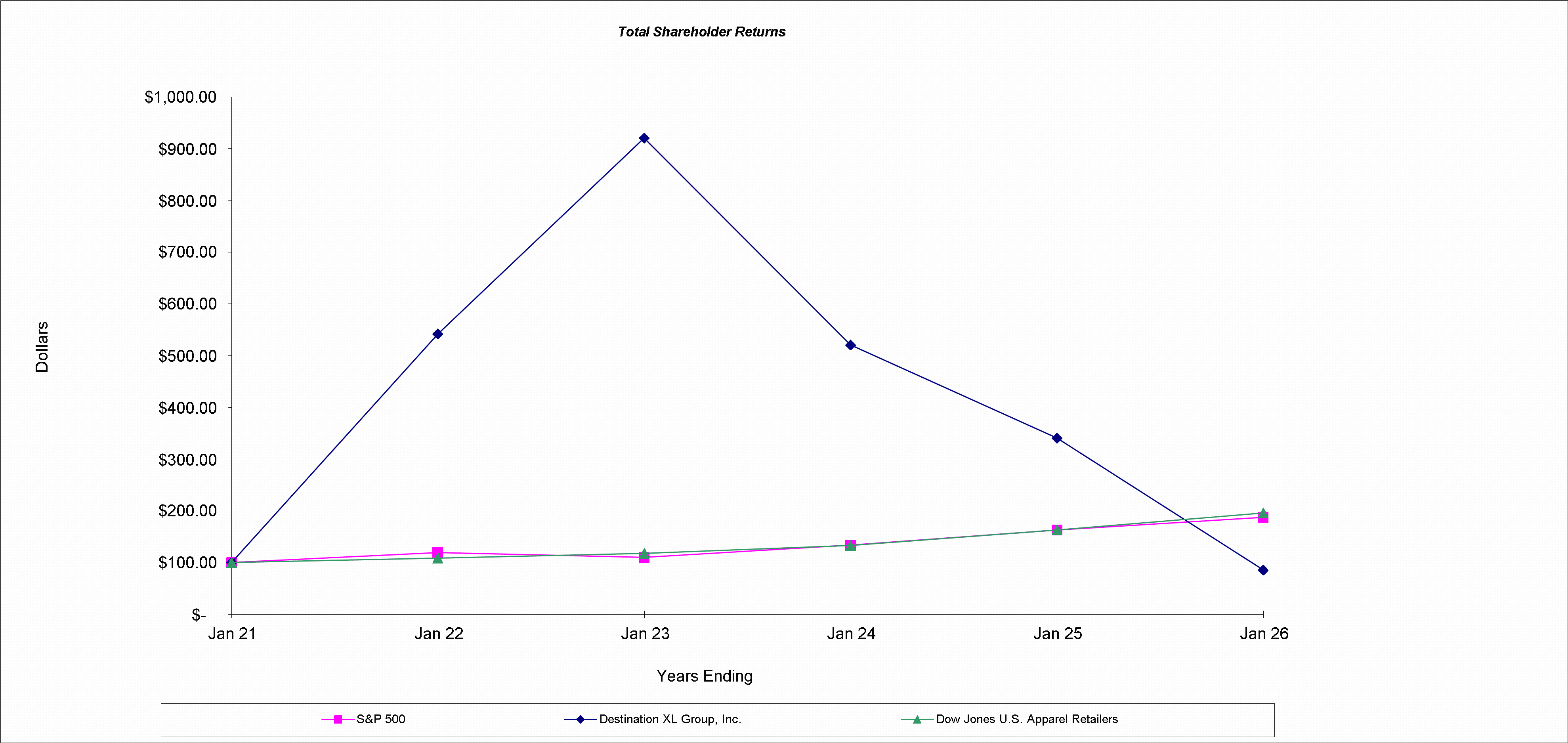
Annual Return Percentage
|
|
|
|
|
|
|
|
|
|
|
|
|
|
|
|
|
|
|
|
|
|
|
|
|
Year ended |
|
Company/Index |
|
|
|
Jan 22 |
|
|
Jan 23 |
|
|
Jan 24 |
|
|
Jan 25 |
|
|
Jan 26 |
|
DXLG |
|
|
441.3 |
% |
|
|
70.0 |
% |
|
|
(43.5 |
%) |
|
|
(34.6 |
%) |
|
|
(75.0 |
%) |
S&P 500 |
|
|
19.3 |
% |
|
|
(8.2 |
%) |
|
|
21.8 |
% |
|
|
21.8 |
% |
|
|
14.9 |
% |
Dow Jones U.S. Apparel Retailers |
|
|
8.1 |
% |
|
|
8.6 |
% |
|
|
13.4 |
% |
|
|
22.6 |
% |
|
|
19.9 |
% |
Indexed Returns
|
|
|
|
|
|
|
|
|
|
|
|
|
|
|
|
|
|
|
|
|
|
|
|
|
|
|
Base Period |
|
|
|
|
|
|
Jan 21 |
|
|
Jan 22 |
|
|
Jan 23 |
|
|
Jan 24 |
|
|
Jan 25 |
|
|
Jan 26 |
|
Company/Index |
|
|
|
|
|
|
|
|
|
|
|
|
|
|
|
|
|
|
DXLG |
|
$ |
100 |
|
|
$ |
541.25 |
|
|
$ |
920.00 |
|
|
$ |
520.00 |
|
|
$ |
340.00 |
|
|
$ |
85.00 |
|
S&P 500 |
|
$ |
100 |
|
|
$ |
119.32 |
|
|
$ |
109.59 |
|
|
$ |
133.50 |
|
|
$ |
162.63 |
|
|
$ |
186.82 |
|
Dow Jones U.S. Apparel Retailers |
|
$ |
100 |
|
|
$ |
108.05 |
|
|
$ |
117.29 |
|
|
$ |
132.95 |
|
|
$ |
163.05 |
|
|
$ |
195.42 |
|
The performance graph above shall not be deemed “filed” for purposes of Section 18 of the Exchange Act or otherwise subject to the liability of that section. This performance graph will not be deemed incorporated by reference into any filing under the Securities Act of 1933, as amended, or the Exchange Act, whether made before or after the date hereof, regardless of any general incorporation language in such filing.
Item 6. Reserved
Item 7. Management’s Discussion and Analysis of Financial Condition and Results of Operations
The following is a discussion and analysis of our financial condition and results of operations for fiscal 2025 as compared to fiscal 2024. Our Annual Report on Form 10-K for the year ended February 1, 2025 (fiscal 2024) includes a discussion and analysis of our financial condition and results of operations comparing fiscal 2024 to fiscal 2023 in Item 7 of Part II, “Management’s Discussion and Analysis of Financial Condition and Results of Operations.”
As noted above in Part I, this section also contains forward-looking statements that reflect the Company’s plans, estimates and beliefs. The Company’s actual results could materially differ from those discussed in these forward-looking statements. Factors that could cause or contribute to those differences include, but are not limited to, those discussed below and elsewhere in this Annual Report, particularly in “Risk Factors” and “Forward-Looking Statements.” The following discussion and analysis of our financial condition and results of operations should be read in light of those risks and uncertainties and in conjunction with our accompanying Consolidated Financial Statements and Notes thereto.
Certain figures discussed below may not foot due to rounding.
Segment Reporting
We have two principal operating segments: our stores and direct business. We consider our stores and direct business segments to be similar in terms of economic characteristics, production processes and operations, and we have therefore aggregated them into one reportable segment consistent with our integrated commerce approach.
Comparable Sales and E-Commerce (Direct) Sales Definition
Our customer’s shopping experience continues to evolve across multiple channels, and we are continually adapting to meet the customer's needs. The majority of our stores have the capability to fulfill online orders if merchandise is not available in the warehouse. As a result, we continue to see more transactions that begin online, but are ultimately completed at the store level. Similarly, if a customer visits a store and the item is out of stock, the associate can order the item through our website. A customer also has the ability to order online and pick up in a store or at curbside. We define store sales as sales that originate and are fulfilled directly at the store level. E-commerce sales, which we also refer to as direct sales, are defined as sales that originate online, whether through our website, at the store level, our Guest Engagement Center, or through a third-party marketplace.
Stores that have been open for 13 months are included in comparable sales. Stores that have been remodeled or re-located during the period are also included in our determination of comparable stores' sales. Stores that have been expanded by more than 25% are considered non-comparable for the first 13 months. The method of calculating comparable sales varies across the retail industry and, as a result, our calculation of comparable sales is not necessarily comparable to similarly titled measures reported by other retailers.
Non-GAAP Financial Measures
We monitor certain financial measures other than those that are in accordance with U.S. generally accepted accounting principles (“GAAP”) on a regular basis in order to track the progress of our business. These non-GAAP financial measures include free cash flow, free cash flow before capital expenditures for store development, adjusted net income (loss), adjusted net income (loss) per share, adjusted EBITDA and adjusted EBITDA margin. We believe that these measures provide helpful information with respect to the Company’s operating performance and that the inclusion of these measures is important to assist investors in comparing our performance in fiscal 2025 to fiscal 2024. However, these measures may not be comparable to similar measures used by other companies and should not be considered superior to or as a substitute for net income (loss), net income (loss) per diluted share or cash flow from operating activities in accordance with GAAP. See “Non-GAAP Reconciliations” below for additional information regarding these non-GAAP financial measures and reconciliations to comparable GAAP financial measures.
RESULTS OF OPERATIONS
Our fiscal year is a 52-week or 53-week period ending on the Saturday closest to January 31. Fiscal 2025 and fiscal 2024 were each a 52-week period.
EXECUTIVE OVERVIEW
|
|
|
|
|
|
|
|
|
|
|
|
Fiscal 2025 |
|
|
Fiscal 2024 |
|
|
|
|
(in millions, except for percentage of sales and per share data) |
Sales |
|
$ |
435.0 |
|
|
$ |
467.0 |
|
|
Net income (loss) (GAAP) |
|
|
(35.9 |
) |
|
|
3.1 |
|
|
Adjusted net income (loss) (Non-GAAP) |
|
|
(11.5 |
) |
|
|
4.3 |
|
|
Adjusted EBITDA (Non-GAAP) |
|
|
1.6 |
|
|
|
19.9 |
|
|
|
|
|
|
|
|
|
|
Per diluted share: |
|
|
|
|
|
|
|
Net income (loss) |
|
$ |
(0.66 |
) |
|
$ |
0.05 |
|
|
Adjusted net income (loss) (Non-GAAP) |
|
$ |
(0.21 |
) |
|
$ |
0.07 |
|
|
|
|
|
|
|
|
|
|
As a percentage of sales: |
|
|
|
|
|
|
|
Gross margin |
|
|
43.4 |
% |
|
|
46.5 |
% |
|
SG&A expenses |
|
|
43.1 |
% |
|
|
42.5 |
% |
|
Operating margin |
|
|
(4.2 |
)% |
|
|
0.8 |
% |
|
Adjusted EBITDA margin (Non-GAAP) |
|
|
0.4 |
% |
|
|
4.3 |
% |
|
|
|
|
|
|
|
|
|
Liquidity: |
|
|
|
|
|
|
|
Cash flow from operating activities |
|
$ |
2.1 |
|
|
$ |
29.6 |
|
|
Free cash flow (Non-GAAP) |
|
$ |
(18.0 |
) |
|
$ |
1.9 |
|
|
|
|
|
|
|
|
|
|
Our results for fiscal 2025 reflect continuing challenges facing the big + tall retail sector, which negatively impacted sales, across both our stores and direct channels. A weaker macroeconomic environment and pressured consumer sentiment led to reduced discretionary spending, lower shopping frequency, and increased emphasis on essentials and lower price points. While difficult to quantify, we believe that the increased use of GLP-1 medications also negatively impacted demand. As a result, our comparable sales for fiscal 2025 were down 8.4%. In addition, the imposition of tariffs created a significant headwind weighing on merchandise margin, particularly in the second half of the year. In response, we remained disciplined, carefully managed expenses, and proactively controlled inventory.
Despite the sales decline, we made meaningful progress on key sales initiatives. We expanded our private brand offerings, refined our value‑driven national brand assortment, expanded the roll out of FiTMAP®, launched a new loyalty program, and strengthened our strategic relationship with Nordstrom. Operationally, we continued to diversify our sourcing base and drove cost efficiencies to mitigate tariff pressures.
For fiscal 2025, we reported a net loss of $(0.66) per diluted share as compared to a net income of $0.05 per diluted share in fiscal 2024. Fiscal 2025 results included a charge of $20.4 million to establish a full valuation allowance against our net deferred tax assets and $4.2 million of transaction-related costs associated with the pending Merger with FullBeauty, which is discussed in more detail below and under Item 1, Business - Recent Developments.
On an adjusted basis, excluding the charge to establish a full valuation allowance, transaction-related costs, impairment charges and a non-recurring legal accrual recorded in fiscal 2024, the adjusted net loss for fiscal 2025 was $(0.21) per diluted share as compared to adjusted net income of $0.07 per diluted share for fiscal 2024. The decrease was driven primarily by the sales shortfall.
We maintained a strong liquidity position, ending fiscal 2025 with $28.8 million in cash and investments as compared to $48.4 million in fiscal 2024. We improved our inventory position, which was down 2.6%, as compared to fiscal 2024. During fiscal 2025, we amended our credit facility to extend the maturity of the facility from October 28, 2026 to August 13, 2030. We had no borrowings under our credit facility during fiscal 2025, and at January 31, 2026, our availability under our credit facility was $55.1 million. The strength of our balance sheet gives us flexibility and resilience as we continue to navigate a challenging big + tall retail sector.
Recent Developments
As discussed above under Item 1, Business, Recent Developments, in December 2025, we announced a proposed Merger with FullBeauty. We believe bringing DXL together with FullBeauty's inclusive women's brands and KingSize would create a comprehensive and diverse size-inclusive brand portfolio spanning value to premium price points across lifestyles and occasions. By leveraging complementary strengths across gender, product and channels, we believe the combined company will be positioned to
accelerate growth, improve operational efficiency and enhance customer experience through a comprehensive, innovative, multi-channel strategy.
We are currently preparing a proxy statement that we plan to distribute to the stockholders of DXL in connection with their votes on the approval of the Merger and the issuance of DXL Common Stock in connection with the Merger, as well as other matters to be voted upon in connection with the approval of the Merger. The transaction is expected to close in the second quarter of fiscal 2026, subject to customary closing conditions and approval by DXL stockholders.
SALES
|
|
|
|
|
|
|
|
|
|
|
|
|
|
|
|
(in thousands) |
|
Fiscal 2025 |
|
|
|
Fiscal 2024 |
|
|
|
Fiscal 2023 |
|
|
Store sales |
|
$ |
310,321 |
|
71.3% |
|
$ |
325,713 |
|
69.7% |
|
$ |
358,710 |
|
68.7% |
Direct sales |
|
|
124,696 |
|
28.7% |
|
|
141,302 |
|
30.3% |
|
|
163,105 |
|
31.3% |
Total sales |
|
$ |
435,017 |
|
100.0% |
|
$ |
467,015 |
|
100.0% |
|
$ |
521,815 |
|
100.0% |
For fiscal 2025, total sales decreased 6.9% to $435.0 million from $467.0 million for fiscal 2024. The decrease was primarily due to a decrease in comparable sales of 8.4%, with stores down 6.9% and the direct business down 11.8%. These decreases were partially offset by an increase in non-comparable sales.
A decrease in traffic continued to be the primary driver for the decrease in comparable sales. While conversion rate was up slightly, our dollars per transaction were down, partly due to the shift in product mix toward more value-driven merchandise, as our customers continue to be price sensitive due to reduced discretionary spending. During the fourth quarter of fiscal 2025, our comparable sales were down 7.3%, with stores down 8.6% and the direct business down 4.3%. Our direct business saw a marked improvement in the fourth quarter as compared to the previous three quarters of fiscal 2025, where comparable sales for the direct business were down double digits. We believe this improvement was driven by more effective digital marketing spend that drove improved traffic during the holiday season.
While we saw positive results from our loyalty program, Price Match Guarantee, FiTMAP, and our Heroes discount in fiscal 2025, our total active customer file continued to be under pressure as customers were spending less and shopping less frequently in the current environment.
Through the first month of fiscal 2026, we have seen improvement in traffic and average order value, both of which contributed to an improvement in sales during February. Comparable sales in February were down 1.3%, with our direct business being up 3.4%, partially offset by our stores, which were down 3.1%.
GROSS MARGIN
For fiscal 2025, gross margin, inclusive of occupancy costs, was 43.4% as compared to 46.5% for fiscal 2024. The decrease of 310 basis points was primarily due to an increase of 220 basis points in occupancy costs, as a percentage of sales, primarily due to the deleveraging from lower sales and increased rents from lease extensions. Occupancy costs, on a dollar basis, increased $5.3 million, or 8.5%, as compared to fiscal 2024, as a result of new stores and lease extensions. Merchandise margin for fiscal 2025 decreased 90 basis points, as compared to fiscal 2024, primarily due to the impact of tariffs and increased markdown activity and promotional offers associated with our marketing initiatives. For fiscal 2025, the impact of tariffs on merchandise margins was estimated to be approximately 50 basis points, as a percentage of sales. These increased costs were partially offset by an improvement in merchandise margins as a result of a shift in product mix toward our private brand merchandise.
There remains significant volatility with respect to evolving trade policies and the imposition of tariffs globally. On February 20, 2026, the U.S. Supreme Court ruled that certain tariffs imposed by the current administration under the International Emergency Economic Powers Act in 2025, including tariffs on global imports from China, Canada, and Mexico, were unlawful. However, not all tariffs imposed in 2025 will be impacted by this decision. Following the U.S. Supreme Court’s ruling, the current administration issued a presidential proclamation imposing additional tariffs under U.S. trade laws, which can remain in effect for up to 150 days unless further extended by the U.S. Congress. Through vendor negotiations, sourcing diversification and cost mitigation programs, such as the First Sale program, we have and will continue to take proactive measures to mitigate the impact of tariffs and trade restrictions on our business and our customers. Given the volatility that currently exists around trade discussions, it is difficult to determine the potential impact that tariffs may have on our financial results for fiscal 2026. However, if currently enacted rates remain in effect throughout fiscal 2026, and no additional tariffs, including those under U.S. trade laws, are added, we estimate that the impact of tariffs on gross margin will be approximately 150 basis points.
SELLING, GENERAL AND ADMINISTRATIVE EXPENSES
Selling, general and administrative (“SG&A”) expenses were $187.4 million, or 43.1% of sales, for fiscal 2025 as compared to $198.3 million, or 42.5% of sales, for fiscal 2024. SG&A expenses, as a percentage of sales, were deleveraged due to the lower sales base.
On a dollar basis, SG&A expenses decreased $10.9 million due to a decrease in marketing costs, incentive-based compensation and supporting payroll. In addition, results for fiscal 2024 included an accrual for estimated non-recurring legal settlement costs of $1.0 million.
For fiscal 2025, marketing costs were 6.1% of sales as compared to 6.8% in fiscal 2024.
Management views SG&A expenses through two primary cost centers: Customer Facing Costs and Corporate Support Costs. Customer Facing Costs, which include store payroll, marketing and other store operating costs, represented 24.8% of sales for fiscal 2025 as compared to 24.1% of sales for fiscal 2024. Corporate Support Costs, which include the distribution center and corporate overhead costs, represented 18.2% of sales for fiscal 2025 as compared to 18.4% of sales for fiscal 2024.
Transaction-Related Costs
Transaction-related costs for fiscal 2025 were $4.2 million and primarily related to fees paid for professional services in connection with the Company's pending Merger.
IMPAIRMENT OF ASSETS
Asset impairment charges primarily represent the write-down of operating lease right-of-use assets and the write-down of store property and equipment, where the carrying value exceeds fair value. In addition, any subsequent gains recognized in connection with a store closure related to a previously recorded operating lease right-of-use asset impairment will be included as an offset to impairment charges, with the remainder of the gain included as a reduction in store occupancy costs.
For fiscal 2025 and fiscal 2024, the Company recorded a total asset impairment charge of $0.2 million and $1.3 million, respectively, for certain store property.
DEPRECIATION AND AMORTIZATION
Depreciation and amortization expense for fiscal 2024 was $15.3 million, as compared to $13.9 million in fiscal 2024. The increase in depreciation and amortization expense reflects the increase in capital expenditures over the past two years as we invest in our stores, e-commerce and other technology projects.
INTEREST INCOME, NET
Net interest income for fiscal 2025 and fiscal 2024 was $0.8 million and $2.1 million, respectively. We invest excess cash in short-term, U.S. government-backed investments. The decrease in interest income for fiscal 2025 as compared to the prior year was primarily due to the decrease in the average balance of investments as well as a decrease in interest rates. Interest costs for both fiscal years were immaterial because we had no outstanding debt and no borrowings under our credit facility during either period.
INCOME TAXES
In the fourth quarter of fiscal 2025, we recorded a charge of $20.4 million to establish a full valuation allowance against our net deferred tax assets. Over the past two years, the big + tall sector has been adversely affected by general economic weakness, including inflation and rising costs, which has reduced discretionary consumer spending. Consistent with these trends, the Company has experienced declining revenue over the past two fiscal years and generated a net operating loss in fiscal 2025. Realization of our deferred tax assets, which primarily relate to net operating loss carryforwards, depends on the generation of future taxable income. Federal net operating losses include $4.4 million that will expire by fiscal 2037 and $59.7 million that do not expire. State net operating losses were $46.1 million, some of which will expire from fiscal 2026 through 2046. While we believe that profitability will return over the long term, we are forecasting operating losses in the near term. Management concluded that this negative evidence outweighs available positive evidence regarding realizability of its deferred tax assets.
The effective tax rate for fiscal 2025, before the $20.4 million charge to establish a full valuation allowance, was 10.7% as compared to 47.5% for fiscal 2024. This decrease in the effective tax rate reflects the impact of certain discrete items and permanent book-to-tax differences as well as the impact of adjustments to our net operating losses reflected in our tax returns filed in fiscal 2025. See Note F to the Consolidated Financial Statements.
At January 31, 2026, we have a full valuation allowance against our net deferred tax assets of $21.8 million.
NET INCOME (LOSS)
Net loss for fiscal 2025 was $(35.9) million, or $(0.66) per diluted share, as compared to net income for fiscal 2024 of $3.1 million, or $0.05 per diluted share.
The decrease in earnings for fiscal 2025 as compared to fiscal 2024 was driven primarily by a decrease in sales as well as a charge to establish a full valuation allowance against our net deferred tax assets. Results for fiscal 2025 included a non-cash charge of $20.4 million to establish a full valuation allowance against net deferred tax assets, transaction-related costs of $4.2 million and an impairment charge against certain store assets of $0.2 million. Results for fiscal 2024 included an impairment charge of $1.3 million against certain store assets and a charge of $1.0 million for an accrual for estimated non-recurring legal settlement costs.
On a non-GAAP basis, adjusting for the non-cash charge to establish a valuation allowance against net deferred tax assets, transaction-related costs, accrual for estimated non-recurring legal settlement costs, and asset impairments, adjusted net loss for fiscal 2025 was $(11.5) million, or $(0.21) per diluted share, as compared to adjusted net income of $4.3 million, or $0.07 per diluted share, for fiscal 2024.
SEASONALITY
Consistent with the retail apparel industry, our business experiences seasonal fluctuations in sales due to the timing of certain holidays and key retail shopping periods. Accordingly, our sales results for a particular quarter may not be indicative of the sales results we expect for the full year.
EFFECTS OF INFLATION
During fiscal 2025, we continued to see the effect of inflationary pressures on raw materials, services and labor and consumer spending. While there seems to be improvement, we cannot be certain of the effect that inflation (or deflation) may have on our results of operations in the future.
LIQUIDITY AND CAPITAL RESOURCES
Our primary sources of liquidity are our cash and cash equivalents, short-term investments, cash generated from operations and availability under our credit facility, which is discussed below. We believe that these sources of liquidity will be sufficient to fund our working capital requirements, commitments and capital expenditures. Cash that is in excess of our forecasted needs may be invested in money market accounts and U.S. government-backed securities.
We believe that our cash, investments, cash generated from operations, and borrowings available to us under our credit facility will be adequate to meet our liquidity needs and capital expenditure requirements for at least the next 12 months. We also believe that cash flows from operating activities and cash on hand will be sufficient to satisfy our capital requirements in the long term; however, to the extent future capital requirements exceed cash on hand plus cash flows from operating activities, we anticipate that working capital will be financed by our credit facility.
At January 31, 2026, our material contractual obligations primarily consisted of our operating lease obligations, as disclosed in Note E, Leases, to the Consolidated Financial Statements. In addition to our lease obligations, at January 31, 2026, we were also contractually committed pursuant to a merchandise purchase obligation to meet minimum purchases of $10.0 million annually through fiscal 2028.
The following table sets forth financial data regarding our liquidity position at the end of the past two fiscal years:
|
|
|
|
|
|
|
|
|
|
(in millions) |
|
Fiscal 2025 |
|
|
Fiscal 2024 |
|
|
Cash flow from operating activities (GAAP basis) |
|
$ |
2.1 |
|
|
$ |
29.6 |
|
|
Capital expenditures, excluding store development |
|
$ |
(11.3 |
) |
|
$ |
(14.5 |
) |
|
Free Cash Flow before capital expenditures for store development (non-GAAP basis) |
|
$ |
(9.2 |
) |
|
$ |
15.1 |
|
|
Capital expenditures for store development |
|
|
(8.8 |
) |
|
|
(13.2 |
) |
|
Free Cash Flow (non-GAAP basis) |
|
$ |
(18.0 |
) |
|
$ |
1.9 |
|
|
|
|
|
|
|
|
|
|
Cash, cash equivalents and short-term investments, at year end |
|
$ |
28.8 |
|
|
$ |
48.4 |
|
|
Total debt, net of unamortized debt issuance costs |
|
$ |
- |
|
|
$ |
- |
|
|
Unused excess availability under Credit Facility |
|
$ |
55.1 |
|
|
$ |
64.7 |
|
|
For fiscal 2025, cash flow from operations decreased to $2.1 million as compared to $29.6 million for fiscal 2024, primarily due to the decrease in operating income in fiscal 2025. Free cash flow, a non-GAAP measure, decreased to $(18.0) million for fiscal 2025 as compared to $1.9 million for fiscal 2024.
Cash flow provided by (used for) investing activities was $10.4 million as compared to $(31.3) million for fiscal 2024. The increase in cash flow provided by investing activities was primarily due to an increase in the maturity of short-term investments, net of purchases, of $34.1 million and a decrease in capital expenditures of $7.6 million.
Cash flow used for financing activities for fiscal 2025 and fiscal 2024 was $0.6 million and $13.9 million, respectively. The use of cash in fiscal 2024 was primarily due to the repurchase of our common stock.
Credit Facility
During fiscal 2025, we amended our revolving credit agreement with Citizens Bank, N.A. by entering into the Second Amendment to Credit Facility (as amended, the "Credit Facility"). As a result of the amendment, the maturity date of the Credit Facility was extended from October 28, 2026 to August 13, 2030 and the revolving commitments under the Credit Facility were reduced from $125.0 million to $100.0 million, to more closely align with our average inventory levels, which serve as the primary borrowing base for the Credit Facility. In addition, the sublimit for swing-line loans under the Credit Facility was reduced from $15.0 million to $10.0 million. The Credit Facility continues to include a sublimit of $20.0 million for commercial and standby letters of credit. Our availability under the Credit Facility did not materially change as a result of the amendment.
Borrowings under the Credit Facility bear interest at either a Base Rate or Daily Simple SOFR rate, at our option. Base Rate loans will bear interest at a rate equal to (i) the greater of: (a) the Prime Rate, (b) the Federal Funds effective rate plus 0.50% per annum and (c) the Daily Simple SOFR rate plus 1.00% per annum (provided the Base Rate shall never be less than the Floor (as defined in the Credit Facility)), plus (ii) a varying percentage, based on our average excess availability, of either 0.25% or 0.50% (the “Applicable Margin”). Daily Simple SOFR loans will bear interest at a rate equal to (i) the Daily Simple SOFR rate plus an adjustment of 0.10% (provided the Daily Simple SOFR rate shall never be less than the Floor), plus (ii) the Applicable Margin. Any swingline loan will continue to bear interest at a rate equal to the Base Rate plus the Applicable Margin. We are subject to an unused line fee of 0.25%.
We had no outstanding borrowings under the Credit Facility at January 31, 2026. At January 31, 2026, outstanding standby letters of credit were $3.6 million. There were no outstanding documentary letters of credit at January 31, 2026. The Credit Facility was not utilized during fiscal 2025, resulting in average unused excess availability during fiscal 2025 of $70.7 million. Unused excess availability at January 31, 2026 was $55.1 million as compared to $64.7 million at February 1, 2025. The decrease in availability under the Credit Facility at January 31, 2026 was the result of the 2.6% decrease in inventory and a decrease in other eligible assets as well as a slightly lower appraised value as a result of current market conditions. Our obligations under the Credit Facility are secured by a lien on substantially all of our assets. The Company was subject to an unused line fee of 0.25% of the total commitment less average outstanding letters of credit.
Our Credit Facility is described in more detail in Note D to the Consolidated Financial Statements.
INVENTORY
At January 31, 2026, total inventories decreased to $73.5 million from $75.5 million at February 1, 2025, which was a 2.6% decrease. We continue to take proactive measures to manage our inventory and adjust our receipt plan given the ongoing macroeconomic factors affecting consumer spending, while at the same time, continuing to evaluate our sourcing strategy to minimize the impact of tariffs. At January 31, 2026, our clearance inventory was 9.9% of our inventory, as compared to 8.6% at February 1, 2025, and below our historical benchmark of approximately 10.0%. Our inventory turnover rate has improved by over 30% from fiscal 2019.
OFF-BALANCE SHEET ARRANGEMENTS
We have no off-balance sheet arrangements as defined by Item 303(a)(4) of Regulation S-K.
CAPITAL EXPENDITURES
The following table sets forth the open stores and related square footage at January 31, 2026 and February 1, 2025, respectively:
|
|
|
|
|
|
|
|
|
|
|
|
|
|
|
|
|
|
|
At January 31, 2026 |
|
|
At February 1, 2025 |
|
Store Concept |
|
Number of
Stores |
|
|
Square
Footage |
|
|
Number of
Stores |
|
|
Square
Footage |
|
(square footage in thousands) |
|
|
|
|
|
|
|
|
|
|
|
|
DXL Retail |
|
|
258 |
|
|
|
1,853 |
|
|
|
247 |
|
|
|
1,795 |
|
DXL Outlet |
|
|
17 |
|
|
|
86 |
|
|
|
15 |
|
|
|
76 |
|
Casual Male XL Retail |
|
|
5 |
|
|
|
15 |
|
|
|
8 |
|
|
|
25 |
|
Casual Male XL Outlet |
|
|
15 |
|
|
|
44 |
|
|
|
18 |
|
|
|
54 |
|
Total Stores |
|
|
295 |
|
|
|
1,998 |
|
|
|
288 |
|
|
|
1,950 |
|
During fiscal 2025, we opened eight new DXL stores, converted two Casual Male XL retail stores and one Casual Male XL outlet to DXL retail stores and converted two Casual Male XL outlets to DXL outlets. Below is a summary of the store activity from February 1, 2025 to January 31, 2026:
|
|
|
|
|
|
|
|
|
|
|
|
|
|
|
|
|
|
|
|
|
Number of Stores: |
|
DXL Retail |
|
|
DXL Outlet |
|
|
Casual Male
XL Retail |
|
|
Casual Male
XL Outlet |
|
|
Total Stores |
|
At February 1, 2025 |
|
|
247 |
|
|
|
15 |
|
|
|
8 |
|
|
|
18 |
|
|
|
288 |
|
New stores |
|
|
8 |
|
|
|
— |
|
|
|
— |
|
|
|
— |
|
|
|
8 |
|
Conversions to DXL format |
|
|
3 |
|
|
|
2 |
|
|
|
(2 |
) |
|
|
(3 |
) |
|
|
— |
|
Closed retail stores |
|
|
— |
|
|
|
— |
|
|
|
(1 |
) |
|
|
— |
|
|
|
(1 |
) |
At January 31, 2026 |
|
|
258 |
|
|
|
17 |
|
|
|
5 |
|
|
|
15 |
|
|
|
295 |
|
Our capital expenditures for fiscal 2025 were $20.1 million, as compared to $27.7 million in fiscal 2024. The capital expenditures for fiscal 2025 primarily related to stores, information technology projects, distribution center and facilities.
For fiscal 2026, we expect our capital expenditures to range from $8.0 million to $12.0 million, net of tenant incentives. The expected decrease in capital expenditures for fiscal 2026 is primarily due to our decision to pause new store openings given the current economic headwinds. Our store development plans for fiscal 2026 will be limited to conversions of a few remaining Casual Male XL stores to the DXL format, store relocations and other capital projects necessary to maintain our existing store portfolio and distribution center. The remainder of our expected capital spend for fiscal 2026 will primarily be for technology-related projects to support our business initiatives. While we have paused our store openings, we continue to believe we could potentially open approximately 50 net new DXL stores across the country when economic conditions and the overall traffic within the big + tall sector improves.
Non-GAAP Reconciliations
We monitor certain non-GAAP financial measures on a regular basis in order to track the progress of our business, including the measures below. We believe that these measures provide helpful information with respect to the Company’s operating performance to stockholders, investors and analysts, and that the inclusion of these non-GAAP measures is important to assist investors in comparing our performance in fiscal 2025 to fiscal 2024, on a comparable basis. However, these measures may not be comparable to similar measures used by other companies and should not be considered superior to or as a substitute for operating net income (loss), net income (loss) per diluted share or cash flows from operating activities in accordance with GAAP. (Certain amounts in the following tables may not foot due to rounding.)
Free Cash Flow
Free cash flow is a metric that management uses to monitor liquidity. Management believes that this metric is important to investors, because it demonstrates the Company’s ability to maintain liquidity while supporting its capital projects and new store growth. Free cash flow is calculated as cash flow from operating activities, less capital expenditures and excludes the mandatory and discretionary repayment of debt. Free cash flow before capital expenditures for store development is calculated as cash flow from operating activities less capital expenditures other than capital expenditures for store development. Capital expenditures for store development includes capital expenditures for new stores, conversions of Casual Male XL stores to DXL and remodels. Capital expenditures related to store relocations and maintenance are not included in store development. The following table provides a reconciliation of free cash flow:
|
|
|
|
|
|
|
|
|
|
|
|
|
|
|
|
|
(in millions) |
|
Fiscal 2025 |
|
|
Fiscal 2024 |
|
|
|
Cash flow from operating activities (GAAP basis) |
|
$ |
2.1 |
|
|
$ |
29.6 |
|
|
|
Capital expenditures, excluding store development |
|
|
(11.3 |
) |
|
|
(14.5 |
) |
|
|
Free Cash Flow before capital expenditures for store development (non-GAAP basis) |
|
$ |
(9.2 |
) |
|
$ |
15.1 |
|
|
|
Capital expenditures for store development |
|
|
(8.8 |
) |
|
|
(13.2 |
) |
|
|
Free cash flow (non-GAAP basis) |
|
$ |
(18.0 |
) |
|
$ |
1.9 |
|
|
|
Adjusted Net Income (Loss) and Adjusted Net Income (Loss) Per Diluted Share
Adjusted net income (loss) and adjusted net income (loss) per diluted share is calculated by excluding any asset impairment charge (gain), the charge to establish a full valuation allowance against deferred tax assets, transaction-related costs and an accrual for estimated non-recurring legal settlement costs. The Company believes that this comparability is useful in comparing the actual results period to period. Adjusted net income (loss) per diluted share is then calculated by dividing the adjusted net income (loss) by the weighted average shares outstanding for the respective period, on a diluted basis. The following table is a reconciliation of net income (loss) on a GAAP basis to adjusted net income (loss), on a non-GAAP basis, for each fiscal year:
|
|
|
|
|
|
|
|
|
|
|
|
|
|
|
|
|
|
|
Fiscal 2025 |
|
|
Fiscal 2024 |
|
|
|
$ |
|
|
Per diluted
share |
|
|
$ |
|
|
Per diluted
share |
|
(in millions, except per share data) |
|
|
|
|
|
|
|
|
|
|
|
|
Net income (loss) (GAAP basis) |
|
$ |
(35.9 |
) |
|
$ |
(0.66 |
) |
|
$ |
3.1 |
|
|
$ |
0.05 |
|
|
|
|
|
|
|
|
|
|
|
|
|
|
Adjust: |
|
|
|
|
|
|
|
|
|
|
|
|
Impairment of assets |
|
|
0.2 |
|
|
|
|
|
|
1.3 |
|
|
|
|
Transaction-related costs |
|
|
4.2 |
|
|
|
|
|
|
— |
|
|
|
|
Accrual for estimated non-recurring legal settlement costs |
|
|
— |
|
|
|
|
|
|
1.0 |
|
|
|
|
Income tax effect of above adjustments (1) |
|
|
(0.5 |
) |
|
|
|
|
|
(1.1 |
) |
|
|
|
Charge to establish a full valuation allowance against net deferred tax assets |
|
|
20.4 |
|
|
|
|
|
|
— |
|
|
|
|
Adjusted net income (loss) (non-GAAP basis) |
|
$ |
(11.5 |
) |
|
$ |
(0.21 |
) |
|
$ |
4.3 |
|
|
$ |
0.07 |
|
|
|
|
|
|
|
|
|
|
|
|
|
|
Weighted average number of common shares
outstanding on a diluted basis |
|
|
|
|
|
54.1 |
|
|
|
|
|
|
59.6 |
|
(1) The income tax effect of pre-tax adjustments to net income (loss) was calculated using the applicable effective tax rate for each respective year. For fiscal 2025, the applicable effective tax rate, before the charge to establish a full valuation allowance against deferred tax assets, was 10.7%.
Adjusted EBITDA and Adjusted EBITDA Margin
Adjusted EBITDA and adjusted EBITDA margin are presented because we believe that these measures are useful to investors in evaluating our performance. Management uses adjusted EBITDA as a key metric to measure profitability and economic productivity. Adjusted EBITDA is calculated as earnings before interest, taxes, depreciation and amortization and before any impairment (gain) of assets, transaction-related costs and an accrual for estimated non-recurring legal settlement costs. The accrual for estimated non-recurring legal settlement costs is excluded from adjusted EBITDA due to its unusual and non-recurring nature. Adjusted EBITDA margin is calculated as adjusted EBITDA divided by sales.
The following table is a reconciliation of net income (loss) on a GAAP basis to adjusted EBITDA and adjusted EBITDA margin, on a non-GAAP basis, for each fiscal year:
|
|
|
|
|
|
|
|
|
|
|
|
|
|
|
|
|
|
(in millions, except percentages) |
|
Fiscal 2025 |
|
|
Fiscal 2024 |
|
|
|
|
|
|
|
|
|
|
Net income (loss), on a GAAP basis |
|
$ |
(35.9 |
) |
|
$ |
3.1 |
|
|
Add back: |
|
|
|
|
|
|
|
Impairment of assets |
|
|
0.2 |
|
|
|
1.3 |
|
|
Transaction-related costs |
|
|
4.2 |
|
|
|
— |
|
|
Accrual for estimated non-recurring legal settlement costs |
|
|
— |
|
|
|
1.0 |
|
|
Provision for income taxes |
|
|
18.6 |
|
|
|
2.8 |
|
|
Interest income, net |
|
|
(0.8 |
) |
|
|
(2.1 |
) |
|
Depreciation and amortization |
|
|
15.3 |
|
|
|
13.9 |
|
|
Adjusted EBITDA, on a non-GAAP basis |
|
$ |
1.6 |
|
|
$ |
19.9 |
|
|
|
|
|
|
|
|
|
|
Sales |
|
$ |
435.0 |
|
|
$ |
467.0 |
|
|
Adjusted EBITDA margin, on a non-GAAP basis: |
|
|
0.4 |
% |
|
|
4.3 |
% |
|
CRITICAL ACCOUNTING POLICIES; USE OF ESTIMATES
Our financial statements are based on the application of significant accounting policies, many of which require our management to make significant estimates and assumptions (see Note A to the Consolidated Financial Statements). We believe that the following items involve some of the more critical judgments in the application of accounting policies that currently affect our financial condition and results of operations:
Long-Term Incentive Plans
Stock awards are primarily granted pursuant to our Long-Term Incentive Plans (“LTIPs”). During fiscal 2025, we had three active LTIPs: the 2023-2025 LTIP, the 2024-2026 LTIP and the 2025-2027 LTIP. See Note H to the Consolidated Financial Statements for additional discussion of our LTIPs. Awards under each LTIP consist of 50% time-based awards and 50% performance-based awards. All time-based awards are amortized over each LTIP’s respective vesting periods.
The performance-based component of each LTIP is a dollar-denominated award, settled in a variable number of equity awards and/or cash awards. Any award will only be granted if such performance targets are achieved. Accordingly, each quarter the Company reviews its expected achievement against such performance targets to assess whether an accrual is necessary. The performance metric for each of these LTIPs is a three-year total shareholder return against peers. As such, the accruals are based on projections that extend beyond a year and are subject to change quarter to quarter based on actual performance. All accruals are recorded as a liability. If performance targets are achieved and equity awards are granted, the related cost of those awards will be reclassified from the accrual to stock-based compensation on grant date.
The performance target under the 2023-2025 LTIP was not achieved at the end of fiscal 2025. With respect to the performance-based component of the 2024-2026 LTIP and the 2025-2027 LTIP, which each approximate $2.4 million at target, awards will be granted at the end of the respective performance period if the performance targets are achieved. Through the end of fiscal 2025, there was no accrual for performance under either LTIP. If the Merger with FullBeauty closes, the performance awards under the 2024-2026 LTIP and the 2025-2027 LTIP will be cancelled and each participant will receive a payout, if any, based on the actual performance, on a pro-rated basis, through the date of closing.
Impairment of Long-Lived Assets
We evaluate property and equipment and operating lease right-of-use assets for impairment when facts and circumstances indicate that the carrying values of such assets may not be recoverable. Our judgment regarding the identification of impairment indicators is based on operational performance at the store level. Factors considered by the Company that could result in an impairment triggering event include significant changes in the use of an asset group, a current period operating or cash flow loss, the underperformance of a store relative to historical or expected operating results, and an accumulation of costs significantly in excess of the amount originally expected for the construction of the long-lived store assets. If the first step of the long-lived asset impairment test concludes that the carrying amount of an asset group is not recoverable, we perform the second step of the long-lived asset impairment test by comparing the fair value of the asset group to its carrying amount and recognizing an impairment charge for the amount by which the carrying amount exceeds the fair value. To estimate the fair value of an asset group, we rely on a discounted cash flow approach estimated to be generated by that asset group. The model for undiscounted future cash flows in step one includes assumptions, at the individual store level, with respect to expectations for future sales and gross margin rates as well as an estimate for occupancy costs, excluding rent payments associated with any operating lease right-of-use (“ROU”) asset. The amount of impairment, if any, is measured based on projected discounted future cash flows using a discount rate reflecting the Company’s average cost of funds. The fair value of a ROU asset is estimated using an income approach based on management’s forecast of future cash flows that could be derived based on the sublease market rent.
In addition, any subsequent gains recognized in connection with a store closure related to a previously recorded operating lease ROU asset impairment will be included as an offset to impairment charges, with the remainder of the gain included as a reduction in store occupancy costs. See Note A to the Consolidated Financial Statements.
For fiscal 2025, fiscal 2024 and fiscal 2023, we recorded an impairment charge of $0.2 million, $1.3 million and $0.1 million, respectively, within Impairment of Assets on the Consolidated Statements of Operations.
RECENT ACCOUNTING PRONOUNCEMENTS
We have reviewed accounting pronouncements and interpretations thereof that have effective dates during the periods reported and in future periods. See Note A to the Consolidated Financial Statements included in this Annual Report for information on recent accounting pronouncements and the impact of impending standards on our future filings.
Item 7A. Quantitative and Qualitative Disclosures About Market Risk
In the normal course of business, our financial position and results of operations are routinely subject to a variety of risks, including market risk associated with interest rate movements on borrowings. We regularly assess these risks and have established policies and business practices to protect against the adverse effects of these and other potential exposures.
Interest Rates
Our exposure to market risk for changes in interest rates relates primarily to our investments, which consisted of cash equivalents and short-term investments at January 31, 2026. The primary objective of our investment activities is to preserve principal. This is accomplished by investing in money market accounts and U.S. treasury bills. We do not use derivative financial instruments. Due to the nature of our investments, we do not expect our operating results or cash flows to be affected to any significant degree by any change in market interest rates.
At January 31, 2026, we had $5.0 million in short-term investments and $11.1 million in cash and cash equivalents, which were invested in U.S. treasury bills, and $9.3 million invested in money market accounts.
During fiscal 2025, we utilized cash from operations to fund our working capital needs. We have a Credit Facility that can also be used, if needed. The Credit Facility is not used for trading or speculative purposes. In addition, under our Credit Facility, we have available letters of credit as sources of financing for our working capital requirements. Borrowings under the Credit Facility, which expires August 13, 2030, bear interest at variable rates based on the prime rate or Daily Simple SOFR rate, as defined in the Credit Agreement. At January 31, 2026, we had no outstanding borrowings under the Credit Facility.
Item 8. Financial Statements and Supplementary Data
Destination XL Group, Inc.
INDEX TO CONSOLIDATED FINANCIAL STATEMENTS
|
|
|
|
|
Page |
Report of Independent Registered Public Accounting Firm (KPMG LLP, Minneapolis, MN, Auditor Firm ID: 185) |
|
40 |
|
|
|
|
|
|
Consolidated Financial Statements: |
|
|
|
|
|
Consolidated Balance Sheets at January 31, 2026 and February 1, 2025 |
|
42 |
|
|
|
Consolidated Statements of Operations for the Fiscal Years Ended January 31, 2026, February 1, 2025 and February 3, 2024 |
|
43 |
|
|
|
Consolidated Statements of Comprehensive Income for the Fiscal Years Ended January 31, 2026, February 1, 2025 and February 3, 2024 |
|
44 |
|
|
|
Consolidated Statements of Changes in Stockholders’ Equity for the Fiscal Years Ended January 31, 2026, February 1, 2025 and February 3, 2024 |
|
45 |
|
|
|
Consolidated Statements of Cash Flows for the Fiscal Years Ended January 31, 2026, February 1, 2025 and February 3, 2024 |
|
46 |
|
|
|
Notes to Consolidated Financial Statements |
|
47 |
REPORT OF INDEPENDENT REGISTERED PUBLIC ACCOUNTING FIRM
To the Stockholders and Board of Directors
Destination XL Group, Inc.:
Opinion on the Consolidated Financial Statements
We have audited the accompanying consolidated balance sheets of Destination XL Group, Inc. and subsidiaries (the Company) as of January 31, 2026 and February 1, 2025, the related consolidated statements of operations, comprehensive income, changes in stockholders’ equity, and cash flows for each of the fiscal years in the three-year period ended January 31, 2026, and the related notes (collectively, the consolidated financial statements). In our opinion, the consolidated financial statements present fairly, in all material respects, the financial position of the Company as of January 31, 2026 and February 1, 2025, and the results of its operations and its cash flows for each of the fiscal years in the three-year period ended January 31, 2026, in conformity with U.S. generally accepted accounting principles.
Basis for Opinion
These consolidated financial statements are the responsibility of the Company’s management. Our responsibility is to express an opinion on these consolidated financial statements based on our audits. We are a public accounting firm registered with the Public Company Accounting Oversight Board (United States) (PCAOB) and are required to be independent with respect to the Company in accordance with the U.S. federal securities laws and the applicable rules and regulations of the Securities and Exchange Commission and the PCAOB.
We conducted our audits in accordance with the standards of the PCAOB. Those standards require that we plan and perform the audit to obtain reasonable assurance about whether the consolidated financial statements are free of material misstatement, whether due to error or fraud. The Company is not required to have, nor were we engaged to perform, an audit of its internal control over financial reporting. As part of our audits, we are required to obtain an understanding of internal control over financial reporting but not for the purpose of expressing an opinion on the effectiveness of the Company’s internal control over financial reporting. Accordingly, we express no such opinion.
Our audits included performing procedures to assess the risks of material misstatement of the consolidated financial statements, whether due to error or fraud, and performing procedures that respond to those risks. Such procedures included examining, on a test basis, evidence regarding the amounts and disclosures in the consolidated financial statements. Our audits also included evaluating the accounting principles used and significant estimates made by management, as well as evaluating the overall presentation of the consolidated financial statements. We believe that our audits provide a reasonable basis for our opinion.
Critical Audit Matter
The critical audit matter communicated below is a matter arising from the current period audit of the consolidated financial statements that was communicated or required to be communicated to the audit committee and that: (1) relates to accounts or disclosures that are material to the consolidated financial statements and (2) involved our especially challenging, subjective, or complex judgments. The communication of a critical audit matter does not alter in any way our opinion on the consolidated financial statements, taken as a whole, and we are not, by communicating the critical audit matter below, providing a separate opinion on the critical audit matter or on the accounts or disclosures to which it relates.
Impairment of Long-Lived Store Assets
As discussed in Note A to the consolidated financial statements, the Company reviews its long-lived assets for events or changes in circumstances that might indicate the carrying amount of the assets may not be recoverable. The Company’s judgment regarding the identification of impairment indicators is based on operational performance at the store level. Factors considered by the Company that could result in an impairment triggering event include significant changes in the use of assets, a current period operating or cash flow loss, underperformance of a store relative to historical or expected operating results, and an accumulation of costs significantly in excess of the amount originally expected for the construction of the long-lived store assets. At January 31, 2026, the Company had property and equipment and operating lease right-of-use assets of $60.0 million and $194.1 million, respectively.
We identified the assessment of impairment triggering events related to long-lived store assets, specifically property and equipment and operating lease right-of-use assets, as a critical audit matter. A high degree of auditor judgment was required to evaluate the
Company’s assessment of (1) stores with current period operating or cash flow losses, and (2) underperforming stores based on current period operating or cash flow results relative to their respective historical results.
The following are the primary procedures we performed to address the critical audit matter. We evaluated the Company’s assessment of (1) stores with current period operating or cash flow losses, and (2) underperforming stores relative to historical operating results. For certain stores, we evaluated the Company’s analysis of potential impairment triggering events by comparing actual operating and cash flow results to the remaining net book value of store assets. We also inspected Board of Directors’ meeting minutes and available analyst information to assess the Company’s identification and evaluation of potential triggering events.
We have served as the Company’s auditor since 2013.
Minneapolis, Minnesota
March 19, 2026
DESTINATION XL GROUP, INC.
CONSOLIDATED BALANCE SHEETS
January 31, 2026 and February 1, 2025
(In thousands, except share data)
|
|
|
|
|
|
|
|
|
|
|
January 31, 2026 |
|
|
February 1, 2025 |
|
|
|
(Fiscal 2025) |
|
|
(Fiscal 2024) |
|
ASSETS |
|
|
|
|
|
|
Current assets: |
|
|
|
|
|
|
Cash and cash equivalents |
|
$ |
23,807 |
|
|
$ |
11,901 |
|
Short-term investments |
|
|
5,029 |
|
|
|
36,516 |
|
Accounts receivable |
|
|
1,861 |
|
|
|
1,629 |
|
Inventories |
|
|
73,522 |
|
|
|
75,486 |
|
Prepaid expenses and other current assets |
|
|
6,747 |
|
|
|
6,355 |
|
Total current assets |
|
|
110,966 |
|
|
|
131,887 |
|
|
|
|
|
|
|
|
Noncurrent assets: |
|
|
|
|
|
|
Property and equipment, net of accumulated depreciation and amortization |
|
|
60,010 |
|
|
|
56,982 |
|
Operating lease right-of-use assets |
|
|
194,068 |
|
|
|
171,084 |
|
Deferred income taxes, net of valuation allowance |
|
|
— |
|
|
|
19,343 |
|
Intangible assets |
|
|
1,150 |
|
|
|
1,150 |
|
Other assets |
|
|
753 |
|
|
|
509 |
|
Total assets |
|
$ |
366,947 |
|
|
$ |
380,955 |
|
|
|
|
|
|
|
|
LIABILITIES AND STOCKHOLDERS' EQUITY |
|
|
|
|
|
|
Current liabilities: |
|
|
|
|
|
|
Accounts payable |
|
$ |
22,941 |
|
|
$ |
24,344 |
|
Accrued expenses and other current liabilities |
|
|
26,628 |
|
|
|
30,432 |
|
Operating leases, current |
|
|
35,881 |
|
|
|
35,920 |
|
Total current liabilities |
|
|
85,450 |
|
|
|
90,696 |
|
|
|
|
|
|
|
|
Long-term liabilities: |
|
|
|
|
|
|
Operating leases, noncurrent |
|
|
173,346 |
|
|
|
148,695 |
|
Other long-term liabilities |
|
|
57 |
|
|
|
341 |
|
Total long-term liabilities |
|
|
173,403 |
|
|
|
149,036 |
|
|
|
|
|
|
|
|
Commitments and contingencies |
|
|
|
|
|
|
|
|
|
|
|
|
|
Stockholders' equity: |
|
|
|
|
|
|
Preferred stock, $0.01 par value, 1,000,000 shares authorized, none issued |
|
|
— |
|
|
|
— |
|
Common stock, $0.01 par value, 125,000,000 shares authorized, 80,564,948 and 79,403,349 shares issued at January 31, 2026 and February 1, 2025, respectively |
|
|
806 |
|
|
|
794 |
|
Additional paid-in capital |
|
|
331,028 |
|
|
|
328,261 |
|
Treasury stock at cost, 25,908,533 shares at January 31, 2026 and February 1, 2025 |
|
|
(143,985 |
) |
|
|
(143,985 |
) |
Accumulated deficit |
|
|
(79,755 |
) |
|
|
(43,847 |
) |
Total stockholders' equity |
|
|
108,094 |
|
|
|
141,223 |
|
Total liabilities and stockholders' equity |
|
$ |
366,947 |
|
|
$ |
380,955 |
|
The accompanying notes are an integral part of the consolidated financial statements.
DESTINATION XL GROUP, INC.
CONSOLIDATED STATEMENTS OF OPERATIONS
For the fiscal years ended January 31, 2026, February 1, 2025 and February 3, 2024
(In thousands, except per share data)
|
|
|
|
|
|
|
|
|
|
|
|
|
|
|
January 31, 2026 |
|
|
February 1, 2025 |
|
|
February 3, 2024 |
|
|
|
(Fiscal 2025) |
|
|
(Fiscal 2024) |
|
|
(Fiscal 2023) |
|
Sales |
|
$ |
435,017 |
|
|
$ |
467,015 |
|
|
$ |
521,815 |
|
Cost of goods sold, including occupancy costs |
|
|
246,030 |
|
|
|
249,820 |
|
|
|
269,393 |
|
Gross profit |
|
|
188,987 |
|
|
|
217,195 |
|
|
|
252,422 |
|
|
|
|
|
|
|
|
|
|
|
Expenses: |
|
|
|
|
|
|
|
|
|
Selling, general and administrative |
|
|
187,377 |
|
|
|
198,282 |
|
|
|
196,529 |
|
Transaction-related costs |
|
|
4,228 |
|
|
|
— |
|
|
|
— |
|
Impairment of assets |
|
|
210 |
|
|
|
1,303 |
|
|
|
116 |
|
Depreciation and amortization |
|
|
15,331 |
|
|
|
13,878 |
|
|
|
13,833 |
|
Total expenses |
|
|
207,146 |
|
|
|
213,463 |
|
|
|
210,478 |
|
|
|
|
|
|
|
|
|
|
|
Operating income (loss) |
|
|
(18,159 |
) |
|
|
3,732 |
|
|
|
41,944 |
|
|
|
|
|
|
|
|
|
|
|
Loss from termination of retirement plans |
|
|
— |
|
|
|
— |
|
|
|
(5,690 |
) |
Interest income, net |
|
|
810 |
|
|
|
2,084 |
|
|
|
2,137 |
|
|
|
|
|
|
|
|
|
|
|
Income (loss) before provision for income taxes |
|
|
(17,349 |
) |
|
|
5,816 |
|
|
|
38,391 |
|
|
|
|
|
|
|
|
|
|
|
Provision for income taxes |
|
|
18,559 |
|
|
|
2,761 |
|
|
|
10,537 |
|
|
|
|
|
|
|
|
|
|
|
Net income (loss) |
|
$ |
(35,908 |
) |
|
$ |
3,055 |
|
|
$ |
27,854 |
|
|
|
|
|
|
|
|
|
|
|
Net income (loss) per share — basic |
|
$ |
(0.66 |
) |
|
$ |
0.05 |
|
|
$ |
0.46 |
|
Net income (loss) per share — diluted |
|
$ |
(0.66 |
) |
|
$ |
0.05 |
|
|
$ |
0.43 |
|
|
|
|
|
|
|
|
|
|
|
Weighted-average number of common shares outstanding: |
|
|
|
|
|
|
|
|
|
Basic |
|
|
54,104 |
|
|
|
56,779 |
|
|
|
61,018 |
|
Diluted |
|
|
54,104 |
|
|
|
59,590 |
|
|
|
64,305 |
|
The accompanying notes are an integral part of the consolidated financial statements.
DESTINATION XL GROUP, INC.
CONSOLIDATED STATEMENTS OF COMPREHENSIVE INCOME
For the fiscal years ended January 31, 2026, February 1, 2025 and February 3, 2024
(In thousands)
|
|
|
|
|
|
|
|
|
|
|
|
|
|
|
January 31, 2026 |
|
|
February 1, 2025 |
|
|
February 3, 2024 |
|
|
|
(Fiscal 2025) |
|
|
(Fiscal 2024) |
|
|
(Fiscal 2023) |
|
Net income (loss) |
|
$ |
(35,908 |
) |
|
$ |
3,055 |
|
|
$ |
27,854 |
|
|
|
|
|
|
|
|
|
|
|
Other comprehensive income (loss) before taxes: |
|
|
|
|
|
|
|
|
|
Retirement plans |
|
|
— |
|
|
|
— |
|
|
|
(167 |
) |
Recognized loss from termination of retirement plans |
|
|
— |
|
|
|
— |
|
|
|
5,690 |
|
Other comprehensive income before taxes |
|
|
— |
|
|
|
— |
|
|
|
5,523 |
|
Tax provision related to items of other comprehensive income |
|
|
— |
|
|
|
— |
|
|
|
(595 |
) |
Other comprehensive income, net of tax |
|
|
— |
|
|
|
— |
|
|
|
4,928 |
|
Comprehensive income (loss) |
|
$ |
(35,908 |
) |
|
$ |
3,055 |
|
|
$ |
32,782 |
|
The accompanying notes are an integral part of the consolidated financial statements.
DESTINATION XL GROUP, INC.
CONSOLIDATED STATEMENTS OF CHANGES IN STOCKHOLDERS’ EQUITY
For the fiscal years ended January 31, 2026, February 1, 2025 and February 3, 2024
(In thousands)
|
|
|
|
|
|
|
|
|
|
|
|
|
|
|
|
|
|
|
|
|
|
|
|
|
|
|
|
|
|
|
|
|
|
|
|
|
|
|
|
|
|
|
|
|
|
|
|
|
|
|
|
|
Accumulated |
|
|
|
|
|
|
|
|
|
|
|
|
Additional |
|
|
|
|
|
|
|
|
|
|
|
Other |
|
|
|
|
|
|
Common Stock |
|
|
|
|
|
Paid-in |
|
|
Treasury Stock |
|
|
|
|
|
Accumulated |
|
|
Comprehensive |
|
|
|
|
|
|
Shares |
|
|
Amounts |
|
|
Capital |
|
|
Shares |
|
|
Amounts |
|
|
Deficit |
|
|
Income (Loss) |
|
|
Total |
|
Balance at January 28, 2023 |
|
|
78,230 |
|
|
$ |
782 |
|
|
|
321,516 |
|
|
|
(15,625 |
) |
|
$ |
(105,386 |
) |
|
$ |
(74,756 |
) |
|
$ |
(4,928 |
) |
|
$ |
137,228 |
|
|
|
|
|
|
|
|
|
|
|
|
|
|
|
|
|
|
|
|
|
|
|
|
|
|
Stock compensation expense |
|
|
— |
|
|
|
— |
|
|
|
2,496 |
|
|
|
— |
|
|
|
— |
|
|
|
— |
|
|
|
— |
|
|
|
2,496 |
|
Issuance of common stock, upon release of restricted stock units ("RSUs") |
|
|
538 |
|
|
|
5 |
|
|
|
(5 |
) |
|
|
— |
|
|
|
— |
|
|
|
— |
|
|
|
— |
|
|
|
— |
|
RSUs granted for achievement of performance-based compensation, reclassified from liability to equity |
|
|
— |
|
|
|
— |
|
|
|
1,146 |
|
|
|
— |
|
|
|
— |
|
|
|
— |
|
|
|
— |
|
|
|
1,146 |
|
Exercise of stock options |
|
|
329 |
|
|
|
3 |
|
|
|
365 |
|
|
|
— |
|
|
|
— |
|
|
|
— |
|
|
|
— |
|
|
|
368 |
|
Shares withheld for taxes related to net share settlement |
|
|
(153 |
) |
|
|
(1 |
) |
|
|
(758 |
) |
|
|
— |
|
|
|
— |
|
|
|
— |
|
|
|
— |
|
|
|
(759 |
) |
Repurchase of common stock, excluding excise taxes |
|
|
— |
|
|
|
— |
|
|
|
— |
|
|
|
(5,416 |
) |
|
|
(24,541 |
) |
|
|
— |
|
|
|
— |
|
|
|
(24,541 |
) |
Excise taxes accrued on repurchase of common stock |
|
|
|
|
|
|
|
|
|
|
|
|
|
|
(210 |
) |
|
|
|
|
|
|
|
|
(210 |
) |
Board of directors' compensation |
|
|
89 |
|
|
|
1 |
|
|
|
442 |
|
|
|
— |
|
|
|
— |
|
|
|
— |
|
|
|
— |
|
|
|
443 |
|
Other comprehensive income |
|
|
— |
|
|
|
— |
|
|
|
— |
|
|
|
— |
|
|
|
— |
|
|
|
— |
|
|
|
4,928 |
|
|
|
4,928 |
|
Net income |
|
|
— |
|
|
|
— |
|
|
|
— |
|
|
|
— |
|
|
|
— |
|
|
|
27,854 |
|
|
|
— |
|
|
|
27,854 |
|
Balance at February 3, 2024 |
|
|
79,033 |
|
|
$ |
790 |
|
|
$ |
325,202 |
|
|
|
(21,041 |
) |
|
$ |
(130,137 |
) |
|
$ |
(46,902 |
) |
|
$ |
— |
|
|
$ |
148,953 |
|
|
|
|
|
|
|
|
|
|
|
|
|
|
|
|
|
|
|
|
|
|
|
|
|
|
Stock compensation expense |
|
|
— |
|
|
|
— |
|
|
|
2,614 |
|
|
|
— |
|
|
|
— |
|
|
|
— |
|
|
|
— |
|
|
|
2,614 |
|
Issuance of common stock, upon release of RSUs |
|
|
164 |
|
|
|
2 |
|
|
|
(2 |
) |
|
|
— |
|
|
|
— |
|
|
|
— |
|
|
|
— |
|
|
|
— |
|
Exercise of stock options |
|
|
140 |
|
|
|
1 |
|
|
|
79 |
|
|
|
— |
|
|
|
— |
|
|
|
— |
|
|
|
— |
|
|
|
80 |
|
Shares withheld for taxes related to net share settlement |
|
|
(26 |
) |
|
|
— |
|
|
|
(78 |
) |
|
|
— |
|
|
|
— |
|
|
|
— |
|
|
|
— |
|
|
|
(78 |
) |
Repurchase of common stock, excluding excise taxes |
|
|
— |
|
|
|
— |
|
|
|
— |
|
|
|
(4,868 |
) |
|
|
(13,730 |
) |
|
|
— |
|
|
|
— |
|
|
|
(13,730 |
) |
Excise taxes accrued on repurchase of common stock |
|
|
— |
|
|
|
— |
|
|
|
— |
|
|
|
— |
|
|
|
(118 |
) |
|
|
— |
|
|
|
— |
|
|
|
(118 |
) |
Board of directors' compensation |
|
|
92 |
|
|
|
1 |
|
|
|
446 |
|
|
|
— |
|
|
|
— |
|
|
|
— |
|
|
|
— |
|
|
|
447 |
|
Net income |
|
|
— |
|
|
|
— |
|
|
|
— |
|
|
|
— |
|
|
|
— |
|
|
|
3,055 |
|
|
|
— |
|
|
|
3,055 |
|
Balance at February 1, 2025 |
|
|
79,403 |
|
|
$ |
794 |
|
|
$ |
328,261 |
|
|
|
(25,909 |
) |
|
$ |
(143,985 |
) |
|
$ |
(43,847 |
) |
|
$ |
— |
|
|
$ |
141,223 |
|
|
|
|
|
|
|
|
|
|
|
|
|
|
|
|
|
|
|
|
|
|
|
|
|
|
Stock compensation expense |
|
|
— |
|
|
|
— |
|
|
|
1,398 |
|
|
|
— |
|
|
|
— |
|
|
|
— |
|
|
|
— |
|
|
|
1,398 |
|
RSUs granted for achievement of performance-based compensation, reclassified from liability to equity |
|
|
— |
|
|
|
— |
|
|
|
1,016 |
|
|
|
— |
|
|
|
— |
|
|
|
— |
|
|
|
— |
|
|
|
1,016 |
|
Issuance of common stock, upon release of RSUs |
|
|
982 |
|
|
|
10 |
|
|
|
(10 |
) |
|
|
— |
|
|
|
— |
|
|
|
— |
|
|
|
— |
|
|
|
— |
|
Exercise of stock options |
|
|
3 |
|
|
|
— |
|
|
|
2 |
|
|
|
— |
|
|
|
— |
|
|
|
— |
|
|
|
— |
|
|
|
2 |
|
Shares withheld for taxes related to net share settlement |
|
|
(112 |
) |
|
|
(1 |
) |
|
|
(151 |
) |
|
|
— |
|
|
|
— |
|
|
|
— |
|
|
|
— |
|
|
|
(152 |
) |
Board of directors' compensation |
|
|
288 |
|
|
|
3 |
|
|
|
512 |
|
|
|
— |
|
|
|
— |
|
|
|
— |
|
|
|
— |
|
|
|
515 |
|
Net loss |
|
|
— |
|
|
|
— |
|
|
|
— |
|
|
|
— |
|
|
|
— |
|
|
|
(35,908 |
) |
|
|
— |
|
|
|
(35,908 |
) |
Balance at January 31, 2026 |
|
|
80,564 |
|
|
$ |
806 |
|
|
$ |
331,028 |
|
|
|
(25,909 |
) |
|
$ |
(143,985 |
) |
|
$ |
(79,755 |
) |
|
$ |
— |
|
|
$ |
108,094 |
|
The accompanying notes are an integral part of the consolidated financial statements.
DESTINATION XL GROUP, INC.
CONSOLIDATED STATEMENTS OF CASH FLOWS
For the fiscal years ended January 31, 2026, February 1, 2025 and February 3, 2024
(In thousands)
|
|
|
|
|
|
|
|
|
|
|
|
|
|
|
January 31, 2026 |
|
|
February 1, 2025 |
|
|
February 3, 2024 |
|
|
|
(Fiscal 2025) |
|
|
(Fiscal 2024) |
|
|
(Fiscal 2023) |
|
Cash flows from operating activities: |
|
|
|
|
|
|
|
|
|
Net income (loss) |
|
$ |
(35,908 |
) |
|
$ |
3,055 |
|
|
$ |
27,854 |
|
Adjustments to reconcile net income (loss) to net cash provided by operating activities: |
|
|
|
|
|
|
|
|
|
Loss from retirement plan terminations |
|
|
— |
|
|
|
— |
|
|
|
5,690 |
|
Amortization and write-off of deferred debt issuance costs |
|
|
113 |
|
|
|
77 |
|
|
|
77 |
|
Impairment of assets |
|
|
210 |
|
|
|
1,303 |
|
|
|
116 |
|
Depreciation and amortization |
|
|
15,331 |
|
|
|
13,878 |
|
|
|
13,833 |
|
Gain on sale of equipment |
|
|
— |
|
|
|
(12 |
) |
|
|
(107 |
) |
Deferred taxes, net of valuation allowance |
|
|
19,343 |
|
|
|
2,190 |
|
|
|
9,329 |
|
Stock compensation expense |
|
|
1,398 |
|
|
|
2,614 |
|
|
|
2,496 |
|
Board of directors' stock compensation |
|
|
515 |
|
|
|
447 |
|
|
|
443 |
|
|
|
|
|
|
|
|
|
|
|
Changes in operating assets and liabilities: |
|
|
|
|
|
|
|
|
|
Accounts receivable |
|
|
752 |
|
|
|
1,862 |
|
|
|
(2,786 |
) |
Inventories |
|
|
1,964 |
|
|
|
5,482 |
|
|
|
12,036 |
|
Prepaid expenses and other current assets |
|
|
(450 |
) |
|
|
1,953 |
|
|
|
(1,094 |
) |
Other assets |
|
|
23 |
|
|
|
(129 |
) |
|
|
29 |
|
Accounts payable |
|
|
(1,403 |
) |
|
|
6,991 |
|
|
|
(10,195 |
) |
Operating leases, net |
|
|
1,628 |
|
|
|
(2,888 |
) |
|
|
(3,563 |
) |
Accrued expenses and other liabilities |
|
|
(1,451 |
) |
|
|
(7,240 |
) |
|
|
(4,564 |
) |
Net cash provided by operating activities |
|
|
2,065 |
|
|
|
29,583 |
|
|
|
49,594 |
|
|
|
|
|
|
|
|
|
|
|
Cash flows from investing activities: |
|
|
|
|
|
|
|
|
|
Additions to property and equipment, net |
|
|
(20,067 |
) |
|
|
(27,723 |
) |
|
|
(17,418 |
) |
Proceeds from sale of equipment |
|
|
— |
|
|
|
12 |
|
|
|
145 |
|
Purchase of short-term investments |
|
|
(10,003 |
) |
|
|
(48,011 |
) |
|
|
(79,883 |
) |
Maturity of short-term investments |
|
|
40,506 |
|
|
|
44,383 |
|
|
|
48,010 |
|
Net cash provided by (used for) investing activities |
|
|
10,436 |
|
|
|
(31,339 |
) |
|
|
(49,146 |
) |
|
|
|
|
|
|
|
|
|
|
Cash flows from financing activities: |
|
|
|
|
|
|
|
|
|
Payment of debt issuance costs |
|
|
(322 |
) |
|
|
— |
|
|
|
— |
|
Repurchase of common stock |
|
|
— |
|
|
|
(13,730 |
) |
|
|
(24,541 |
) |
Payment of excise tax on repurchased shares of common stock |
|
|
(123 |
) |
|
|
(205 |
) |
|
|
— |
|
Proceeds from the exercise of stock options |
|
|
2 |
|
|
|
80 |
|
|
|
368 |
|
Tax withholdings paid related to net share settlements |
|
|
(152 |
) |
|
|
(78 |
) |
|
|
(759 |
) |
Net cash used for financing activities |
|
|
(595 |
) |
|
|
(13,933 |
) |
|
|
(24,932 |
) |
Net increase (decrease) in cash and cash equivalents |
|
|
11,906 |
|
|
|
(15,689 |
) |
|
|
(24,484 |
) |
Cash and cash equivalents: |
|
|
|
|
|
|
|
|
|
Beginning of period |
|
|
11,901 |
|
|
|
27,590 |
|
|
|
52,074 |
|
End of period |
|
$ |
23,807 |
|
|
$ |
11,901 |
|
|
$ |
27,590 |
|
The accompanying notes are an integral part of the consolidated financial statements.
DESTINATION XL GROUP, INC.
NOTES TO CONSOLIDATED FINANCIAL STATEMENTS
JANUARY 31, 2026
A. SUMMARY OF SIGNIFICANT ACCOUNTING POLICIES
Nature of Business
Destination XL Group, Inc. (collectively with its subsidiaries referred to as the “Company”) is the largest specialty retailer in the United States of big + tall men’s clothing and footwear. The Company operates under the trade names of Destination XL®, DXL®, DXL® Big + Tall, DXL Men’s Apparel, DXL Outlets®, Casual Male XL® and Casual Male XL Outlets. At January 31, 2026, the Company operated 258 DXL stores, 5 Casual Male XL stores, 15 Casual Male XL outlets and 17 DXL outlets located throughout the United States, including an e-commerce site, www.dxl.com, and a mobile app.
Basis of Presentation
The consolidated financial statements include the accounts of the Company and its subsidiaries. All significant intercompany accounts, transactions and profits are eliminated.
The accompanying financial statements have been prepared in accordance with accounting principles generally accepted in the United States. The preparation of financial statements in conformity with generally accepted accounting principles requires management to make estimates and assumptions that affect the reported amounts of assets and liabilities and disclosures of contingent liabilities as of the date of the financial statements and the reported amounts of revenue and expenses during the reporting period. Actual results could differ from estimates.
Segment Reporting
The Company has two principal operating segments: its stores and its direct business. The Company considers its stores and direct operating segments to be similar in terms of economic characteristics, production processes and operations, and has therefore aggregated them into one reportable segment consistent with its integrated commerce business approach. See Note L, Segment Disclosures.
Fiscal Year
The Company’s fiscal year is a 52-week or 53-week period ending on the Saturday closest to January 31. Fiscal 2025 and fiscal 2024 were each a 52-week period, which ended on January 31, 2026 and February 1, 2025, respectively. Fiscal 2023 was a 53-week period, which ended on February 3, 2024.
Cash and Cash Equivalents
Cash and cash equivalents consist of cash in banks and short-term investments, which have a maturity of ninety days or less when acquired. Included in cash equivalents are credit card and debit card receivables from banks, which generally settle within two to four business days.
Short-Term Investments
Short-term investments consist of those investments that have a maturity date, when acquired, that is greater than three months and twelve months or less. These investments are classified as held-to-maturity and are carried at amortized cost, which approximates fair value due to the short period between purchase and maturity.
Concentration of Credit Risk
Cash and cash equivalents include amounts due from third party financial institutions, which from time to time, may be in excess of the Federal Deposit Insurance Corporation (“FDIC”) insurance limits. The Company is potentially exposed to a concentration of credit risk when cash and cash equivalent deposits in these financial institutions are in excess of FDIC limits. The Company considers the credit risk associated with these financial instruments to be minimal as cash and cash equivalents are held by financial institutions with high credit ratings and it has not historically sustained any credit losses associated with our cash and cash equivalents balances. In addition, its cash and cash equivalents and short-term investments include money market accounts with Citizens Bank, N.A. and investments in U.S. government-backed securities.
Accounts Receivable
Accounts receivable primarily include amounts due for rebates from certain vendors. For fiscal 2025, fiscal 2024 and fiscal 2023, the Company did not incur any losses on its accounts receivable.
Fair Value of Financial Instruments
Accounting Standards Codification (“ASC”) Topic 825, Financial Instruments requires disclosure of the fair value of certain financial instruments. The carrying amounts of cash and cash equivalents, short-term investments, accounts receivable, accounts payable and accrued expenses approximate fair value because of the short maturity of these instruments. See Note K, Fair Value Measurement for information regarding the fair value of certain financial assets.
ASC Topic 820, Fair Value Measurements and Disclosures defines fair value, establishes a framework for measuring fair value and enhances disclosures about fair value measurements.
The valuation techniques utilized are based upon observable and unobservable inputs. Observable inputs reflect market data obtained from independent sources, while unobservable inputs reflect internal market assumptions. These two types of inputs create the following fair value hierarchy:
Level 1 – Quoted prices in active markets for identical assets or liabilities.
Level 2 – Observable inputs other than Level 1 prices such as quoted prices for similar assets or liabilities; quoted prices in markets that are not active or other inputs that are observable or can be corroborated by observable market data for substantially the full term of the related asset or liabilities.
Level 3 – Unobservable inputs that are supported by little or no market activity and that are significant to the fair value of assets or liabilities.
The Company utilizes observable market inputs (quoted market prices) when measuring fair value whenever possible.
Stores that have indicators of impairment and fail the recoverability test (based on undiscounted cash flows) are measured for impairment by comparing the fair value of the assets against their carrying value. Fair value of the assets is estimated using a projected discounted cash flow analysis and is classified within Level 3 of the fair value hierarchy. See Impairment of Long-Lived Assets below.
Inventories
All inventories are valued at the lower of cost or market, using a weighted-average cost method.
Property and Equipment
Property and equipment are stated at cost. Major additions and improvements are capitalized while repairs and maintenance are charged to expense as incurred. Upon retirement or other disposition, the cost and related accumulated depreciation of the assets are removed from the accounts and the resulting gain or loss, if any, is reflected in the results of operations. Depreciation is computed on the straight-line method over the assets’ estimated useful lives as follows:
|
|
|
Furniture and fixtures |
|
Five to ten years |
Equipment |
|
Five to ten years |
Leasehold improvements |
|
Lesser of useful lives or related lease term |
Hardware and software |
|
Three to seven years |
Intangibles
Domain Name
In fiscal 2018, the Company purchased the rights to the domain name “dxl.com.” The domain name has a carrying value of $1.2 million and is considered an indefinite-lived asset. At each reporting period, management analyzes current events and circumstances to determine whether the indefinite life classification continues to be valid. Management has the option to perform a qualitative assessment of whether it is more likely than not that the indefinite-lived intangible asset’s fair value is less than its carrying value before performing a quantitative impairment test. The indefinite-lived asset is tested for impairment using a relief from royalty method by comparing the estimated fair values of the indefinite-lived asset with the carrying value. The estimates used in the determination of fair value are subjective in nature and involve the use of significant assumptions, including revenue growth rate, terminal growth rate, discount rate and royalty rate, which requires significant management judgment. The assumptions are based on significant inputs not observable in the market and thus represent Level 3 measurements within the fair value hierarchy.
The Company expenses in-store advertising costs as incurred. Creative production costs, if any, are expensed in the period in which the advertising is first aired and media costs are expensed as incurred. Direct response advertising costs, if any, are expensed in the period in which the mailing occurs. There were no deferred direct response costs at January 31, 2026 and February 1, 2025. Advertising expense, which is included in selling, general and administrative expenses, was $26.7 million, $31.8 million and $30.9 million for fiscal 2025, fiscal 2024 and fiscal 2023, respectively.
Revenue Recognition
The Company’s accounting policies with respect to revenue recognition are discussed in Note B, Revenue Recognition.
Accumulated Other Comprehensive Income (Loss) – (“AOCI”)
Other comprehensive income (loss) for fiscal 2023 included amounts related to the Company's terminated pension plans and is reported in the Consolidated Statements of Comprehensive Income (Loss). In the fourth quarter of fiscal 2023, the Company terminated its frozen retirement plans, which was the only AOCI activity. As a result, as of February 3, 2024 there was no remaining AOCI.
Other comprehensive income, recognition of loss and reclassification from AOCI for fiscal 2023 were as follows:
|
|
|
|
|
Fiscal 2023 |
|
(in thousands) |
|
|
Balance at beginning of fiscal year |
$ |
(4,928 |
) |
|
|
|
Other comprehensive income (loss) before recognition of loss and reclassification, net of taxes |
|
(199 |
) |
Recognition of loss on retirement plan terminations, net of taxes (1) |
|
5,052 |
|
Amounts reclassified from accumulated other comprehensive income (loss), net of taxes (2) |
|
75 |
|
Other comprehensive income, net of taxes |
|
4,928 |
|
Balance at end of fiscal year |
$ |
— |
|
(1)In fiscal 2023, the Company terminated its pension plan and supplemental executive retirement plan and all obligations were settled through the purchase of nonparticipating annuities. Accordingly, the Company recognized the unrealized loss of its pension plans of $5.7 million, which is reflected in the "Loss from Termination of Retirement Plans" on the Consolidated Statement of Operations. The corresponding tax effect of $0.6 million was recognized and is reflected as part of the income tax provision.
(2)Included the amortization through the date of settlement of the unrecognized (gain)/loss on retirement plans, which was charged to selling, general and administrative expense on the Consolidated Statements of Operations. The amortization of the unrecognized loss was $102,000, with a corresponding tax benefit of $27,000 for fiscal 2023.
Income Taxes
Deferred income taxes are provided to recognize the effect of temporary differences between tax and financial statement reporting. Such taxes are provided for using enacted tax rates expected to be in place when such temporary differences are realized. A valuation allowance is recorded to reduce deferred tax assets if it is determined that it is more likely than not that the full deferred tax asset would not be realized. If it is subsequently determined that a deferred tax asset will more likely than not be realized, a credit to earnings is recorded to reduce the allowance. See Note F, Income Taxes.
ASC Topic 740, Income Taxes (“ASC 740”) clarifies a company’s accounting for uncertain income tax positions that are recognized in its financial statements and also provides guidance on a company’s de-recognition of uncertain positions, financial statement classification, accounting for interest and penalties, accounting for interim periods, and disclosure requirements. In accordance with ASC 740, the Company will recognize the benefit from a tax position only if it is more likely than not that the position would be sustained upon audit based solely on the technical merits of the tax position. The Company’s policy is to recognize accrued interest and penalties related to unrecognized tax benefits as income tax expense in its Consolidated Statement of Operations. The Company has not accrued or paid interest or penalties in amounts that were material to its results of operations for fiscal 2025, fiscal 2024 and fiscal 2023.
The Company is subject to U.S. federal income tax as well as income tax of multiple state and foreign jurisdictions. The Company has concluded all U.S. federal income tax matters for years through fiscal 2021, with remaining fiscal years subject to income tax examination by federal tax authorities.
Net Income (Loss) Per Share
Basic earnings per share are computed by dividing net income (loss) by the weighted average number of shares of common stock outstanding during the respective period. Diluted earnings per share is determined by giving effect to unvested shares of deferred stock and restricted stock units ("RSUs") and the exercise of stock options using the treasury stock method. The following table provides a reconciliation of the number of shares outstanding for basic and diluted earnings per share:
|
|
|
|
|
|
|
|
|
|
|
|
|
|
|
FISCAL YEARS ENDED |
|
|
|
January 31, 2026 |
|
|
February 1, 2025 |
|
|
February 3, 2024 |
|
(in thousands) |
|
|
|
|
|
|
|
|
|
Common stock outstanding: |
|
|
|
|
|
|
|
|
|
Basic weighted average common shares
outstanding |
|
|
54,104 |
|
|
|
56,779 |
|
|
|
61,018 |
|
Common stock equivalents – stock options,
deferred stock and RSUs (1) |
|
|
— |
|
|
|
2,811 |
|
|
|
3,287 |
|
Diluted weighted average common shares
outstanding |
|
|
54,104 |
|
|
|
59,590 |
|
|
|
64,305 |
|
(1) Common stock equivalents of 2.0 million for fiscal 2025 were excluded from the determination of diluted weighted average common shares outstanding due to the net loss reported for the period.
The following potential common stock equivalents were excluded from the computation of diluted earnings per share in each year because the exercise price of such options was greater than the average market price per share of common stock for the respective periods or because the unearned compensation associated with stock options, RSUs, or deferred stock had an anti-dilutive effect.
|
|
|
|
|
|
|
|
|
|
|
|
|
|
|
FISCAL YEARS ENDED |
|
|
|
January 31, 2026 |
|
|
February 1, 2025 |
|
|
February 3, 2024 |
|
(in thousands, except exercise prices) |
|
|
|
|
|
|
|
|
|
Stock options (time-vested) |
|
|
44 |
|
|
|
21 |
|
|
|
85 |
|
RSUs (time-vested) |
|
|
1,259 |
|
|
|
744 |
|
|
|
39 |
|
Range of exercise prices of such options |
|
$1.85 - $6.59 |
|
|
$4.48 - $6.59 |
|
|
$4.48 -$6.59 |
|
Excluded from the computation of basic and diluted earnings per share for all periods were 573,000 shares of unvested performance share units ("PSUs"). PSUs are included in the computation of basic and diluted earnings per share if, and when, the respective performance targets are achieved. In addition, deferred stock of 589,357 shares, 479,700 shares and 435,568 shares in fiscal 2025, fiscal 2024, and fiscal 2023, respectively, were excluded from basic earnings per share. Outstanding shares of deferred stock are not considered issued and outstanding until the vesting date of the deferral period and are excluded from basic earnings per share until such shares are issued.
Stock-based Compensation
ASC Topic 718, Compensation – Stock Compensation requires measurement of compensation cost for all stock awards at fair value on the date of grant and recognition of compensation over the service period for awards expected to vest. The fair value of stock options is determined using the Black-Scholes valuation model and requires the input of subjective assumptions. These assumptions include estimating the length of time employees will retain their vested stock options before exercising them (the “expected term”), the estimated volatility of the Company’s common stock price over the expected term and the number of options that will ultimately not complete their vesting requirements (“forfeitures”). As required under the accounting rules, the Company reviews its valuation assumptions at each grant date and, as a result, is likely to change its valuation assumptions used to value employee stock-based awards granted in future periods. The value derived from using the Black-Scholes model is recognized as expense over the vesting period, net of estimated
forfeitures. The estimation of stock awards that will ultimately vest requires judgment. Actual results, and future changes in estimates, may differ from the Company’s current estimates.
The Company has outstanding PSUs. The fair value and derived service periods of the PSUs were calculated using the Monte Carlo model. See Note I, Stock Compensation Plans for more discussion regarding the performance metrics and the valuation assumptions used to calculate the fair value and derived service periods.
The Company recognized total stock-based compensation expense of $1.4 million, $2.6 million and $2.5 million for fiscal 2025, fiscal 2024 and fiscal 2023, respectively. Stock-based compensation expense in fiscal 2024 and fiscal 2023 included the expense associated with the grant of PSUs, as discussed above.
The total stock-based compensation cost related to time-vested awards not yet recognized as of January 31, 2026 was approximately $1.7 million and will be expensed over a weighted average remaining life of approximately 26 months.
The total grant-date fair value of awards vested was $2.2 million, $1.3 million and $1.2 million for fiscal 2025, fiscal 2024 and fiscal 2023, respectively.
Any excess tax benefits resulting from the exercise of stock options or the release of restricted shares were recognized as a component of income tax expense in the period in which they occurred.
Valuation Assumptions - Stock Compensation
The fair value of each non-vested share is equal to the closing price of the Company’s stock on the date of grant.
There were no grants of stock options in fiscal 2025 or fiscal 2024. For fiscal 2023, the fair value of each option grant was estimated on the date of grant using the Black-Scholes option-pricing model based on the assumptions in the table below.
|
|
|
|
|
|
|
|
|
Fiscal 2025 |
|
Fiscal 2024 |
|
Fiscal 2023 |
Expected volatility |
|
- |
|
- |
|
86.3% - 92.1% |
Risk-free interest rate |
|
- |
|
- |
|
3.71%-4.42% |
Expected life (in years) |
|
- |
|
- |
|
2.5 |
Dividend rate |
|
- |
|
- |
|
- |
Weighted average fair value of options granted |
|
- |
|
- |
|
$3.24 |
Weighted average fair value of non-vested shares granted |
|
$1.45 |
|
$3.48 |
|
$4.47 |
Expected volatilities are based on historical volatilities of the Company’s common stock; the expected life represents the weighted average period of time that options granted are expected to be outstanding giving consideration to vesting schedules and historical exercise patterns; and the risk-free rate is based on the U.S. Treasury yield curve in effect at the time of grant for periods corresponding with the expected life of the option.
Impairment of Long-Lived Assets
The Company recorded an impairment charge of $0.2 million, $1.3 million and $0.1 million in fiscal 2025, fiscal 2024 and fiscal 2023, respectively.
The Company reviews its long-lived assets for events or changes in circumstances that might indicate the carrying amount of the assets may not be recoverable. The Company’s judgment regarding the identification of impairment indicators is based on operational performance at the store level. Factors considered by the Company that could result in an impairment triggering event include significant changes in the use of assets, a current period operating or cash flow loss, the underperformance of a store relative to historical or expected operating results, and an accumulation of costs significantly in excess of the amount originally expected for the construction of the long-lived store assets. The Company assesses the recoverability of the assets by determining whether the carrying value of such assets over their respective remaining lives can be recovered through projected undiscounted future cash flows. The model for undiscounted future cash flows includes assumptions, at the individual store level, with respect to expectations for future sales and gross margin rates as well as an estimate for occupancy costs, excluding rental payments related to the respective store’s operating lease right-of-use ("ROU") asset. If the first step of the long-lived asset impairment test concludes that the carrying amount of the asset group, which includes any ROU asset, is not recoverable, we perform the second step of the long-lived asset impairment test by comparing the fair value of the asset group to its carrying amount and recognizing an impairment charge for the amount by which the carrying amount exceeds the fair value. The amount of impairment, if any, is measured based on projected discounted future cash flows using a discount rate reflecting the Company’s average cost of funds and is limited to the amount by which the asset group’s carrying value exceeds the fair value of
its individual assets. The fair value of ROU assets is estimated using an income approach based on management’s forecast of future cash flows that could be derived based on the sublease market rent. With respect to the impairment charges taken on operating lease ROU assets, if the Company subsequently makes a decision to close previously impaired stores and a gain is realized as a result of the reevaluation of the existing lease liabilities, to the extent the gain related to previously recorded impairment charges against the ROU assets, the gain will be included as an offset to asset impairment charges originally recorded on that ROU asset, with the remainder included as a reduction in store occupancy costs.
The impairment charge of $0.2 million and $1.3 million for fiscal 2025 and fiscal 2024, respectively, related to the write-down of certain store assets. The impairment charge of $0.1 million in fiscal 2023 related to the write-down of certain stores assets and operating lease ROU assets.
Leases
The Company determines if an arrangement contains a lease at the inception of a contract. ROU assets represent the Company’s right to use an underlying asset for the lease term and lease liabilities represent the Company’s obligation to make lease payments arising from the lease. ROU assets and lease liabilities are recognized at the commencement date based on the present value of the remaining future minimum lease payments, initial direct costs and any lease incentives are included in the value of those ROU assets. As the interest rate implicit in the Company’s leases is not readily determinable, the Company utilizes its incremental borrowing rate, based on information available at the lease measurement date, to determine the present value of future payments. The Company elected the lessee non-lease component separation practical expedient, which permits the Company to not separate non-lease components from the lease components to which they relate. The Company also made an accounting policy election that the recognition requirement of ASC Topic 842, Lessors – Certain Leases with Variable Lease Payments will not be applied to certain, if any, non-store leases, with a term of 12 months or less, recognizing those lease payments on a straight-line basis over the lease term. At January 31, 2026, the Company had no short-term leases.
The Company’s store leases typically contain options that permit renewals for additional periods of up to five years each. In general, for store leases with an initial term of 10 years or more, the options to extend are not considered reasonably certain at lease commencement. For store leases with an initial term of 5 years, the Company evaluates each lease independently and, when the Company considers it reasonably certain that it will exercise an option to extend, the associated payment of that option will be included in the measurement of the ROU asset and lease liability. Renewal options are not included in the lease term for automobile and equipment leases because they are not considered reasonably certain of being exercised at lease commencement. As discussed in Note 4, Leases, during the second quarter of fiscal 2025, the Company amended the lease agreement for its corporate headquarters and distribution center to extend the initial term for an additional period of seven years commencing on February 1, 2026 and ending on January 31, 2033. At the end of the extension term, the Company will have the option to further extend the term for three additional successive periods of five years each. The extension options were not considered reasonably certain at the time of the lease remeasurement.
For store leases, the Company accounts for lease components and non-lease components as a single lease component. Certain store leases may require additional payments based on sales volume, as well as reimbursement for real estate taxes, common area maintenance and insurance, and are expensed as incurred as variable lease costs. Other store leases contain one periodic fixed lease payment that includes real estate taxes, common area maintenance and insurance. These fixed payments are considered part of the lease payment and included in the ROU assets and lease liabilities. Tenant allowances are included as an offset to the ROU asset and amortized as reductions to rent expense over the associated lease term.
See Note E, Leases for additional information.
Recently Issued Accounting Pronouncements – Adopted
In December 2023, the Financial Accounting Standards Board (“FASB”) issued ASU 2023-09, Income Taxes (Topic 740) (“ASU 2023-09”), which enhances transparency about income tax information through improvements to income tax disclosures primarily related to the rate reconciliation and income taxes paid information and includes other amendments to improve the effectiveness of income tax disclosures. ASU 2023-09 is effective for fiscal years beginning after December 15, 2024, with early adoption permitted. Accordingly, the Company adopted ASU 2023-09 for fiscal 2025, on a prospective basis. Prior year disclosures for fiscal 2024 and fiscal 2023 have not been adjusted to reflect the new disclosure requirements. See Note F, Income Taxes.
Recently Issued Accounting Pronouncements – Not Yet Adopted
In October 2023, the FASB issued ASU 2023-06, Disclosure Improvements: Codification Amendment in Response to the SEC’s Disclosure Update and Simplification Initiative (“ASU 2023-06”). ASU 2023-06 incorporates several disclosure and presentation requirements currently residing in Regulations S-X and S-K. The amendments will be applied prospectively and will be effective when the SEC removes the related requirements from Regulations S-X and S-K. Any amendments the SEC does not remove by June 30, 2027 will not be effective. ASU 2023-06 is not expected to have a material impact on the Company’s Consolidated Financial Statements or related disclosures because the Company is currently subject to the reporting requirements of Regulations S-X and S-K.
In November 2024, the FASB issued ASU 2024-03, Income Statement—Reporting Comprehensive Income—Expense Disaggregation Disclosures (Subtopic 220-40) ("ASU 2024-03"), which will require disclosure, in the notes to financial statements, of specified information about certain costs and expenses, including disclosure of amounts for (a) purchases of inventory, (b) employee compensation, (c) depreciation and (d) intangible asset amortization, included in each relevant expense caption. In January 2025, the FASB issued ASU 2025-01, Income Statement - Reporting Comprehensive Income - Expense Disaggregation Disclosures (Subtopic 220-40): Clarifying the Effective Date (“ASU 2025-01”). ASU 2024-03, as clarified by ASU 2025-01, will be effective for the Company's annual financial statements beginning in fiscal 2027 and interim periods beginning in fiscal 2028. The Company is currently evaluating the impact of ASU 2024-03 and ASU 2025-01 on its financial statement presentation and related disclosures.
No other new accounting pronouncements issued or effective during fiscal 2025 have had or are expected to have a significant impact on the Company’s Consolidated Financial Statements.
B. REVENUE RECOGNITION
The Company operates as a retailer of big + tall men’s clothing, which includes sales through its stores and direct channels. Revenue is recognized by the operating segment that initiates a customer’s order. Store sales are defined as sales that originate and are fulfilled directly at the store level. Direct sales are defined as sales that originate online, including those initiated online at the store level, on the Company's website or on third-party marketplaces. Generally, all revenues are recognized when control of the promised goods is transferred to customers, in an amount that reflects the consideration in exchange for those goods. Sales tax collected from customers and remitted to taxing authorities is excluded from revenue and is included as part of accrued expenses on the Consolidated Balance Sheets.
Unredeemed Loyalty Coupons. The Company offers a free loyalty program to its customers for which points accumulate based on the purchase of merchandise. Under ASC 606, these loyalty points provide the customer with a material right and a distinct performance obligation with revenue deferred and recognized when the points are redeemed. The cycle of earning and redeeming loyalty points is generally under one year in duration. The Company's legacy loyalty program ended at the end of fiscal 2024 and all unused loyalty points and certificates were expired. As a result, there was no loyalty accrual at February 1, 2025. The Company's new loyalty program launched at the start of fiscal 2025. The loyalty accrual, net of breakage, at January 31, 2026 was $0.4 million.
Unredeemed Gift Cards, Gift Certificates, and Credit Vouchers. Upon issuance of a gift card, gift certificate or credit voucher, a liability is established for its cash value. The liability is relieved and net sales are recorded upon redemption by the customer. Based on historical redemption patterns, the Company can reasonably estimate the amount of gift cards, gift certificates and credit vouchers for which redemption is remote, which is referred to as "breakage". Breakage is recognized over two years in proportion to historical redemption trends and is recorded as sales in the Consolidated Statements of Operations. The gift card liability, net of breakage, was $3.1 million and $3.3 million at January 31, 2026 and February 1, 2025, respectively.
Shipping. Shipping and handling costs are accounted for as fulfillment costs and are included in cost of sales for all periods presented. Amounts related to shipping and handling that are billed to customers are recorded in sales, and the related costs are recorded in cost of goods sold including occupancy costs, in the Consolidated Statements of Operations.
Disaggregation of Revenue
As noted above under Segment Reporting in Note A, the Company’s business at January 31, 2026 consists of one reportable segment. Substantially all of the Company’s revenue is generated from its stores and direct businesses. The Company has determined that the following sales channels depict the nature, amount, timing and uncertainty of how revenue and cash flows are affected by economic factors for each of the following fiscal years:
|
|
|
|
|
|
|
|
|
|
|
|
|
|
|
|
|
|
|
|
|
|
|
|
|
|
|
|
|
(in thousands) |
|
Fiscal 2025 |
|
|
|
Fiscal 2024 |
|
|
|
Fiscal 2023 |
|
|
Store sales |
|
$ |
310,321 |
|
71.3% |
|
$ |
325,713 |
|
69.7% |
|
$ |
358,710 |
|
68.7% |
Direct sales |
|
|
124,696 |
|
28.7% |
|
|
141,302 |
|
30.3% |
|
|
163,105 |
|
31.3% |
Total sales |
|
$ |
435,017 |
|
100.0% |
|
$ |
467,015 |
|
100.0% |
|
$ |
521,815 |
|
100.0% |
C. PROPERTY AND EQUIPMENT
Property and equipment consisted of the following at the dates indicated:
|
|
|
|
|
|
|
|
|
(in thousands) |
|
January 31, 2026 |
|
|
February 1, 2025 |
|
Furniture and fixtures |
|
$ |
88,730 |
|
|
$ |
83,491 |
|
Equipment |
|
|
26,741 |
|
|
|
26,133 |
|
Leasehold improvements |
|
|
141,905 |
|
|
|
131,822 |
|
Hardware and software |
|
|
124,701 |
|
|
|
118,820 |
|
Construction in progress |
|
|
3,295 |
|
|
|
7,774 |
|
|
|
|
385,372 |
|
|
|
368,040 |
|
Less: accumulated depreciation |
|
|
325,362 |
|
|
|
311,058 |
|
Total property and equipment, net |
|
$ |
60,010 |
|
|
$ |
56,982 |
|
Depreciation expense was $15.3 million, $13.9 million and $13.8 million for fiscal 2025, fiscal 2024, and fiscal 2023, respectively.
Additions to property and equipment that were included in accounts payable and accrued expenses at January 31, 2026, February 1, 2025 and February 3, 2024 were $2.0 million, $3.5 million, and $2.3 million, respectively.
D. DEBT OBLIGATIONS
Credit Agreement with Citizens Bank, N.A.
The Company has a credit facility with Citizens Bank, N.A., which was amended during the third quarter of fiscal 2025 (as amended, the "Credit Facility"). As amended, the borrowing commitment under the Credit Facility was reduced from $125.0 million to $100.0 million and the maturity date of the Credit Facility was extended to August 13, 2030.
The Credit Facility includes a sublimit of $20.0 million for commercial and standby letters of credit and a sublimit of up to $10.0 million for swing line loans, which was reduced from $15.0 million as part of the amendment on August 13, 2025. The Company’s ability to borrow under the Credit Facility is determined using an availability formula based on eligible assets.
Borrowings under the Credit Facility bear interest at either a Base Rate or Daily Simple SOFR rate, at the Company's option. Base Rate loans will bear interest at a rate equal to (i) the greater of: (a) the Prime Rate, (b) the Federal Funds effective rate plus 0.50% per annum and (c) the Daily Simple SOFR rate plus 1.00% per annum (provided the Base Rate shall never be less than the Floor (as defined in the Credit Facility)), plus (ii) a varying percentage, based on the Company’s average excess availability, of either 0.25% or 0.50% (the “Applicable Margin”). Daily Simple SOFR loans will bear interest at a rate equal to (i) the Daily Simple SOFR rate plus an adjustment of 0.10% (provided the Daily Simple SOFR rate shall never be less than the Floor), plus (ii) the Applicable Margin. Any swingline loan will continue to bear interest at a rate equal to the Base Rate plus the Applicable Margin. The Company is subject to an unused line fee of 0.25%.
The Company’s obligations under the Credit Facility are secured by a lien on substantially all of its assets. If the Company’s availability under the Credit Facility at any time is less than the greater of (i) 10% of the Revolving Loan Cap (the lesser of the aggregate revolving commitments or the borrowing base) and (ii) $7.5 million, then the Company is required to maintain a minimum consolidated fixed charge coverage ratio of 1.0:1.0 until such time as availability has exceeded the greater of (1) 10% of the Revolving Loan Cap and (2) $7.5 million for 30 consecutive days.
At January 31, 2026, the Company had no outstanding borrowings and availability of $55.1 million under the Credit Facility. There were no borrowings under the Credit Facility during fiscal 2025, resulting in an average unused excess availability of approximately $70.7 million. Outstanding standby letters of credit were $3.6 million at January 31, 2026. At January 31, 2026, the Company's prime interest rate was 7.00%.
Interest and Fees
The Company paid interest and fees totaling $0.3 million, $0.4 million and $0.3 million for fiscal 2025, fiscal 2024 and fiscal 2023, respectively.
E. LEASES
The Company leases all of its store locations and its corporate headquarters, which also includes its distribution center, under operating leases. The store leases typically have initial terms of 5 years to 10 years, with options that usually permit renewal for additional five-year periods.
In the second quarter of fiscal 2025, the Company extended the lease term of its corporate headquarters from February 1, 2026 to January 31, 2033, with the opportunity to extend for three additional consecutive periods of five years. In connection with the lease amendment to extend the term of the lease, the landlord provided the Company with an improvement allowance in an amount up to $4.7 million, which has been included as an offset to the ROU asset and will be amortized as a reduction to rent expense over the lease term.
The Company also leases certain equipment and other assets under operating leases, typically with initial terms of 3 to 5 years. The Company is generally obligated for the cost of property taxes, insurance and common area maintenance fees relating to its leases, which are considered variable lease costs and are expensed as incurred.
ASC 842 requires the assessment of any lease modification to determine if the modification should be treated as a separate lease and if not, modification accounting would be applied. Lease modification accounting requires the recalculation of the ROU asset, lease liability and lease expense over the respective lease term. As of January 31, 2026, the Company’s operating leases liabilities represent the present value of the remaining future minimum lease payments updated based on concessions and lease modifications, as applicable.
Lease costs related to store locations are included in Cost of goods sold including occupancy costs on the Consolidated Statements of Operations, and expenses and lease costs related to the corporate headquarters and equipment leases are included in Selling, general and administrative expenses on the Consolidated Statements of Operations.
The following table is a summary of the Company’s components of lease costs for fiscal 2025, fiscal 2024 and fiscal 2023:
|
|
|
|
|
|
|
|
|
|
|
|
|
Fiscal 2025 |
|
|
Fiscal 2024 |
|
|
Fiscal 2023 |
|
(in thousands) |
|
|
|
|
|
|
|
|
Operating lease cost |
$ |
52,734 |
|
|
$ |
48,838 |
|
|
$ |
45,018 |
|
Variable lease costs(1) |
|
15,071 |
|
|
|
13,288 |
|
|
|
12,849 |
|
Total lease costs |
$ |
67,805 |
|
|
$ |
62,126 |
|
|
$ |
57,867 |
|
(1)Variable lease costs include the cost of property taxes, insurance and common area maintenance fees related to its leases.
Supplemental cash flow and balance sheet information related to leases for fiscal 2025, fiscal 2024 and fiscal 2023 are as follows:
|
|
|
|
|
|
|
|
|
|
|
|
|
(in thousands) |
|
Fiscal 2025 |
|
|
Fiscal 2024 |
|
|
Fiscal 2023 |
|
Cash paid for amounts included in the measurement of lease liabilities: |
|
|
|
|
|
|
|
|
|
Operating cash flows for operating leases |
|
$ |
55,843 |
|
|
$ |
52,723 |
|
|
$ |
51,411 |
|
Non-cash operating activities: |
|
|
|
|
|
|
|
|
|
Right-of-use assets obtained in exchange for operating lease liabilities |
|
$ |
61,652 |
|
|
$ |
69,576 |
|
|
$ |
46,960 |
|
|
|
|
|
|
|
|
|
|
|
Weighted average remaining lease term |
|
5.6 yrs. |
|
|
5.4 yrs. |
|
|
4.9 yrs. |
|
Weighted average discount rate |
|
|
6.52 |
% |
|
|
6.33 |
% |
|
|
6.52 |
% |
The table below reconciles the undiscounted cash flows for each of the next five years and thereafter to the operating lease liabilities recorded on the Consolidated Balance Sheet as of January 31, 2026:
|
|
|
|
|
(in thousands) |
|
|
|
2026 |
|
$ |
48,114 |
|
2027 |
|
|
49,214 |
|
2028 |
|
|
42,904 |
|
2029 |
|
|
34,798 |
|
2030 |
|
|
26,678 |
|
Thereafter |
|
|
51,906 |
|
Total minimum lease payments |
|
$ |
253,614 |
|
Less: amount of lease payments representing interest |
|
|
44,387 |
|
Present value of future minimum lease payments |
|
$ |
209,227 |
|
Less: current obligations under leases |
|
|
35,881 |
|
Noncurrent lease obligations |
|
$ |
173,346 |
|
As of January 31, 2026, the Company had no leases that have not yet commenced.
During the third quarter of fiscal 2025, the landlord for one of the store locations exercised its right under the lease agreement to terminate the lease effective April 1, 2026. As consideration for the landlord's right to terminate prior to the end of the lease term, the landlord will pay the Company a termination fee of approximately $1.4 million, which will be recognized by the Company upon the termination of the lease and once the Company has vacated the leased premises.
F. INCOME TAXES
The Company accounts for income taxes in accordance with ASC 740, Income Taxes. ASC 740 requires recognition of deferred tax assets and liabilities for temporary differences using enacted tax rates expected to apply when those differences reverse. Deferred tax assets are recognized only to the extent that their realization is considered more‑likely‑than‑not. If it is more‑likely‑than‑not that some portion or all of the deferred tax assets will not be realized, a valuation allowance must be established.
The Company’s deferred tax assets primarily relate to federal and state net operating loss carryforwards. Realization of these assets depends on the generation of future taxable income. Over the past two years, the big + tall sector has been adversely affected by general economic weakness, including inflation and rising costs, which has reduced discretionary consumer spending. Consistent with these trends, the Company has experienced declining revenue over the past two fiscal years and generated a net operating loss in fiscal 2025.
In addition, deteriorating macroeconomic factors have contributed to a decline in the Company’s market capitalization. While the Company believes that profitability will return over the long term, the Company is forecasting operating losses in the near term. Management concluded that this negative evidence outweighs available positive evidence regarding realizability of its deferred tax assets. Accordingly, in the fourth quarter of fiscal 2025, the Company recorded a non-cash charge of $20.4 million to establish a full valuation allowance against its net deferred tax assets. At January 31, 2026 and February 1, 2025, the valuation allowance was $21.8 million and $1.5 million, respectively.
As of January 31, 2026, for federal income tax purposes, the Company had net operating loss carryforwards of $4.4 million, which will expire by fiscal 2037, and net operating loss carryforwards of $59.7 million that are not subject to expiration. For state income tax purposes, the Company had $46.1 million of net operating loss carryforwards that are available to offset future taxable income, some of which will expire from fiscal 2026 through fiscal 2046. Additionally, the Company has $5.0 million of net operating loss carryforwards related to the Company’s operations in Canada, which will expire from fiscal 2026 through fiscal 2041.
The utilization of net operating loss carryforwards and the realization of tax benefits in future years depends predominantly upon having taxable income. Under the provisions of the Internal Revenue Code, certain substantial changes in the Company’s ownership may result in a limitation on the amount of net operating loss carryforwards and tax credit carryforwards, which may be used in future years. As of January 31, 2026, there has been no such ownership change. See Note M, Agreement and Plan of Merger.
The components of the net deferred tax assets as of January 31, 2026 and February 1, 2025 were as follows (in thousands):
|
|
|
|
|
|
|
|
|
|
|
January 31, 2026 |
|
|
February 1, 2025 |
|
Deferred tax assets, net: |
|
|
|
|
|
|
Net operating loss carryforward |
|
$ |
17,498 |
|
|
$ |
12,868 |
|
Accrued expenses and other |
|
|
1,671 |
|
|
|
4,328 |
|
Operating lease liabilities |
|
|
54,027 |
|
|
|
47,708 |
|
Goodwill and intangibles |
|
|
(142 |
) |
|
|
(122 |
) |
Inventory reserves |
|
|
610 |
|
|
|
1,080 |
|
Foreign tax credit carryforward |
|
|
52 |
|
|
|
102 |
|
Federal wage tax credit carryforward |
|
|
888 |
|
|
|
861 |
|
State tax credits |
|
|
51 |
|
|
|
51 |
|
Operating lease right-of-use assets |
|
|
(50,113 |
) |
|
|
(44,212 |
) |
Property and equipment |
|
|
(2,759 |
) |
|
|
(1,804 |
) |
Subtotal |
|
$ |
21,783 |
|
|
$ |
20,860 |
|
Valuation allowance |
|
|
(21,783 |
) |
|
|
(1,517 |
) |
Net deferred tax assets |
|
$ |
— |
|
|
$ |
19,343 |
|
For fiscal 2025, the Company had total deferred tax assets of $74.8 million, total deferred tax liabilities of $53.0 million and a valuation allowance of $21.8 million.
Income (loss) before provision for income taxes was as follows:
|
|
|
|
|
|
|
|
|
|
|
|
|
|
|
FISCAL YEARS ENDED |
|
|
|
January 31, 2026 |
|
|
February 1, 2025 |
|
|
February 3, 2024 |
|
(in thousands) |
|
|
|
|
|
|
|
|
|
United States |
|
$ |
(17,403 |
) |
|
$ |
5,767 |
|
|
$ |
38,341 |
|
Foreign |
|
|
54 |
|
|
|
49 |
|
|
|
50 |
|
Income (loss) before provision for income taxes |
|
$ |
(17,349 |
) |
|
$ |
5,816 |
|
|
$ |
38,391 |
|
The provision for income taxes consisted of the following:
|
|
|
|
|
|
|
|
|
|
|
|
|
|
|
FISCAL YEARS ENDED |
|
|
|
January 31, 2026 |
|
|
February 1, 2025 |
|
|
February 3, 2024 |
|
(in thousands) |
|
|
|
|
|
|
|
|
|
Current: |
|
|
|
|
|
|
|
|
|
Federal |
|
$ |
(735 |
) |
|
$ |
182 |
|
|
$ |
— |
|
State |
|
|
(58 |
) |
|
|
381 |
|
|
|
1,200 |
|
Foreign |
|
|
9 |
|
|
|
8 |
|
|
|
8 |
|
|
|
|
(784 |
) |
|
|
571 |
|
|
|
1,208 |
|
Deferred: |
|
|
|
|
|
|
|
|
|
Federal |
|
|
15,639 |
|
|
|
1,108 |
|
|
|
7,911 |
|
State |
|
|
3,704 |
|
|
|
1,082 |
|
|
|
1,418 |
|
Foreign |
|
|
— |
|
|
|
— |
|
|
|
— |
|
|
|
|
19,343 |
|
|
|
2,190 |
|
|
|
9,329 |
|
Total provision |
|
$ |
18,559 |
|
|
$ |
2,761 |
|
|
$ |
10,537 |
|
The following is a reconciliation between the statutory and effective income tax rates in dollars and percentage for the provision for income tax for fiscal 2025, after the adoption of ASU 2023-09:
|
|
|
|
|
|
|
|
|
|
|
FISCAL YEAR ENDED |
|
|
|
January 31, 2026 |
|
|
as a percentage of pre-tax income |
|
(dollars in thousands) |
|
|
|
|
|
|
Federal income tax at the statutory rate |
|
$ |
(3,599 |
) |
|
|
20.7 |
% |
State and local taxes, net of federal benefit (1)(3) |
|
|
3,620 |
|
|
|
(20.9 |
%) |
Foreign tax effects (2) |
|
|
5 |
|
|
|
--- |
% |
Effect of changes in tax law or rates enacted in the current year |
|
|
— |
|
|
|
--- |
% |
Effect of cross-border tax laws |
|
|
10 |
|
|
|
(0.1 |
%) |
Tax credits |
|
|
(34 |
) |
|
|
0.2 |
% |
Change in valuation allowance (3) |
|
|
16,514 |
|
|
|
(95.2 |
%) |
Nondeductible items: |
|
|
|
|
|
|
Permanent items |
|
|
1,053 |
|
|
|
(6.1 |
%) |
Other nondeductible items |
|
|
990 |
|
|
|
(5.6 |
%) |
Other, net |
|
|
— |
|
|
|
--- |
% |
Total provision |
|
$ |
18,559 |
|
|
|
(107.0 |
%) |
(1)Texas was the only state or local jurisdiction that contributed to the majority (greater than 50%) of the tax effect in this category.
(2)Includes the expiration of a net operating loss, which was fully offset by the release of the corresponding $0.2 million valuation allowance.
(3)In the fourth quarter of fiscal 2025, the Company recorded an aggregate charge of $20.4 million, or 117.7% as a percentage of pre-tax income, to establish a full valuation allowance against its net deferred tax assets.
The following is a reconciliation between the statutory and effective income tax rates in dollars for the provision for income tax for
fiscal 2024 and fiscal 2023, before the adoption of ASU 2023-09:
|
|
|
|
|
|
|
|
|
|
|
|
FISCAL YEARS ENDED |
|
|
|
|
February 1, 2025 |
|
|
February 3, 2024 |
|
|
|
|
|
|
|
|
|
|
(in thousands) |
|
|
|
|
|
|
|
Federal income tax at the statutory rate |
|
$ |
1,223 |
|
|
$ |
8,086 |
|
|
State taxes, net of federal tax benefit |
|
|
264 |
|
|
|
1,000 |
|
|
State deferred taxes, net of federal benefit |
|
|
353 |
|
|
|
1,418 |
|
|
Section 162(m) limitation |
|
|
808 |
|
|
|
746 |
|
|
Permanent items |
|
|
(66 |
) |
|
|
(199 |
) |
|
Taxes stranded in OCI released with termination of retirement plans |
|
|
— |
|
|
|
890 |
|
|
Change in valuation allowance (1) |
|
|
8 |
|
|
|
(179 |
) |
|
Adjustment to §382 NOLs |
|
|
— |
|
|
|
(1,159 |
) |
|
Other, net |
|
|
171 |
|
|
|
(66 |
) |
|
Total provision |
|
$ |
2,761 |
|
|
$ |
10,537 |
|
|
(1)The change in the valuation allowance during the fiscal year ended February 1, 2025 excludes the portion of the change in the valuation allowance that related to expired NOLs that were previously fully reserved.
As discussed in Note A, the Company’s financial statements reflect the expected future tax consequences of uncertain tax positions that the Company has taken or expects to take on a tax return, based solely on the technical merits of the tax position.
The amount of cash income taxes paid in fiscal 2025 was as follows:
|
|
|
|
|
|
|
FISCAL YEAR ENDED |
|
|
|
January 31, 2026 |
|
(in thousands) |
|
|
|
Federal |
|
$ |
- |
|
State and local: |
|
|
|
Texas |
|
|
117 |
|
California |
|
|
14 |
|
Michigan |
|
|
(43 |
) |
Pennsylvania |
|
|
(36 |
) |
All other states and local jurisdictions |
|
|
(32 |
) |
Foreign |
|
|
14 |
|
Income taxes paid, net of refunds |
|
$ |
34 |
|
The Company made tax payments of $1.1 million and $1.6 million for fiscal 2024 and fiscal 2023, respectively.
G. COMMITMENTS AND CONTINGENCIES
At January 31, 2026, the Company was obligated under operating leases covering store and office space, and certain equipment for future minimum rentals. See Note E, Leases for the schedule of future remaining lease obligations. In addition to its lease obligations, the Company is also contractually committed pursuant to a merchandise purchase obligation to meet minimum purchases of $10.0 million annually through fiscal 2028.
The Company is subject to various legal proceedings and claims that arise in the ordinary course of business. When a loss is considered probable, the Company records an accrual based on the reasonably estimable loss or range of loss. Costs related to such legal proceedings are expensed and reported in selling, general and administrative expenses in the Consolidated Statements of Operations. The Company believes its accruals at January 31, 2026 are adequate in light of the probable and estimable liabilities. The Company does not believe that any identified claims or litigation will be material to its results of operations, cash flows, or financial condition.
H. LONG-TERM INCENTIVE PLANS
The following is a summary of the Company’s Long-Term Incentive Plan (“LTIP”). All equity awards granted under these long-term incentive plans were issued from the Company’s stockholder-approved 2016 Incentive Compensation Plan. See Note I, Stock Compensation Plans.
At January 31, 2026, the Company has three active LTIPs: the 2023-2025 LTIP, the 2024-2026 LTIP and the 2025-2027 LTIP. Each participant in any LTIP participates based on that participant’s “Target Cash Value,” which is defined as the participant’s annual base salary (on the participant’s effective date) multiplied by his or her LTIP percentage. Under each LTIP, 50% of each participant’s Target Cash Value is subject to time-based vesting and 50% is subject to performance-based vesting. The time-based awards under each of the LTIPs were granted in a combination of 50% RSUs and 50% cash.
Performance targets for the 2023-2025 LTIP, the 2024-2026 LTIP and the 2025-2027 LTIP were established and approved by the Compensation Committee on May 1, 2023, April 1, 2024 and April 1, 2025, respectively. The performance period for each LTIP is three years. Awards for any achievement of performance targets will not be granted until the performance targets are achieved and then will be subject to additional vesting through August 31, 2026, August 31, 2027 and August 31, 2028, respectively. The time-based awards under the 2023-2025 LTIP, the 2024-2026 LTIP and the 2025-2027 LTIP vest in four equal installments through April 1, 2027, April 1, 2028, and April 1, 2029, respectively. If the Company completes the Merger, as discussed in Note M, Agreement and Plan of Merger, the performance-based awards would be cancelled and a payout equal to actual achievement, on a pro-rated basis, on the date of closing would be made to eligible participants.
The performance target under the 2023-2025 LTIP, which ended on January 31, 2026, was not achieved and as a result there were no awards granted. Assuming that the Company achieves the performance targets at target levels and all time-based awards vest, the compensation expense associated with the 2024-2026 LTIP and the 2025-2027 LTIP is estimated to be approximately $4.9 million for each LTIP. Approximately half of the targeted compensation expense for each LTIP relates to the time-based awards, which are being expensed straight-line over approximately 49 months. At January 31, 2026, there is no accrual for performance-based awards under the 2024-2026 LTIP or the 2025-2027 LTIP.
I. STOCK COMPENSATION PLANS
The Company has one active stock-based compensation plan, which is the Second Amended and Restated 2016 Incentive Compensation Plan (the “2016 Plan”). A grant of a stock option award or stock appreciation right will reduce the outstanding reserve on a one-for-one basis, meaning one share for every share granted. A grant of a full-value award, including, but not limited to, restricted stock, restricted stock units and deferred stock, will reduce the outstanding reserve by a fixed ratio of 1.9 shares for every share granted. At the Company's Annual Meeting of Stockholders held on August 8, 2024, the Company's stockholders approved an increase of 6,150,000 shares authorized for future grant under the 2016 Plan. At January 31, 2026, 21,270,538 shares were authorized under the 2016 Plan, of which 4,068,502 shares remain available for grant.
The 2016 Plan is administered by the Compensation Committee. The Compensation Committee is authorized to make all determinations with respect to amounts and conditions covering awards. Options are not granted at a price less than fair value on the date of the grant. Except with respect to 5% of the shares available for awards under the 2016 Plan, no award will become exercisable or otherwise forfeitable unless such award has been outstanding for a minimum period of one year from its date of grant.
Stock Option Activity
The following table summarizes the stock option activity for fiscal 2025:
|
|
|
|
|
|
|
|
|
|
|
|
|
|
|
|
|
Number of
Shares |
|
|
Weighted-average
exercise price
per option |
|
|
Weighted-average
remaining
contractual term |
|
Aggregate
intrinsic value
(000's) |
|
Stock Options |
|
|
|
|
|
|
|
|
|
|
|
Outstanding options at beginning of year |
|
|
2,971,460 |
|
|
$ |
0.65 |
|
|
|
|
$ |
6,207 |
|
Options granted |
|
|
— |
|
|
|
— |
|
|
|
|
|
— |
|
Options forfeited |
|
|
(504 |
) |
|
|
5.43 |
|
|
|
|
|
— |
|
Options expired |
|
|
(6,639 |
) |
|
|
5.30 |
|
|
|
|
|
— |
|
Options exercised |
|
|
(3,025 |
) |
|
|
0.69 |
|
|
|
|
|
3 |
|
Outstanding options at end of year |
|
|
2,961,292 |
|
|
$ |
0.64 |
|
|
4.6 yrs. |
|
$ |
263 |
|
Options exercisable at end of year |
|
|
2,961,292 |
|
|
$ |
0.64 |
|
|
4.6 yrs. |
|
$ |
263 |
|
Non-Vested Share Activity
The following table summarizes activity for non-vested shares for fiscal 2025:
|
|
|
|
|
|
|
|
|
|
|
|
|
|
|
|
|
|
|
|
|
|
|
|
|
|
|
RSUs (1) |
|
|
Deferred
shares (2) |
|
|
Performance share
units (3) |
|
|
Fully-vest
shares (4) |
|
|
Total number
of shares |
|
|
Weighted-average
grant-date
fair value |
|
Shares |
|
|
|
|
|
|
|
|
|
|
|
|
|
|
|
|
|
|
Outstanding non-vested shares at beginning of year |
|
|
761,081 |
|
|
|
479,700 |
|
|
|
573,000 |
|
|
|
— |
|
|
|
1,813,781 |
|
|
$ |
3.41 |
|
Shares granted |
|
|
1,714,473 |
|
|
|
109,657 |
|
|
|
— |
|
|
|
213,729 |
|
|
|
2,037,859 |
|
|
$ |
1.45 |
|
Shares forfeited |
|
|
(248,719 |
) |
|
|
— |
|
|
|
— |
|
|
|
— |
|
|
|
(248,719 |
) |
|
$ |
2.45 |
|
Shares expired |
|
|
— |
|
|
|
— |
|
|
|
— |
|
|
|
— |
|
|
|
— |
|
|
|
— |
|
Shares vested/issued |
|
|
(981,833 |
) |
|
|
— |
|
|
|
— |
|
|
|
(213,729 |
) |
|
|
(1,195,562 |
) |
|
$ |
1.97 |
|
Outstanding non-vested shares at end of year |
|
|
1,245,002 |
|
|
|
589,357 |
|
|
|
573,000 |
|
|
|
— |
|
|
|
2,407,359 |
|
|
$ |
2.56 |
|
Vested and expected to vest at end of year |
|
|
1,245,002 |
|
|
|
589,357 |
|
|
|
— |
|
|
|
— |
|
|
|
1,834,359 |
|
|
$ |
2.05 |
|
(1)During fiscal 2025, grants primarily related to the grant of time-based RSUs under the 2025-2027 LTIP and the grant of awards under the 2022-2024 LTIP in connection with the achievement of the performance target in fiscal 2024. See Note H, Long-Term Incentive Plans. As a result of net share settlements, of the 981,833 RSUs that vested, 870,253 shares of common stock were issued.
(2)The 109,657 shares of deferred stock, with a fair value of $144,991 represent director compensation in lieu of cash, in accordance with the director's irrevocable election. The shares of deferred stock will be issued upon the director's separation from service.
(3)On August 11, 2023, the Company granted 573,000 PSUs in connection with the extension of Mr. Kanter's employment agreement. The award consists of nine tranches, with the first tranche vesting if and when the 30-day volume-weighted closing price of the Company's common stock is equal to or greater than $6.50 per share. Each subsequent tranche will vest upon achievement of the 30-day volume-weighted closing price of the Company's common stock in $0.25 increments with the ninth tranche vesting when such price is equal to or greater than $8.50 per share. Any unvested PSUs will expire on August 11, 2026, or earlier if there is a separation of service in accordance with the terms of the agreement. The $2.4 million fair value was expensed over the respective derived service periods of each tranche which ranged from 12 to 13 months. The respective fair value and derived service periods assigned to the PSUs were determined using a Monte Carlo model based on a weighted historical volatility of 57.8%, a term of 3 years, stock price on the date of grant of $4.98 per share, a risk-free rate of 4.6% and a cost of equity of 11.0%.
(4)Represented compensation, with a fair value of $263,240, to certain directors, who are required to receive shares, in lieu of cash, in order to satisfy their minimum equity ownership under the Non-Employee Director Compensation Plan. Voluntary shares received, in lieu of cash, are reported below under Non-Employee Director Compensation Plan
Non-Employee Director Compensation Plan
The Company's Seventh Amended and Restated Non-Employee Director Compensation Plan, as amended, the "Non-Employee Director Compensation Plan," provides a convenient method for its non-employee directors to acquire shares of the Company’s common stock at fair market value by voluntarily electing to receive shares of common stock in lieu of cash for service as a director.
The Non-Employee Director Compensation Plan requires a minimum equity ownership requirement which requires each director to receive at least 60% of their annual retainers in shares of common stock until the value of their equity ownership is equal to at least three times the annual retainer. Any shares issued to satisfy the minimum equity ownership were granted from the 2016 Plan. All other shares were granted under the Non-Employee Director Compensation Plan.
The following shares of common stock, with the respective fair value, were issued from the Non-Employee Director Compensation Plan to its non-employee directors as compensation for fiscal 2025, fiscal 2024 and fiscal 2023:
|
|
|
|
|
|
|
|
|
|
|
Number of shares of
common stock issued |
|
|
Fair value of
common stock issued |
|
Fiscal 2025 |
|
|
74,592 |
|
|
$ |
107,115 |
|
Fiscal 2024 |
|
|
42,609 |
|
|
$ |
139,987 |
|
Fiscal 2023 |
|
|
59,532 |
|
|
$ |
301,578 |
|
At January 31, 2026, 517,333 shares remained available for grant under the Non-Employee Director Compensation Plan.
J. EMPLOYEE BENEFIT PLANS
Defined Contribution Plan
The Company has one defined contribution plan, the Destination XL Group, Inc. 401(k) Savings Plan (the “401(k) Plan”). Under the 401(k) Plan, the Company offers a qualified automatic contribution arrangement with the Company matching 100% of the first 1% of deferred compensation and 50% of the next 5% (with a maximum contribution of 3.5% of eligible compensation). Employees who are 21 years of age or older are eligible to make deferrals after 6 months of employment and are eligible to receive a Company match after one year of employment and 1,000 hours.
The Company recognized $2.4 million, $2.3 million and $2.4 million of expense under the 401(k) Plan in fiscal 2025, 2024 and 2023, respectively.
Termination of Retirement Plans
In connection with the acquisition of Casual Male Corp. in May 2002, the Company assumed the assets and liabilities of the frozen Casual Male Noncontributory Pension Plan “Casual Male Corp. Retirement Plan,” which was previously known as the J. Baker, Inc. Qualified Plan and the frozen Casual Male Supplemental Executive Retirement Plan. In the second quarter of fiscal 2023, the Company's Board of Directors approved the termination of these frozen plans. Results for fiscal 2023 included a charge of $5.7 million, which represented the recognition of the unrealized loss.
K. FAIR VALUE MEASUREMENT
At January 31, 2026 and February 1, 2025, the Company held U.S. treasury bills, which were classified as held-to maturity and carried at amortized cost as follows:
|
|
|
|
|
|
|
|
|
|
|
|
|
|
|
|
|
|
|
|
Fair Value |
|
(in thousands) |
Carrying value |
|
|
Quoted Prices in Active Markets for Identical Assets
(Level 1) |
|
|
Significant Observable Inputs
(Level 2) |
|
|
Significant Unobservable Inputs
(Level 3) |
|
At January 31, 2026: |
|
|
|
|
|
|
|
|
|
|
|
Cash and cash equivalents: |
|
11,052 |
|
|
|
11,056 |
|
|
|
— |
|
|
|
— |
|
Short-term investments |
|
5,029 |
|
|
|
5,039 |
|
|
|
— |
|
|
|
— |
|
|
|
|
|
|
|
|
|
|
|
|
|
At February 1, 2025: |
|
|
|
|
|
|
|
|
|
|
|
Short-term investments |
|
36,516 |
|
|
|
36,560 |
|
|
|
— |
|
|
|
— |
|
|
|
|
|
|
|
|
|
|
|
|
|
L. SEGMENT DISCLOSURES
The Company sells clothing, footwear and accessories to big + tall men through its 295 store locations and its direct business, which includes its website, mobile app and certain marketplaces. The Company has identified its stores and its direct business as two separate operating segments. Resources are allocated and performance is assessed by our President and Chief Executive Officer, whom we have determined to be our Chief Operating Decision Maker (the "CODM").
The CODM evaluates the performance of its operating segments and allocates resources based on sales performance, merchandise margins and 4-wall contribution (a non-GAAP measure). The accounting policies are the same as those described in the “Summary of Significant Accounting Policies” for the Company. The Company defines 4-wall contribution, which the CODM considers the performance measure for segment profitability, as segment revenues less cost of goods sold, occupancy costs and selling expenses.
We aggregate our two operating segments because they are economically similar. Both segments sell the same merchandise, at the same pricing, and share the same customer base, production, advertising spend and distribution. Our distribution channels are available to our customers regardless of how they initiate their transaction. Through our mobile app or website, a customer can initiate a purchase online and that purchase could be filled either by the distribution center or one of our stores. Similarly, a customer also has the option to pick up in store or have the merchandise shipped directly to them. The 4-wall contribution margin for each segment is materially similar, further supporting the economic similarity of these two operating segments and that no additional value would be provided by reporting the segments separately.
The following table is a summary of our segment disclosures and a reconciliation of 4-wall contribution (a non-GAAP measure) to net income (a GAAP measure):
|
|
|
|
|
|
|
|
|
|
|
|
|
|
|
Fiscal 2025 |
|
|
Fiscal 2024 |
|
|
Fiscal 2023 |
|
(in thousands) |
|
|
|
|
|
|
|
|
|
Sales |
|
$ |
435,017 |
|
|
$ |
467,015 |
|
|
$ |
521,815 |
|
Cost of goods sold |
|
|
(177,162 |
) |
|
|
(186,235 |
) |
|
|
(210,340 |
) |
Occupancy costs |
|
|
(68,868 |
) |
|
|
(63,585 |
) |
|
|
(59,053 |
) |
Store payroll and benefits |
|
|
(55,269 |
) |
|
|
(53,765 |
) |
|
|
(54,103 |
) |
Other selling expenses |
|
|
(26,131 |
) |
|
|
(26,928 |
) |
|
|
(25,790 |
) |
4-wall contribution (non-GAAP) |
|
|
107,587 |
|
|
|
136,502 |
|
|
|
172,529 |
|
|
|
|
|
|
|
|
|
|
|
Advertising |
|
|
(26,680 |
) |
|
|
(31,844 |
) |
|
|
(30,932 |
) |
Corporate G&A |
|
|
(50,510 |
) |
|
|
(54,374 |
) |
|
|
(54,144 |
) |
Distributing and supporting G&A |
|
|
(28,787 |
) |
|
|
(31,371 |
) |
|
|
(31,560 |
) |
Depreciation and amortization |
|
|
(15,331 |
) |
|
|
(13,878 |
) |
|
|
(13,833 |
) |
Transaction-related costs |
|
|
(4,228 |
) |
|
|
— |
|
|
|
— |
|
Impairment of assets |
|
|
(210 |
) |
|
|
(1,303 |
) |
|
|
(116 |
) |
Loss from termination of retirement plans |
|
|
— |
|
|
|
— |
|
|
|
(5,690 |
) |
Interest income, net |
|
|
810 |
|
|
|
2,084 |
|
|
|
2,137 |
|
Income (loss) before provision (benefit) for income taxes |
|
$ |
(17,349 |
) |
|
$ |
5,816 |
|
|
$ |
38,391 |
|
Provision (benefit) for income taxes |
|
|
18,559 |
|
|
|
2,761 |
|
|
|
10,537 |
|
Net income (loss) (GAAP) |
|
$ |
(35,908 |
) |
|
$ |
3,055 |
|
|
$ |
27,854 |
|
The CODM does not receive information about assets at the segment level because the Company's assets are managed at a consolidated level by department as opposed to by segment.
M. AGREEMENT AND PLAN OF MERGER
On December 11, 2025, the Company, Divine Merger Sub I, Inc., a Delaware corporation and wholly owned direct subsidiary of the Company (“Merger Sub”), and FBB Holdings I, Inc., a Delaware corporation (“FBB” or "FullBeauty Brands"), entered into an Agreement and Plan of Merger (the “Merger Agreement”). The Merger Agreement provides that, on the terms and subject to the conditions set forth therein, Merger Sub will merge with and into FBB, with FBB continuing as the surviving corporation as a wholly owned subsidiary of the Company (the “Merger”).
At the effective time of the Merger, each share of common stock, par value $0.01 per share, of FBB (“FBB Common Stock”) will be converted into the right to receive that number of fully paid and nonassessable shares of the common stock, par value $0.01 per share, of the Company (the “DXL Common Stock”) equal to the Exchange Ratio, as defined in the Merger Agreement. A holder of FBB
Common Stock who would otherwise be entitled to receive a fraction of a share of DXL Common Stock will have such fractional share rounded up to one whole share of DXL Common Stock. Following the consummation of the Merger, holders of FBB Common Stock will own 55% of the combined company and holders of DXL Common Stock will own 45% of the combined company.
The Merger, which is expected to close during the second quarter of fiscal 2026, is subject to customary closing conditions, including approval by our stockholders. Costs incurred in connection with this Merger, primarily related to professional service fees, of $4.2 million, were included in "Transaction-related costs" on the Consolidated Statement of Operations for fiscal 2025.
N. Nasdaq Notification of Non-Compliance
The Company’s common stock is publicly traded and listed on The Nasdaq Global Market (“Nasdaq”) under the symbol “DXLG". Nasdaq has continued listing standards that the Company must maintain to avoid delisting, including, among others, a minimum consolidated closing bid price requirement of $1.00 per share. On February 4, 2026, the Company received a notice from the Listing Qualifications staff of Nasdaq notifying the Company that, based upon the closing bid price of its common stock for the last 30 consecutive trading days, the Company was not in compliance with Nasdaq Listing Rule 5450(a)(1), as the minimum bid price for the Company’s common stock was less than $1.00 per share for the previous 30 consecutive trading days. The Company has been provided a compliance period of 180 calendar days, or until August 3, 2026, to regain compliance with the minimum bid price requirement.
The notice does not result in the immediate delisting of the Company’s common stock from Nasdaq. The Company intends to monitor the closing bid price of the Company’s common stock to allow a reasonable period for the price to rebound from its recent decline and will continue to consider its available options to regain compliance. There can be no assurance that the Company will be able to regain compliance with the minimum bid price requirement or maintain compliance with the other listing requirements.
O. SUBSEQUENT EVENT
On February 20, 2026, the U.S. Supreme Court ruled that certain tariffs imposed by the current administration under the International Emergency Economic Powers Act (“IEEPA”) were unlawful. Following the ruling, the current administration indicated it would discontinue collection of such IEEPA‑based duties and announced its intent to impose additional tariffs under other statutory authorities, including newly announced temporary global tariffs in addition to existing non‑IEEPA tariffs. The availability, timing, and amount of any potential refunds of previously paid IEEPA‑related duties remain uncertain and may depend on further legal, regulatory, and administrative processes. The duration, scope, and rates of existing and newly announced tariff measures, as well as the potential for modifications, suspensions, or additional retaliatory actions, are also uncertain and could affect the Company’s operations, supply chain, and cost structure. The Company is monitoring these developments and assessing their potential impact on its business, financial condition, and results of operations.
Item 9. Changes in and Disagreements with Accountants on Accounting and Financial Disclosure
None.
Item 9A. Controls and Procedures
Management’s Conclusions Regarding the Effectiveness of Disclosure Controls and Procedures
As required by Rule 13a-15 under the Securities Exchange Act of 1934, as amended (the “Exchange Act”), our management, under the supervision and with the participation of our Chief Executive Officer and Chief Financial Officer, evaluated the effectiveness of our disclosure controls and procedures (as defined in Rules 13a-15(e) and 15d-15(e) under the Exchange Act) as of January 31, 2026. Based on this evaluation, our Chief Executive Officer and Chief Financial Officer concluded that, as of January 31, 2026, our disclosure controls and procedures were effective.
Management’s Annual Report on Internal Control Over Financial Reporting
Our management is responsible for establishing and maintaining adequate internal control over financial reporting as defined in Rule 13a-15(f) under the Exchange Act. Our internal control over financial reporting is a process designed under the supervision of our Chief Executive Officer and Chief Financial Officer to provide reasonable assurance regarding the reliability of financial reporting and the preparation of financial statements for external purposes in accordance with generally accepted accounting principles. Our internal control over financial reporting includes those policies and procedures that:
(i) pertain to the maintenance of records that, in reasonable detail, accurately and fairly reflect the transactions and dispositions of our assets;
(ii) provide reasonable assurance that transactions are recorded as necessary to permit preparation of financial statements in accordance with generally accepted accounting principles, and that our receipts and expenditures are being made only in accordance with authorizations of our management and directors; and
(iii) provide reasonable assurance regarding prevention or timely detection of unauthorized acquisition, use or disposition of assets that could have a material effect on the financial statements.
There are inherent limitations in the effectiveness of any internal control, including the possibility of human error and the circumvention or overriding of controls. Accordingly, even effective internal controls can provide only reasonable assurances with respect to financial statement preparation. Also, projections of any evaluation of effectiveness to future periods are subject to the risk that controls may become inadequate because of changes in conditions, or that the degree of compliance with the policies or procedures may deteriorate.
Management assessed the design and effectiveness of our internal control over financial reporting as of January 31, 2026. In making this assessment, management used the criteria set forth by the Committee of Sponsoring Organizations of the Treadway Commission (COSO) in Internal Control-Integrated Framework (2013).
Based on management’s assessment and the above mentioned criteria, management determined that we maintained effective internal control over financial reporting as of January 31, 2026.
This Annual Report does not include an attestation report of our registered public accounting firm regarding internal control over financial reporting. Management's report was not subject to attestation by our registered public accounting firm because as a non-accelerated filer we are not subject to Section 404(b) of the Sarbanes-Oxley Act of 2002.
Changes in Internal Control Over Financial Reporting
There were no changes in our internal control over financial reporting (as defined in Rules 13a-15(f) and 15d-15(f) under the Exchange Act) that occurred during the fourth quarter of fiscal 2025 that has materially affected, or is reasonably likely to materially affect, our internal control over financial reporting.
Item 9B. Other Information
(b) Rule 10b5-1 Trading Plans
During the three months ended January 31, 2026, none of our directors or officers (as defined in Rule 16a-1(f) of the Exchange Act) adopted or terminated a Rule 10b5-1 trading arrangement or non-Rule 10b5-1 trading arrangement (as such terms are defined in Item 408 of Regulation S-K).
Item 9C. Disclosure Regarding Foreign Jurisdictions that Prevent Inspections
Not applicable.
PART III.
Pursuant to Paragraph G(3) of the General Instructions to Form 10-K, the information required by Part III (Items 10, 11, 12, 13 and 14) is being incorporated by reference herein from our definitive proxy statement (or an amendment to this Annual Report) to be filed with the Securities and Exchange Commission within 120 days of the end of the fiscal year ended January 31, 2026 in connection with our 2026 Annual Meeting of Stockholders.
Item 10. Directors, Executive Officers and Corporate Governance
Information with respect to this item is incorporated by reference from our definitive proxy statement (or amendment to this Annual Report) to be filed with the SEC within 120 days of the end of the fiscal year ended January 31, 2026.
Item 11. Executive Compensation
Information with respect to this item is incorporated by reference from our definitive proxy statement (or amendment to this Annual Report) to be filed with the SEC within 120 days of the end of the fiscal year ended January 31, 2026.
Item 12. Security Ownership of Certain Beneficial Owners and Management and Related Stockholder Matters
Information with respect to this item is incorporated by reference from our definitive proxy statement (or amendment to this Annual Report) to be filed with the SEC within 120 days of the end of the fiscal year ended January 31, 2026.
Item 13. Certain Relationships and Related Transactions, and Director Independence
Information with respect to this item is incorporated by reference from our definitive proxy statement (or amendment to this Annual Report) to be filed with the SEC within 120 days of the end of the fiscal year ended January 31, 2026.
Item 14. Principal Accountant Fees and Services
Information with respect to this item is incorporated by reference from our definitive proxy statement (or amendment to this Annual Report) to be filed with the SEC within 120 days of the end of the fiscal year ended January 31, 2026.
PART IV.
Item 15. Exhibits and Financial Statement Schedules
15(a)(1) Financial Statements
The list of consolidated financial statements and notes required by this Item 15(a)(1) is set forth in the “Index to Consolidated Financial Statements” on page 39 of this Annual Report.
15(a)(2) Financial Statement Schedules
All schedules have been omitted because the required information is not applicable or is not present in amounts sufficient to require submission of the schedules, or because the information required is included in the financial statements or notes thereto.
15(a)(3) Exhibits
The list of exhibits required by this Item 15(a)(3) is set forth in the “Index to Exhibits” beginning on page 67 of this Annual Report.
Item 16. Form 10-K Summary
Omitted at registrant’s option.
Index to Exhibits
|
|
|
|
|
Exhibits |
|
Description |
|
|
|
|
|
|
|
2.1 |
|
Agreement and Plan of Merger, dated December 11, 2025, by and among Destination XL Group, Inc., Divine Merger Sub I, Inc., and FBB Holdings I, Inc.(included as Exhibit 2.1 to the Company's Current Report on Form 8-K filed on December 11, 2025, and incorporated herein by reference). |
|
# |
|
|
|
|
|
3.1 |
|
Certificate of Amendment to Restated Certificate of Incorporation, effective as of August 6, 2021 (included as Exhibit 3.1 to the Company's Quarterly Report on Form 10-Q filed on August 31, 2021, and incorporated herein by reference). |
|
|
|
|
|
|
|
3.2 |
|
Restated Certificate of Incorporation of the Company (conformed copy incorporating all amendments through August 6, 2021 (included as Exhibit 3.2 to the Company's Quarterly Report on Form 10-Q filed on August 31, 2021, and incorporated herein by reference). |
|
|
|
|
|
|
|
3.3 |
|
Fourth Amended and Restated By-Laws (included as Exhibit 3.1 to the Company’s Current Report on Form 8-K filed on June 18, 2015, and incorporated herein by reference). |
|
|
|
|
|
|
|
4.1 |
|
Description of Securities (included as Exhibit 4.1 to the Company's Annual Report on Form 10-K filed on March 17, 2022, and incorporated herein by reference). |
|
|
|
|
|
|
|
10.1 |
|
2006 Incentive Compensation Plan, as amended (included as Exhibit 10.3 to the Company’s Annual Report on Form 10-K filed March 17, 2014 (File No. 001-34219), and incorporated herein by reference). |
|
† |
|
|
|
|
|
10.2 |
|
2016 Incentive Compensation Plan, as amended November 2, 2023 (included as Exhibit 10.2 to the Company's Annual Report on Form 10-K filed March 21, 2024, and incorporated herein by reference). |
|
† |
|
|
|
|
|
10.3 |
|
Second Amended and Restated 2016 Incentive Compensation Plan (included as Exhibit 10.1 to the Company's Current Report on Form 8-K filed August 8, 2024, and incorporated herein as reference). |
|
† |
|
|
|
|
|
10.4 |
|
Form of Non-Qualified Option Agreement for Associates (included as Exhibit 10.3 to the Company’s Annual Report on Form 10-K filed March 20, 2017, and incorporated herein by reference). |
|
† |
|
|
|
|
|
10.5 |
|
Form of Non-Qualified Option Agreement for Associates (pursuant to the Company’s Long-Term Incentive Plan, as amended) (included as Exhibit 10.3 to the Company’s Quarterly Report on Form 10-Q filed August 27, 2020, and incorporated herein by reference). |
|
† |
|
|
|
|
|
10.6 |
|
Form of Restricted Stock Agreement for Associates (included as Exhibit 10.5 to the Company’s Annual Report on Form 10-K filed March 20, 2017, and incorporated herein by reference). |
|
† |
|
|
|
|
|
10.7 |
|
Form of Restricted Stock Agreement for Associates (pursuant to the Company’s Long-Term Incentive Plan) (included as Exhibit 10.6 to the Company’s Annual Report on Form 10-K filed March 20, 2017, and incorporated herein by reference). |
|
† |
|
|
|
|
|
10.8 |
|
Form of Restricted Stock Unit Agreement for Associates (included as Exhibit 10.7 to the Company’s Annual Report on Form 10-K filed March 20, 2017, and incorporated herein by reference). |
|
† |
|
|
|
|
|
10.9 |
|
Form of Restricted Stock Unit Agreement for Associates (pursuant to the Company’s Long-Term Incentive Plan) (included as Exhibit 10.8 to the Company’s Annual Report on Form 10-K filed March 20, 2017, and incorporated herein by reference). |
|
† |
|
|
|
|
|
10.10 |
|
Form of Deferred Stock Award Agreement for Non-Employee Directors (included as Exhibit 10.9 to the Company’s Annual Report on Form 10-K filed March 20, 2017, and incorporated herein by reference). |
|
† |
|
|
|
|
|
10.11 |
|
Seventh Amended and Restated Non-Employee Director Compensation Plan (included as Exhibit 10.11 to the Company's Annual Report on Form 10-K filed March 21, 2024, and incorporated herein by reference). |
|
† |
|
|
|
|
|
10.12 |
|
Credit Agreement dated October 28, 2021, by and among Citizens Bank, N.A., as Administrative Agent and Collateral Agent, Other Lenders identified therein, the Company, as lead borrower, and the Borrowers and Guarantors identified therein (included as Exhibit 10.1 to the Company's Current Report on Form 8-K filed on November 2, 2021, and incorporated herein by reference). |
|
# |
|
|
|
|
|
|
|
|
|
|
10.13 |
|
First Amendment dated April 20, 2023 to the Credit Agreement dated October 28, 2021, by and among Citizens Bank, N.A., as Administrative Agent and Collateral Agent, Other Lenders identified therein, the Company, as lead borrower, and the Borrowers and Guarantors identified therein (included as Exhibit 10.1 to the Company's Current Report on Form 8-K filed on April 24, 2023, and incorporated herein by reference). |
|
# |
|
|
|
|
|
10.14 |
|
Second Amendment dated August 13, 2025 to the Credit Agreement dated October 28, 2021, by and among Citizens Bank, N.A., as Administrative Agent and Collateral Agent, Other Lenders identified therein, the Company, as lead borrower, and the Borrowers and Guarantors identified therein (included as Exhibit 10.1 to the Company's Current Report on Form 8-K filed on August 14, 2025, and incorporated herein by reference). |
|
# |
|
|
|
|
|
10.15 |
|
Amended and Restated Employment Agreement between the Company and Harvey S. Kanter effective April 1, 2022 (included as Exhibit 10.1 to the Company's Current Report on Form 8-K filed April 5, 2022, and incorporated herein by reference). |
|
† |
|
|
|
|
|
10.16 |
|
First Amendment to the Amended and Restated Employment Agreement between the Company and Harvey S. Kanter, dated August 11, 2023, which includes the Form of Performance Share Award Agreement (included as Exhibit 10.1 to the Company's Current Report on Form 8-K filed August 15, 2023, and incorporated herein by reference). |
|
† |
|
|
|
|
|
10.17 |
|
Second Amended and Restated Employment Agreement between the Company and Peter H. Stratton, Jr. dated as of November 27, 2017 (included at Exhibit 10.32 to the Company’s Annual Report on Form 10-K filed on March 23, 2018, and incorporated herein by reference). |
|
† |
|
|
|
|
|
10.18 |
|
Employment Agreement between the Company and Robert S. Molloy dated as of January 7, 2010 (included as Exhibit 10.2 to the Company’s Current Report on Form 8-K filed on January 11, 2010 (File No. 001-34219), and incorporated herein by reference). |
|
† |
|
|
|
|
|
10.19 |
|
Second Amended and Restated Employment Agreement between the Company and Antony Gaeta dated as of April 16, 2023 (included as Exhibit 10.1 to the Company's Current Report on Form 8-K filed April 14, 2023 and incorporated herein by reference). |
|
† |
|
|
|
|
|
10.20 |
|
Amended and Restated Employment Agreement between the Company and John F. Cooney effective March 6, 2022 (included as Exhibit 10.6 to the Company’s Quarterly Report on Form 10-Q filed on May 26, 2022, and incorporated herein by reference). |
|
† |
|
|
|
|
|
10.21 |
|
Employment Agreement between the Company and Stacey Jones effective February 19, 2021 (included as Exhibit 10.1 to the Company's Quarterly Report on Form 10-Q filed on May 27, 2021, and incorporated herein by reference). |
|
† |
|
|
|
|
|
10.22 |
|
Amended and Restated Employment Agreement between the Company and Allison Surette effective March 6, 2022 (included as Exhibit 10.5 to the Company’s Quarterly Report on Form 10-Q filed on May 26, 2022, and incorporated herein by reference). |
|
† |
|
|
|
|
|
10.23 |
|
Sixth Amended and Restated Annual Incentive Plan (included as Exhibit 10.1 to the Company’s Current Report on Form 8-K filed on November 7, 2023, and incorporated herein by reference). |
|
† |
|
|
|
|
|
10.24 |
|
Fourth Amended and Restated Long-Term Incentive Plan (included as Exhibit 10.2 to the Company Current Report on Form 8-K filed on April 5, 2022, and incorporated herein by reference). |
|
† |
|
|
|
|
|
10.25 |
|
Letter Agreement, dated January 29, 2014, by and between the Company and Red Mountain Capital Partners LLC (included as Exhibit 10.1 to the Company’s Quarterly Report on Form 10-Q filed on November 17, 2017, and incorporated herein by reference). |
|
|
|
|
|
|
|
10.26 |
|
Letter Agreement, dated April 4, 2018, by and between the Company and Red Mountain Capital Partners LLC (included as Exhibit 10.38 to the Company’s Annual Report on Form 10-K filed on March 19, 2020, and incorporated herein by reference). |
|
|
|
|
|
|
|
10.27 |
|
Form of Securities Purchase Agreement (included as Exhibit 10.1 to the Company’s Current Report on Form 8-K/A, filed on February 5, 2021, and incorporated herein by reference). |
|
|
|
|
|
|
|
10.28 |
|
Lease Agreement dated February 1, 2006 by and between the Company and Spirit SPE Canton, LLC (included as Exhibit 10.3 to the Company’s Current Report on Form 8-K filed on February 3, 2006 (File No. 001-34219), and incorporated herein by reference). |
|
|
|
|
|
|
|
|
|
|
|
|
10.29 |
|
Amendment to Lease Agreement dated June 20, 2025 between the Company and 555 TNPK 74 Owner, LLC.(included as Exhibit 10.1 to the Company's Current Report on Form 8-K filed on June 23, 2025, and incorporated herein by reference). |
|
|
|
|
|
|
|
19.1 |
|
Securities Trading Policy (included as Exhibit 19.1 to the Company's Annual Report on Form 10-K filed on March 20, 2025 and incorporated by reference). |
|
|
|
|
|
|
|
21.1 |
|
Subsidiaries of the Registrant. |
|
* |
|
|
|
|
|
23.1 |
|
Consent of Independent Registered Public Accounting Firm. |
|
* |
|
|
|
|
|
31.1 |
|
Certification of Chief Executive Officer of the Company pursuant to Rule 13a-14(a) under the Securities Exchange Act of 1934. |
|
* |
|
|
|
|
|
31.2 |
|
Certification of Chief Financial Officer of the Company pursuant to Rule 13a-14(a) under the Securities Exchange Act of 1934. |
|
* |
|
|
|
|
|
32.1 |
|
Certification of Chief Executive Officer pursuant to 18 U.S.C. Section 1350, as adopted pursuant to Section 906 of the Sarbanes-Oxley Act of 2002. |
|
* |
|
|
|
|
|
32.2 |
|
Certification of Chief Financial Officer pursuant to 18 U.S.C. Section 1350, as adopted pursuant to Section 906 of the Sarbanes-Oxley Act of 2002. |
|
* |
|
|
|
|
|
97.1 |
|
Executive Officer Clawback Policy adopted November 2, 2023 (included as Exhibit 97.1 to the Company's Annual Report on Form 10-K filed on March 21, 2024, and incorporated herein by reference). |
|
† |
|
|
|
|
|
101 |
|
The following materials from the Company’s Annual Report on Form 10-K for the year ended January 31, 2026, formatted in Inline XBRL (eXtensible Business Reporting Language): (i) Consolidated Balance Sheets, (ii) Consolidated Statements of Operations, (iii) Consolidated Statements of Changes in Stockholders’ Equity, (iv) Consolidated Statements of Comprehensive Income, (v) Consolidated Statements of Cash Flows, and (vi) Notes to Consolidated Financial Statements. |
|
* |
|
|
|
|
|
104 |
|
Cover Page Interactive Data File – The cover page interactive data file does not appear in the interactive data file because its XBRL tags are embedded within the Inline XBRL document. |
|
* |
* Filed herewith.
† Denotes management contract or compensatory plan or arrangement.
# Certain schedules and/or exhibits were omitted from this filing pursuant to Item 601(a)(5) of Regulation S-K. We agree to furnish supplementally a copy of any omitted schedule or exhibit to the SEC upon request.
SIGNATURES
Pursuant to the requirements of Section 13 or 15(d) of the Securities Exchange Act of 1934, the registrant has duly caused this report to be signed on its behalf by the undersigned, thereunto duly authorized.
|
|
|
|
|
|
|
DESTINATION XL GROUP, INC. |
March 19, 2026 |
|
|
|
|
|
|
By: |
|
/s/ HARVEY S. KANTER |
|
|
|
|
Harvey S. Kanter President and Chief Executive Officer |
Pursuant to the requirements of the Securities Exchange Act of 1934, this report has been signed below by the following persons on behalf of the registrant in the capacities and on the dates indicated.
|
|
|
|
|
Signatures |
|
Title |
|
Date |
/s/ HARVEY S. KANTER Harvey S. Kanter |
|
President and Chief Executive Officer (Principal Executive Officer) |
|
March 19, 2026 |
/s/ PETER H. STRATTON, JR. Peter H. Stratton, Jr. |
|
Executive Vice President, Chief Financial Officer and Treasurer (Principal Financial Officer) |
|
March 19, 2026 |
/s/ JOHN F. COONEY John F. Cooney |
|
Senior Vice President of Finance, Chief Accounting Officer and Corporate Controller (Principal Accounting Officer) |
|
March 19, 2026 |
/s/ LIONEL F. CONACHER Lionel F. Conacher |
|
Chairman of the Board of Directors |
|
March 19, 2026 |
|
|
|
|
|
/s/ CARMEN BAUZA |
|
Director |
|
March 19, 2026 |
Carmen Bauza |
|
|
|
|
/s/ JACK BOYLE Jack Boyle |
|
Director |
|
March 19, 2026 |
/s/ WILLEM MESDAG Willem Mesdag |
|
Director |
|
March 19, 2026 |
/s/ IVY ROSS Ivy Ross |
|
Director |
|
March 19, 2026 |
/s/ ELAINE RUBIN Elaine Rubin |
|
Director |
|
March 19, 2026 |